
Bay Area cities are converting hotels, schools into housing


Add Axios as your preferred source to
see more of our stories on Google.


The next in-demand apartment could be inside an old Bay Area school, church or hotel.
Why it matters: As developers and cities like San Francisco seek to repurpose empty space into much-needed housing, a mix of building types are on the table.
State of play: The San Francisco metro area, which includes Oakland and Berkeley, recorded the fourth-highest number of conversions to apartments in 2023 at 552, according to a RentCafe analysis.
- That's primarily due to the conversion of a former warehouse property in Alameda County, which created 372 new apartments.
- Other Bay Area cities have also explored their options with the redevelopment of retail spaces, an old convent, a defunct medical center, a former California College of the Arts campus and more.
The big picture: Businesses closing or downsizing during the pandemic created many vacant commercial spaces, sparking a surge in conversions.
- Former offices and hotels dominated the national trend in 2023, comprising 28% and 36%, respectively, of newly completed projects, per RentCafe's study.
- Former schools accounted for 3% of U.S. apartment conversions, data shared with Axios shows.
Reality check: Conversions in general are complex, expensive and often hampered by local building restrictions.
- Even if a project clears the SF Planning Department, it can face hurdles with issues like seismic retrofitting, building codes and plumbing — especially if the facility is older or has structural problems.
- In March, voters approved Mayor London Breed's proposition to incentivize office-to-hotel conversions by transferring tax exemptions the first time commercial buildings are sold to new owners for residential use.
- The SF controller's office has predicted, however, that the incentive would likely be too small to close the financial feasibility gap.
What they're saying: Transforming empty buildings into affordable housing "would require significant changes from the city's planning department and the state's building codes," Kevin Riley Jr., a Bay Area architect who works on multifamily housing, told Axios via email.
- "Costs are already incredibly high."
Yes, but: The projects are "a testament to sustainable design," preserving buildings' heritage while minimizing the environmental impact of demolition, says Doug Ressler of real estate research firm Yardi Matrix.
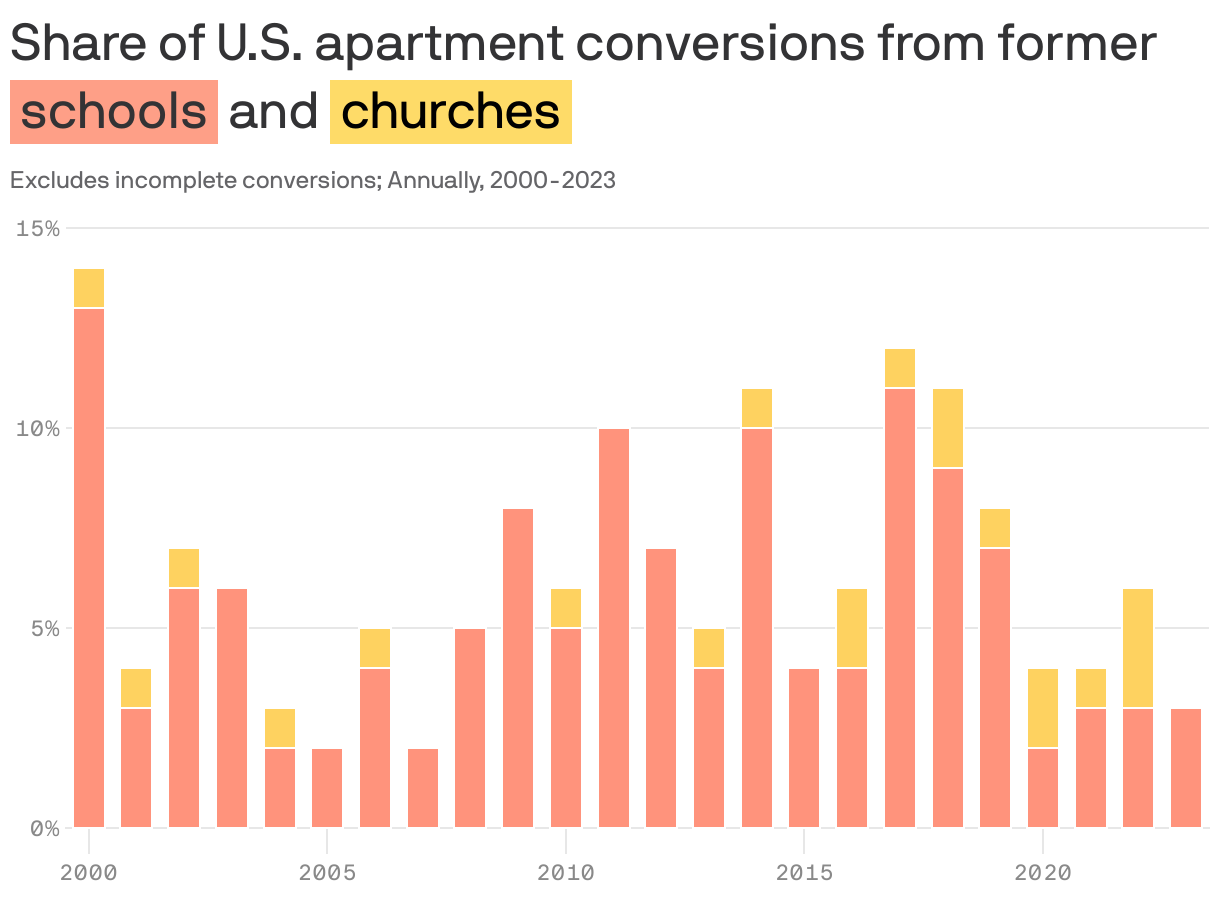
Between the lines: Several factors contributed to historical jumps in school conversions since 2000, including declining enrollment in some school districts and heightened interest in city living and historic preservation, according to RentCafe.
- The 2008 financial crisis also led more developers to consider repurposing existing buildings like schools to reduce construction costs, research analyst Veronica Grecu told Axios.
- Conversions later picked up in the 2010s, partly because of new financing incentives and the increasing need for affordable housing options.
What to watch: State and federal historic preservation tax credits can incentivize flips of some properties, researchers say.