Race to replace Dianne Feinstein is led by Southern Californians

Add Axios as your preferred source to
see more of our stories on Google.
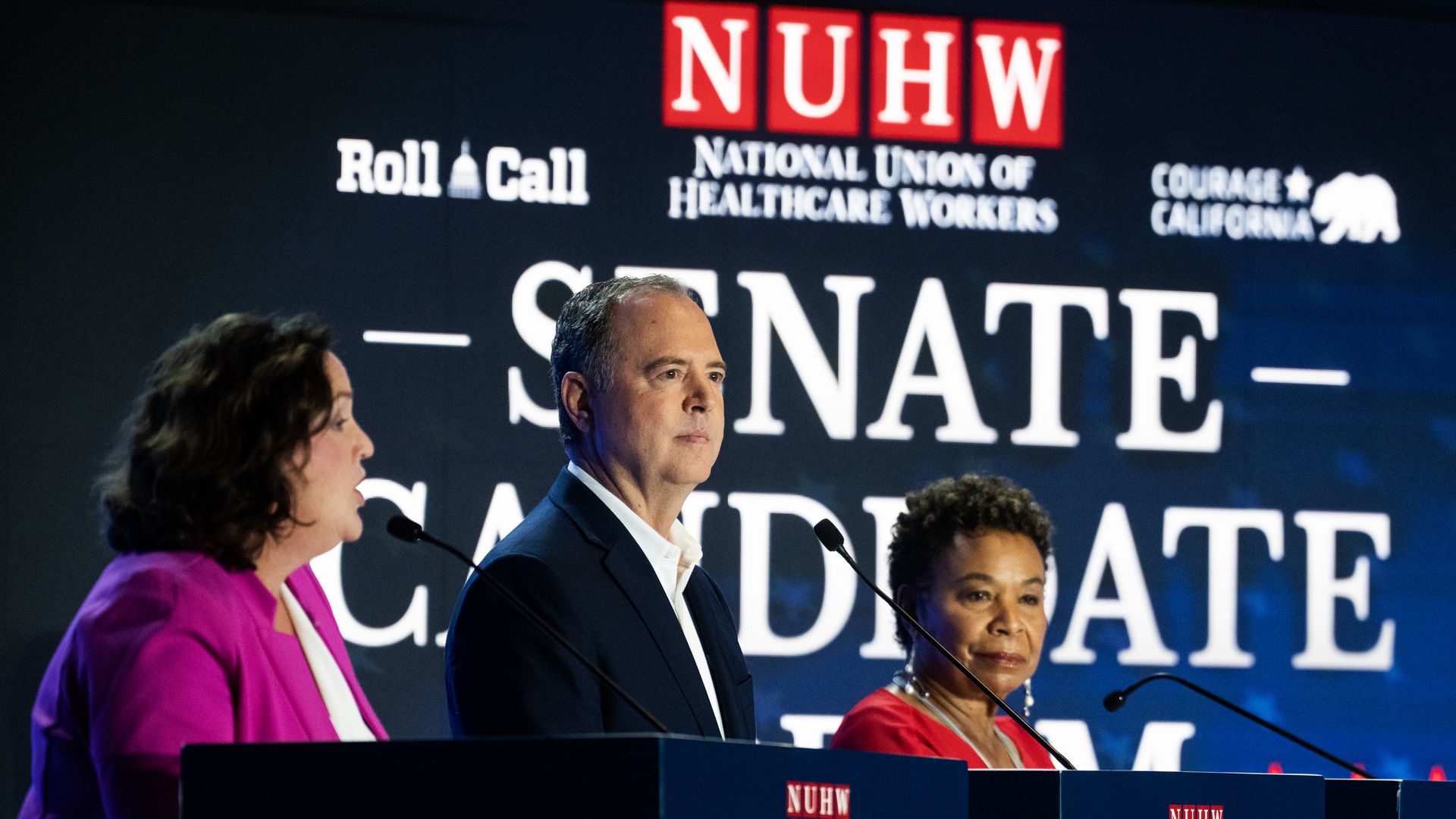
Reps. Katie Porter, left, Adam Schiff and Barbara Lee participate in a Senate candidate forum in Los Angeles last fall. Photo: Tom Williams/CQ-Roll Call via Getty Images
With top contenders in the Senate race all hailing from Southern California, the Bay Area will likely have no local representation in the Senate for the first time in decades.
Why it matters: Though she represented the whole state, Dianne Feinstein was most associated with the city where she grew up and served in local office.
- During her more than 30 years in the Senate, Feinstein also became an influential voice, serving in multiple leadership positions.
What they're saying: "We have been really fortunate to have strong leaders in and from San Francisco who have been fierce champions for the City," Parisa Safarzadeh, a spokesperson for the mayor's office, told Axios via email.
- The Senate outcome could result in more attention on the southern part of the state, but that is mattering less as the Democratic Party becomes nationalized, San Francisco State University political science professor Jason McDaniel tells Axios.
- "I don't think the representational deficit will be felt in terms of actual money or legislation," McDaniel added. "It'll be more idiosyncratic, individual stuff."
Driving the news: Heading into Election Day, RealClearPolitics' average of polls in the race shows Rep. Adam Schiff (D-Calif.) in the lead, followed by Republican Steve Garvey and Rep. Katie Porter (D-Calif.).
- All three have centered their careers on Southern California.
- Rep. Barbara Lee (D-Calif.), who represents Oakland, is also running for the seat, but she has lagged in the polls.
- Under California's voting system, only the top two vote-getters in the primary will advance to November's general election.
Context: Feinstein, who died last fall, made history in 1978 when she became the first woman to serve as mayor of San Francisco. As president of the Board of Supervisors, she assumed the role after then-Mayor George Moscone and Supervisor Harvey Milk were assassinated.
- She led the city through the aftermath of that tragedy and later helped overhaul San Francisco's cable car lines before navigating the AIDS crisis.
- In 1992, she was elected to the Senate, in which she was a principal sponsor of the federal assault weapons ban and chaired the Senate Intelligence Committee through investigations of alleged torture of al-Qaida prisoners after 9/11.
Between the lines: Much of her gun control efforts were tied to her experiences in San Francisco, including a 1993 mass shooting that remains the city's deadliest to this day.
- She also pushed to protect about 300,000 acres of wilderness in Northern California, recognize same-sex marriage and reduce automotive greenhouse gas emissions to address climate change impacts.