Extreme weather leads to more power outages in Texas


Add Axios as your preferred source to
see more of our stories on Google.
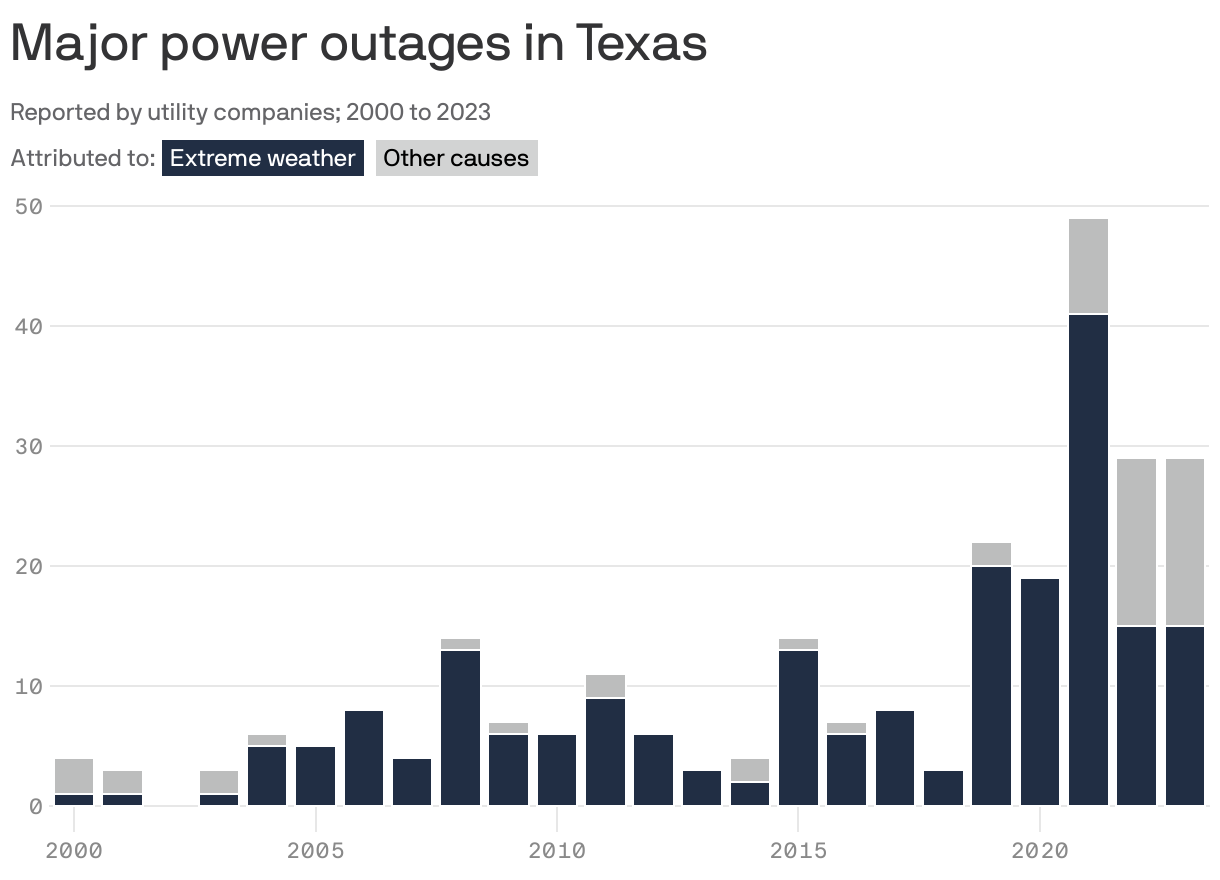
Texas has experienced a rising number of extreme weather-related power outages over the last two decades, a recent analysis shows.
Why it matters: The state's electric grid is under increasing strain as climate change raises the frequency and severity of certain types of extreme weather events like heat waves and heavy rainstorms.
- Outages and lengthy restoration times can cost the economy billions of dollars and lead to deaths.
Flashback: The Electric Reliability Council of Texas, which oversees the state's electrical grid, asked residents to conserve electricity several times last summer — including nearly every day for one week in August — when operators expected record demand to exceed available electricity.
- ERCOT came close to, but avoided, the kind of emergency operations that end in rolling blackouts.
State of play: Conservation notices probably aren't going away anytime soon, as Texas enters what's expected to be another very hot summer.
By the numbers: Texas saw 210 weather-related outages from 2000-2023, more than any other state, per the nonprofit research group Climate Central.
- Of those, 65 outages took place from 2000-2012. The other 145 were from 2013- 2023, with 41 tallied in 2021.
- Such outages are defined as affecting at least 50,000 homes or businesses or those cutting service of at least 300 megawatts.
The big picture: Weather-related power outages are also on the rise nationwide, Climate Central reports.
- Extreme weather accounted for about 80% of all major U.S. and Texas power outages in the last two decades.
Reality check: People of color and those in low-income communities often experience a disproportionate share of power outages, an example being the February 2021 winter storm in Texas.
- They also tend to live in neighborhoods with older homes, more vulnerable pipes and fewer food options, which makes it harder for them to withstand outages.
The intrigue: Heat waves, one of the hazards most clearly linked to human-caused climate change, are becoming more problematic, Climate Central found.
- Extreme heat accounts for a smaller share of outages but creates acute public health hazards when it does occur.
What they're saying: "Climate Central sees the increase in power outages as being related to the increase in extreme weather," said Jen Brady, a researcher at Climate Central and the report's main author.
- She noted 15 heat-related major outages nationwide from 2000-2009; that number rose to 32 from 2014-2023.
- "As not only the intensity of weather events continues to increase, but also the stress on the system from things like increased cooling demand, weather-related power outages will likely continue to increase as well across the country," she said.
Yes, but: Other factors are at work too, Brady said, such as the age of, and load placed on, parts of the grid.
- Some load demand may be due to population growth rather than extreme weather trends.
- ERCOT acknowledged this year it underestimated how quickly the San Antonio area would grow.
What's next: Texas utilities are expected to add more natural gas power plants after voters last fall approved incentives for such projects.
- The Texas A&M System is looking to put a network of plants on its land across the state.
- Making the statewide grid more resilient to outages also requires changes at homes and businesses, including solar panels and better insulation, Texas grid expert Doug Lewin wrote in a recent newsletter.
- At the same time, Texas is seeing a wind and solar energy boom.