Homes owned by Black people valued less in San Antonio


Add Axios as your preferred source to
see more of our stories on Google.
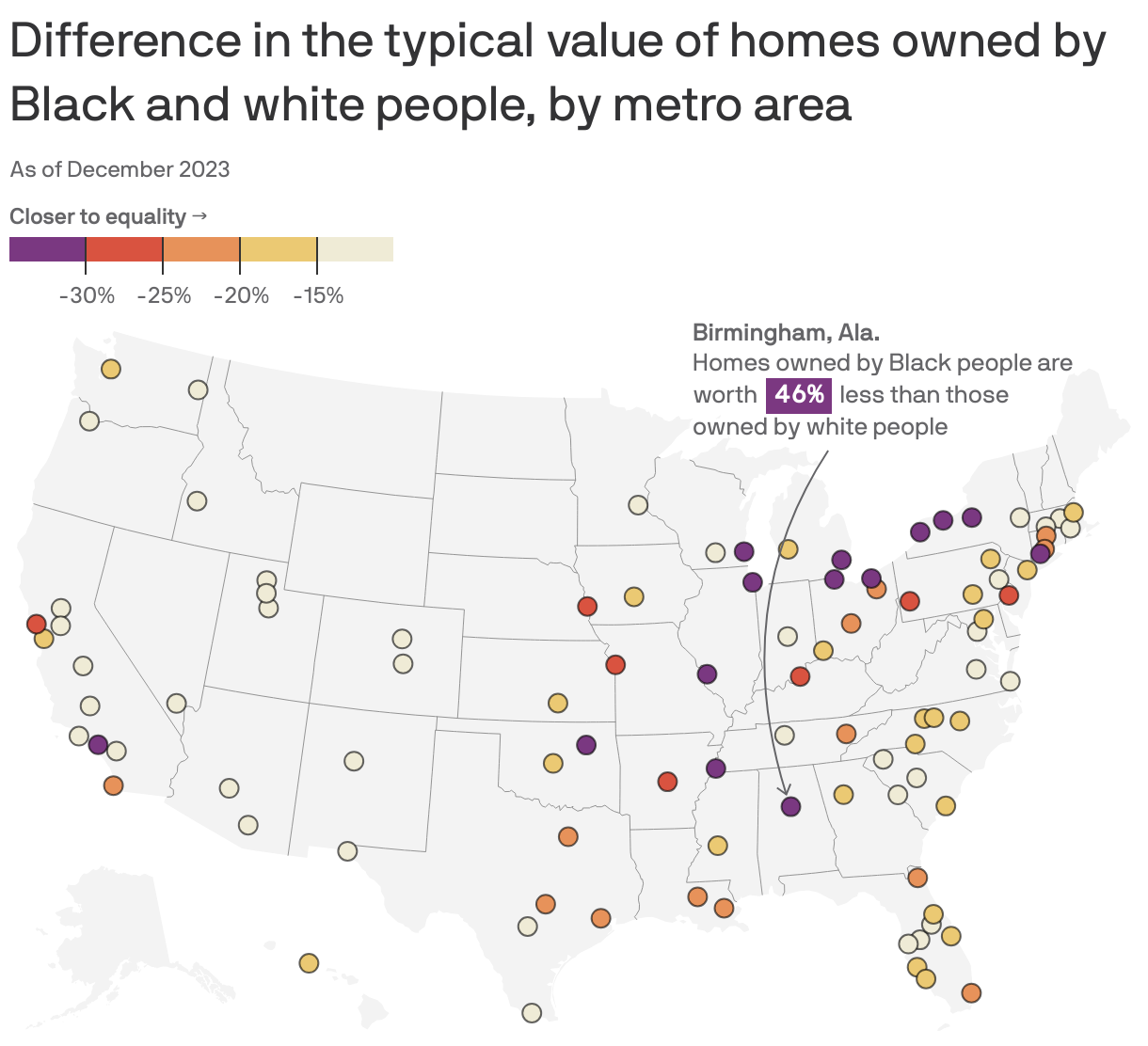
The typical home value of San Antonio-area homes with Black owners is 10.5% less than homes with white owners, per Zillow data shared with Axios.
Why it matters: Homeownership remains the biggest driver of the wealth gap, per the U.S. Department of Housing and Urban Development, Axios' Brianna Crane reports.
By the numbers: The typical value of a San Antonio home with a white owner is $308,700.
- For a Black San Antonio homeowner, it's $276,300.
The big picture: Nationally, the typical value of U.S. homes with Black owners ($291,000) is 18% less than the typical value of homes with white owners ($354,000), per Zillow data.
- McAllen is the only metro of the 100 analyzed where the typical value of homes with Black owners is higher than that of homes with white owners.
Zoom out: The gap is larger in other major Texas cities.
- In Houston, homes owned by Black people are valued at nearly 23% less than homes owned by white people.
- In Dallas, it's a 22.5% gap.
- In Austin, it's 22%.
Between the lines: High debt-to-income ratios and poor or nonexistent credit histories are the largest reasons Black mortgage applicants are denied at a higher rate than other racial groups in the U.S., Urban Institute researcher Jung Hyun Choi tells Axios.
- Higher amounts of debt and delinquent payments are tanking credit scores and driving up that debt-to-income ratio, she explains.
- Compared to other groups, Black people are most likely to be unbanked, largely due to a lack of trust spurred by predatory lending and discriminatory banking practices.
What's happening: The appraiser workforce is mostly white, according to HUD, and it's often difficult to report appraisal discrimination — though new federal policies aim to address that pervasive problem.
What they're saying: Black owners seeing their homes appraising for less than those of their white counterparts isn't new.
- "It's no longer a myth or legend that this happens," HUD chief of staff Julienne Joseph tells Axios.