How to navigate Utah's surrogacy laws


Add Axios as your preferred source to
see more of our stories on Google.
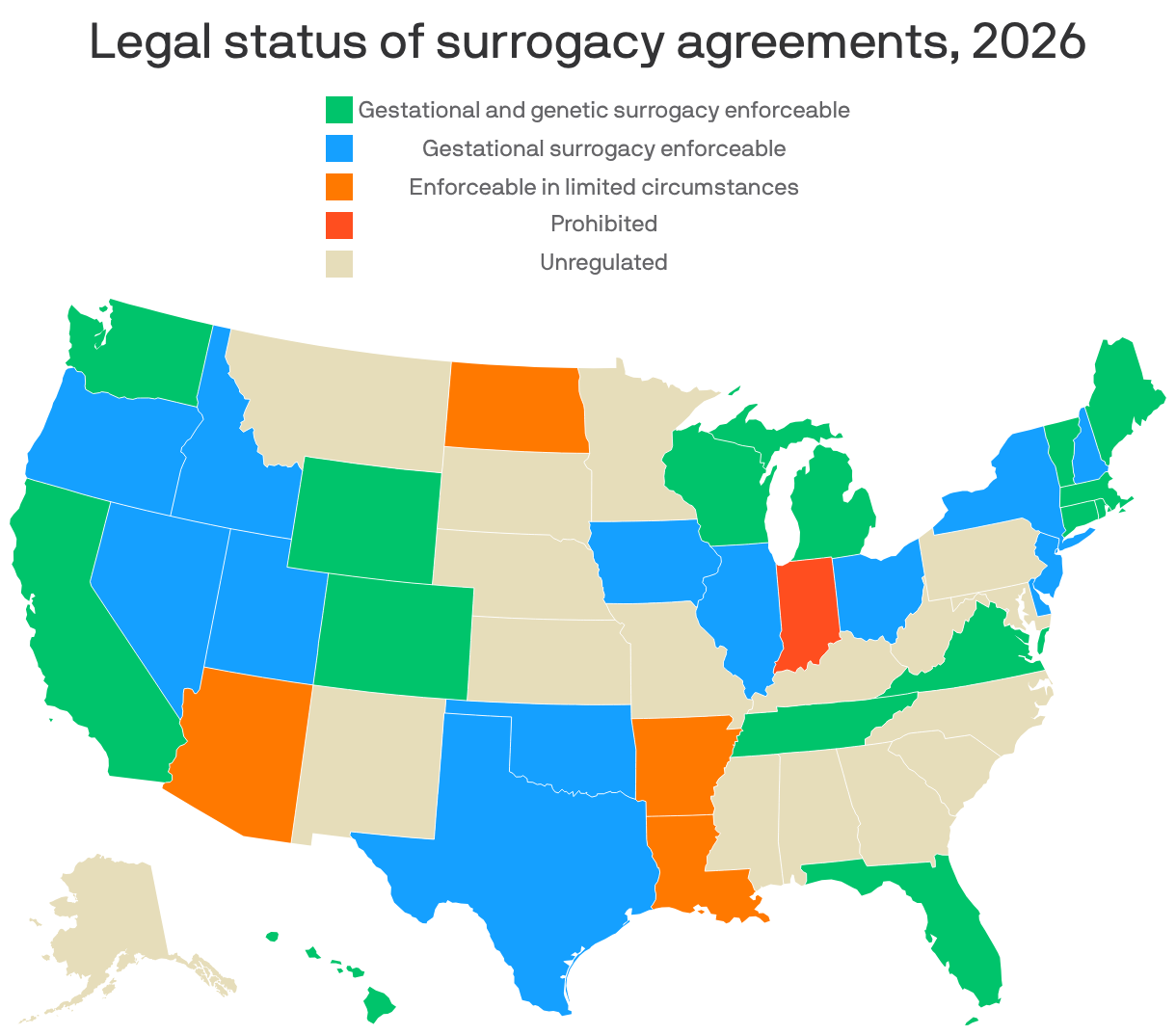
Without a federal law, surrogacy in the U.S. is governed by a patchwork of state regulations.
Why it matters: As more Americans turn to surrogacy to build their families, varied local rules can determine everything from whether agreements are legally binding to who is recognized as a parent at birth.
Zoom in: Utah law enforces surrogacy agreements with multiple restrictions.
- At least one of the intended parents must be genetically related to the child.
- Neither the surrogate nor their spouse may be genetically related to the child.
- The intended parents must be married to each other.
Between the lines: Not all states that enforce surrogacy agreements have the same restrictions. The agreements often happen across state lines, so multiple state laws might need to be considered.
- Nevada, for instance, allows single intended parents, unlike Utah.
- State laws also vary as to how surrogates are compensated.
By the numbers: As of 2026, surrogacy agreements are enforceable in 31 states (with some limitations), void in one, and unregulated in 17, Surrogacy360 tells Axios.
What they're saying: A growing number of lawyers "have begun to specialize in advising either intended parents or being the separate counsel for a surrogate," said Ming Wong, an attorney and the director of community justice and access at the National Center for LGBTQ Rights.
- Because contracts involve so many potential risks, like one party changing their mind midway through the process, "we always encourage people to at least talk to an attorney … even in a state where it's not criminalized," Wong told Axios.