Surrogacy laws are all over the map

Add Axios as your preferred source to
see more of our stories on Google.
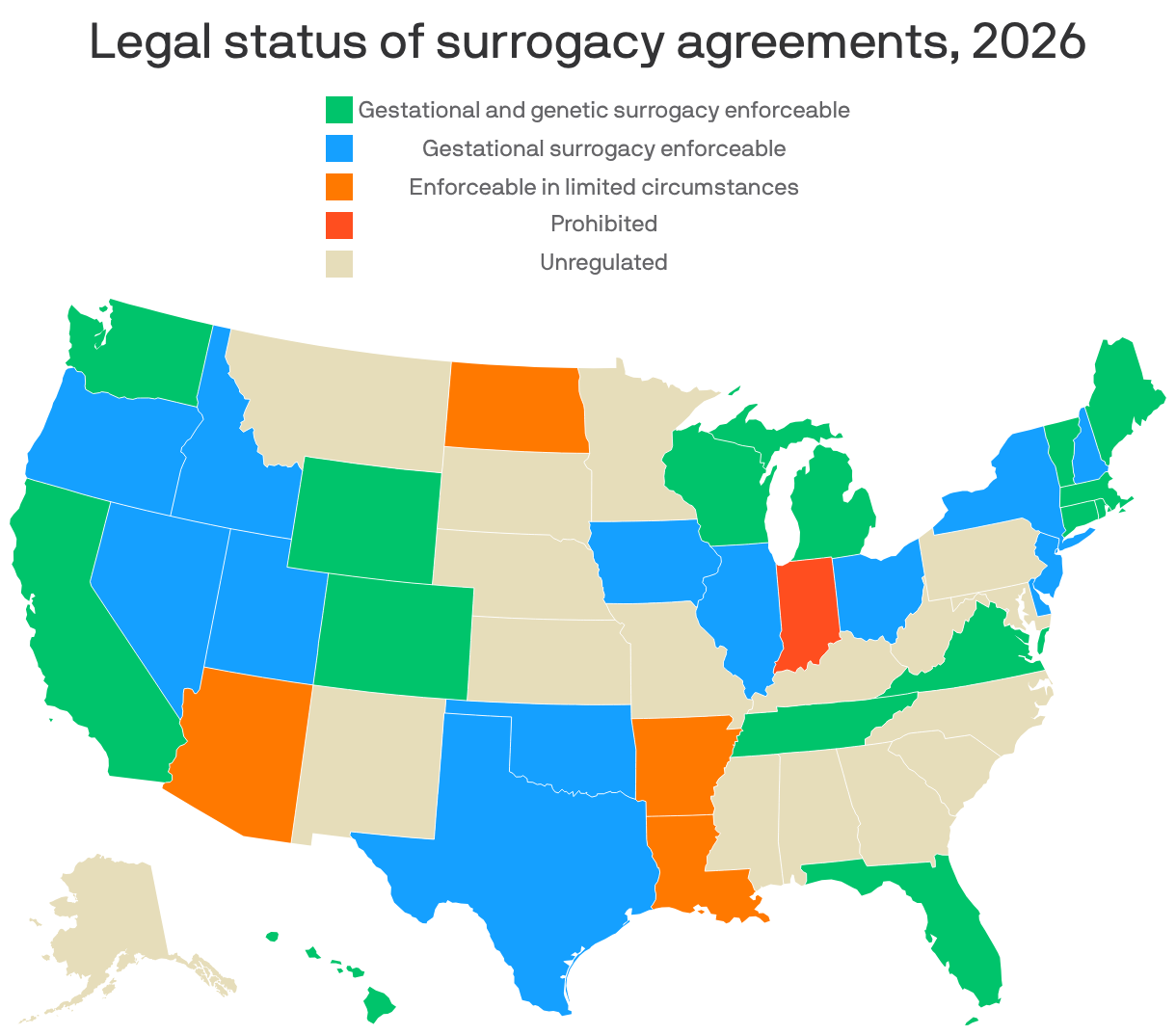
Without a federal law, surrogacy in the U.S. is governed by a patchwork of state regulations/
Why it matters: Confusing, varied local rules can determine everything from whether agreements are legally binding to who is recognized as a parent at birth.
By the numbers: As of 2026, surrogacy agreements are enforceable in 31 states (with some limitations), void in one, and unregulated in 17, Surrogacy360 tells Axios.
Major differences between state laws include:
- How a surrogate must be compensated (if not considered "altruistic").
- Who becomes the legal parents of a child born via surrogate.
- And whether genetic surrogacy (when the surrogate uses her own egg) is even allowed.
Between the lines: Some state regulations have barriers for intended parents who are single, unmarried, not a heterosexual couple and/or not genetically related to the child.
- And, often, surrogacy agreements happen across state lines, so multiple state laws might need to be considered.
What they're saying: A growing number of lawyers "have begun to specialize in advising either intended parents or being the separate counsel for a surrogate," says Ming Wong, an attorney and the director of community justice and access at the National Center for LGBTQ Rights.
- Because contracts involve so many potential risks, like one party changing their mind midway through the process, "we always encourage people to at least talk to an attorney … even in a state where it's not criminalized," Wong says.
The latest: The trend across the country has largely been toward clearer regulation that protects surrogates, intended parents and children.
- New surrogacy regulation was enacted in Massachusetts, Michigan and Illinois last year, and in Oregon and Hawaii this year.
Yes, but: In states without enforceable surrogacy rules, Wong says, there's a risk that agreements could look like a criminal act, similar to "baby-selling."
- Still, surrogacy is still practiced in most U.S. states, even in those where laws are unclear, according to surrogacy agency Creative Family Connections, which has a map about how laws for compensated surrogacy are practiced across the country.
