New Latter-day Saints president Dallin H. Oaks brings record of conservatism

Add Axios as your preferred source to
see more of our stories on Google.
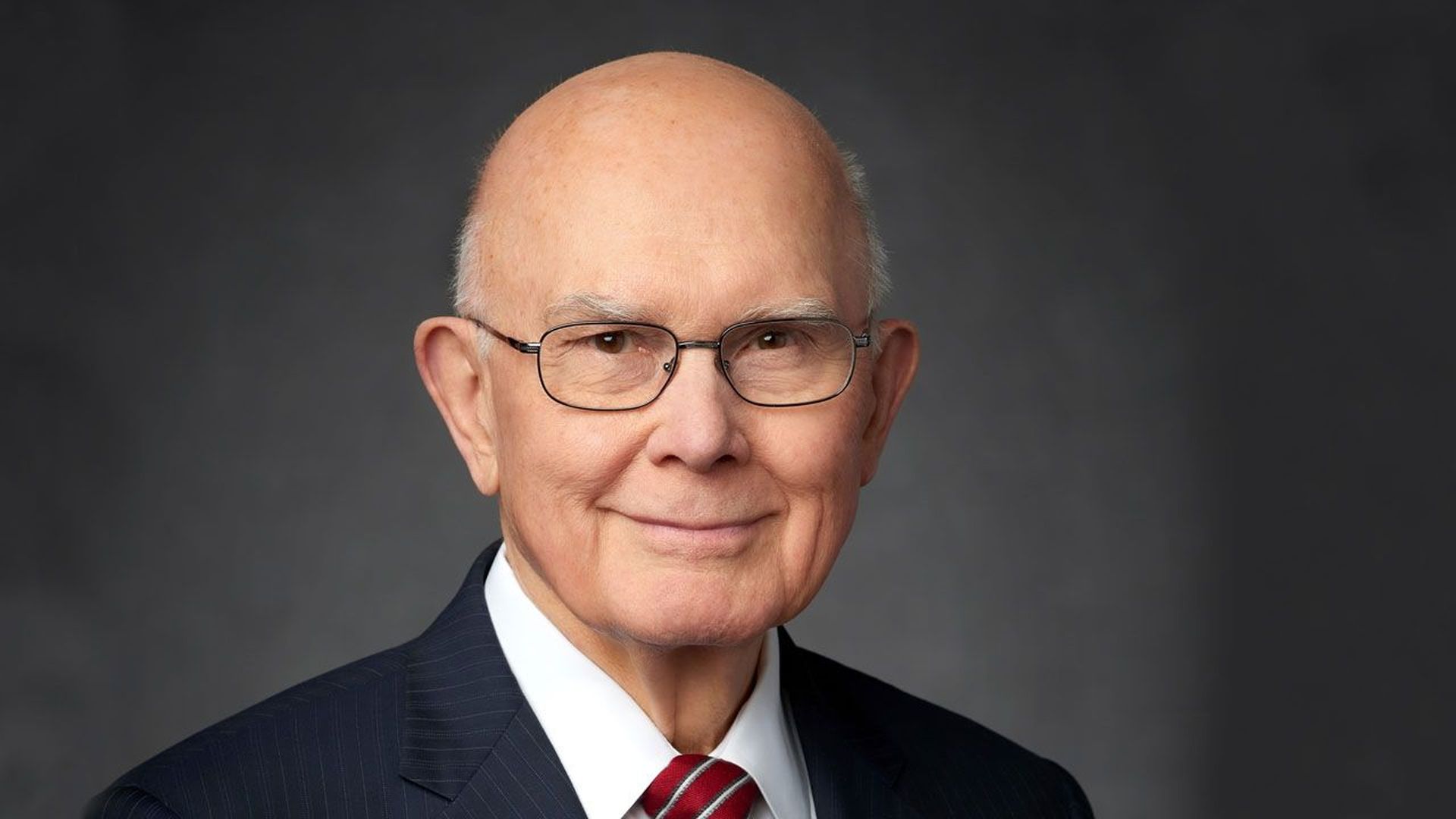
A portrait of Dallin H. Oaks, taken in 2018. Photo courtesy of the Church of Jesus Christ of Latter-day Saints
Dallin H. Oaks was announced Tuesday as the 18th president and prophet of the Church of Jesus Christ of Latter-day Saints.
The big picture: Oaks, 93, has long worked to exert the faith's conservative leanings in the civic sphere, opposing many LGBTQ+ protections and seeking more expansive religious exemptions to laws.
- As a leader in the church, he has generally championed an orthodox approach to faith.
Context: Oaks served as chief justice of the Utah Supreme Court in the 1980s, was a clerk for U.S. Chief Justice Earl Warren before that, and was considered for the U.S. Supreme Court by the Reagan and Ford administrations.
- He was also a law professor at the University of Chicago in the 1960s and '70s.
The intrigue: Oaks has a unique record of positions on civic and political matters.
Catch up quick: Oaks has taken right-leaning positions on issues ranging from criminal procedure to LGBTQ wedding photography.
- As a law professor, he argued that evidence should not be thrown out when police violate the Constitution during search and seizure.
- He argued in favor of sodomy laws in the late 1970s, when many states were repealing them, and began to attack anti-discrimination laws for LGBTQ+ people by the 1980s.
- As president of BYU in the mid-1970s, he demanded — and received — the nation's first religious exemption to Title IX, the law tying federal funds to gender equality in access to education. He also launched investigations into gender discrimination on campus.
- Oaks, along with other church leaders, vigorously promoted California's Proposition 8, which outlawed same-sex marriage in 2008. When marriage equality proponents called for boycotts against the law's supporters, he described their pushback as "bullying" and intimidation, and compared the backlash to racist discrimination in the 1960s.
The other side: Oaks has said Latter-day Saints are not required to align on all political matters.
- Last year, he urged members to be "peacemakers" amid political contention.
Zoom in: For decades, Oaks has been active in religious freedom advocacy, winning recognition from the high-profile Becket Fund for Religious Liberty.
- He testified in favor of the 1991 Religious Freedom Restoration Act, which was later used to exempt religious employers from a federal requirement to cover contraception in their health insurance plans.
- In 1998, he returned to Congress to seek passage of a law that purported to prevent local zoning codes from discriminating against religious groups. The church has since invoked that law in efforts to circumvent height limits and other ordinances for its temples.
- He chastised President Barack Obama in 2011 for using the phrase "freedom of worship," which Oaks saw as excessively limiting, and criticized the administration for prioritizing LGBTQ+ rights.
- While announcing the church's support for anti-discrimination laws in 2015, Oaks complained,"It is one of today's great ironies that some people who have fought so hard for LGBT rights now try to deny the rights of others to disagree with their public policy proposals." The New York Times called the church's position disingenuous.
- When the church again raised the hopes of LGBTQ+ members and allies by supporting a 2022 marriage equality law, Oaks said the motive was to "protect the tax-exempt status" and other benefits for religious groups that oppose same-sex marriage.
What we're watching: Whether Oaks steers the church toward lawsuits that would broaden the scope of religious privilege while the U.S. Supreme Court fields a 6-3 conservative majority.