When the Quail Creek dam burst above St. George

Add Axios as your preferred source to
see more of our stories on Google.
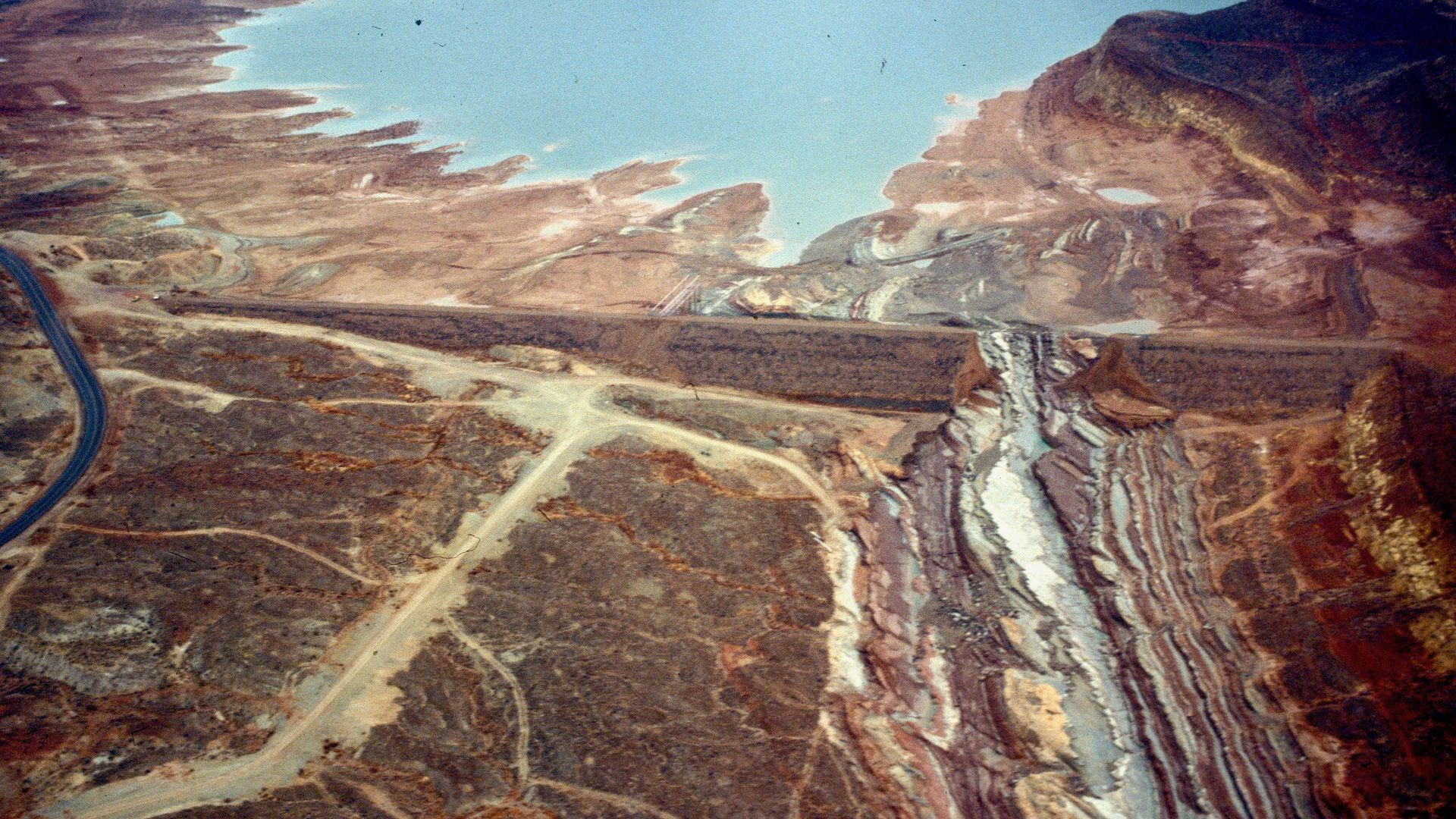
An aerial view of the Quail Creek dike after it breached in 1989. Image via the Utah Geological Survey
Forty years ago this week, Utah was celebrating its newest major water project: the Quail Creek dam, which created a reservoir on which hinged "the total future of Washington County," local officials declared.
Why it mattered: Three years later, the adjacent dike failed, creating a 300-foot-wide gap that unleashed 25,000 acre-feet of Quail Creek Reservoir's water onto St. George, sweeping away bridges, roads and farms and seriously damaging scores of homes.
This is Old News, where we try to plug the holes in Utah's history.
Flashback: At the dedication ceremony in September 1985, state and local leaders were jubilant. The new reservoir would bolster the water supply for the fast-growing area and support a new hydroelectric plant.
- Washington County voters had supported the project's bond proposal by a 9-to-1 margin.
Yes, but: The dike began seeping a few months after it was dedicated. Repairs in spring 1986 exposed several holes in the dike foundation, some of which took hundreds of sacks of cement to regrout, investigators later reported.
- Eventually, a crack started to form in fall of 1988.
On New Year's Eve, crews noticed a trickle of cloudy water that by nightfall turned into a river, with water flows equivalent to more than double the late-summer levels in Big Cottonwood Creek.
- Crews fled for safety and 1,500 people in and around St. George were ordered to evacuate barely an hour before ringing in the new year.
- At 12:30am, the dike breached, and a 20-foot wall of water crashed down into the Virgin River.
Path of destruction: The flood took out 450 acres of crops, 130 pigs, 40 cows, three bridges, two other dams, a gas line and a stretch of S.R. 9 — before it reached the neighborhoods of St. George.
- There it damaged 30 houses and almost 60 apartments, as well as several businesses and two more bridges.
- No one was killed.
By the numbers: The damage in Utah totaled about $12.4 million, according to estimates by the U.S. Geological Survey.
Between the lines: A state investigation that March found that foundation design caused the failure.
- "If the materials had been protected by proper filters, drains, and foundation surface treatment, the failure would not have occurred," investigators wrote.
State regulators began requiring all new dam proposals to undergo independent review. The next year, lawmakers codified that requirement and gave the state engineer more power over how dams are designed and operated.
The bottom line: Washington County's population has nearly quintupled since 1989, and the farm fields that flooded then are now filled with homes and businesses.
- If the failure had happened recently, the outcome likely would have been far worse.