Utah considers tighter kratom regulations


Add Axios as your preferred source to
see more of our stories on Google.
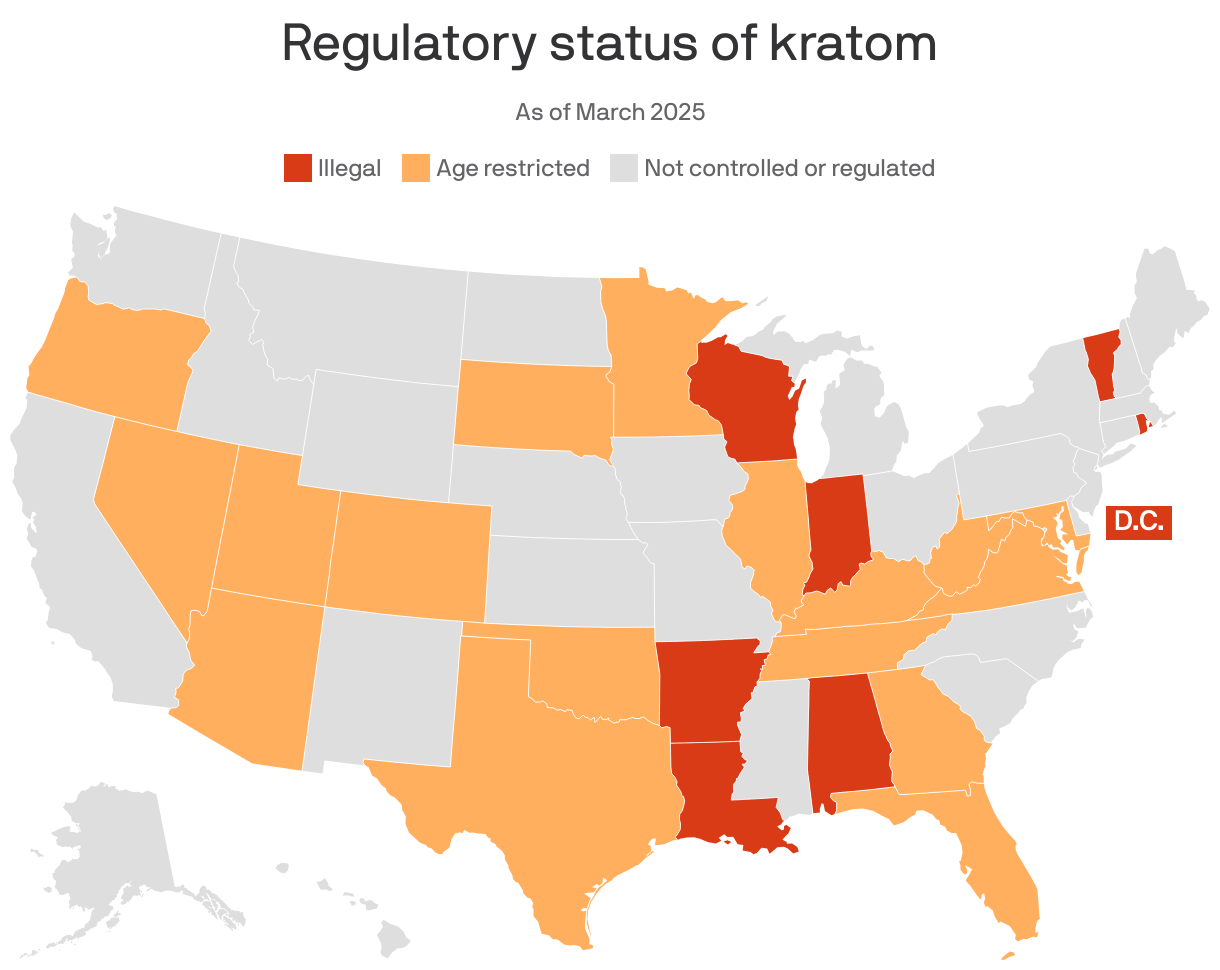
Federal and state regulators may make some kratom products harder to get in Utah with a crackdown on a potent compound found in supplements: 7-hydroxymitragynine, or 7-OH.
Why it matters: 7-OH, sometimes referred to as "legal morphine," has been found in dangerous concentrations in tablets, gummies and drink mixes — even in states that have tried to regulate it.
State of play: Utah in 2019 banned substances containing more than 2% 7-OH.
- Lawmakers also required all legal kratom products to be registered with the state agriculture department, labeled with the amount of 7-OH, and sold only to customers 18 and older.
Reality check: Some Utah supplement stores, gas stations and smoke shops are still selling synthesized and concentrated 7-OH, likely in violation of state law, KUER reported in August.
Context: The FDA recently recommended scheduling the compound as a controlled substance alongside LSD and heroin.
- Depending on whether and how the U.S. Drug Enforcement Administration enacts the recommendation, that could ramp up enforcement or further restrict the products that remain legal in Utah.
What is kratom?
"Kratom" can refer to the plant or powdered leaf — or kratom-derived concentrates in forms like tablets, gummies, drink mixes and shots.
The product has been marketed as a mood booster, pain reliever and remedy for symptoms linked to quitting opioids, but that doesn't mean all kratom products are "natural and safe," according to the Mayo Clinic.
Is kratom dangerous?
Kratom leaf products are like "a light beer" in terms of potency, says Chris McCurdy, a professor of medicinal chemistry at the University of Florida who's studied kratom for more than 20 years.
- But he says once you extract and concentrate compounds like OH-7 — removing the natural plant material — you're closer to Everclear, the grain spirit, banned in Utah, which can be 95% alcohol by volume.
- Only trace amounts of OH-7 are found in the kratom plant, but potency in herbal supplements varies widely.
The politics of kratom
As in Utah, officials at the FDA have said they're not targeting the herbal supplement kratom but the 7-OH byproduct.
- That's the approach favored by many supplement industry groups, which want to avoid a total ban.
Yes, but: Plant-based products have come under scrutiny too, with some users saying they've experienced addiction and other health problems.
- Earlier this year, a company agreed to pay $8.75 million to settle a class-action lawsuit that alleged it had marketed a plant-based product as a safe alternative to alcohol and didn't warn that it could be addictive.
Flashback: In 2016, the DEA planned to list kratom as a Schedule I drug — the most restrictive category — until a deluge of public opposition scuttled the proposal.
The latest: State agriculture officials have proposed new restrictions that would:
- Require permits to sell any kratom product.
- Set dosage limits and more detailed concentration limits.
- Ban labels that appeal to children.
- Require warnings that kratom can be habit-forming.
- Add fines for violations.
Catch up quick: A Utah bill this year included some similar measures but failed in a committee.
Between the lines: Enforcement problems are contributing to the sale of kratom products that are officially banned in Utah, said Brandon Forsyth, a state agriculture official.
- Some retailers "are basically acting like drug cartels," he told a legislative committee two weeks ago. "We had one of our inspectors go in with police and raid a retail location, and there was stacks of cash and guns in the back room."
- There's just one employee dedicated to kratom full time, so they can't afford to send an inspector to, say, southern Utah until they learn of violations by multiple retailers, Forsyth said.
Zoom in: One Utahn testified that he became addicted to 7-OH products he bought easily, even though they've been banned since 2019.
- "I have to go to therapy, AA programs, and I live every day, 24 hours a day, to stay sober, when I can go to a gas station ... or to any smoke shop" for a fix, he said.