Salt Lake City's coldest temps are rising fast


Add Axios as your preferred source to
see more of our stories on Google.
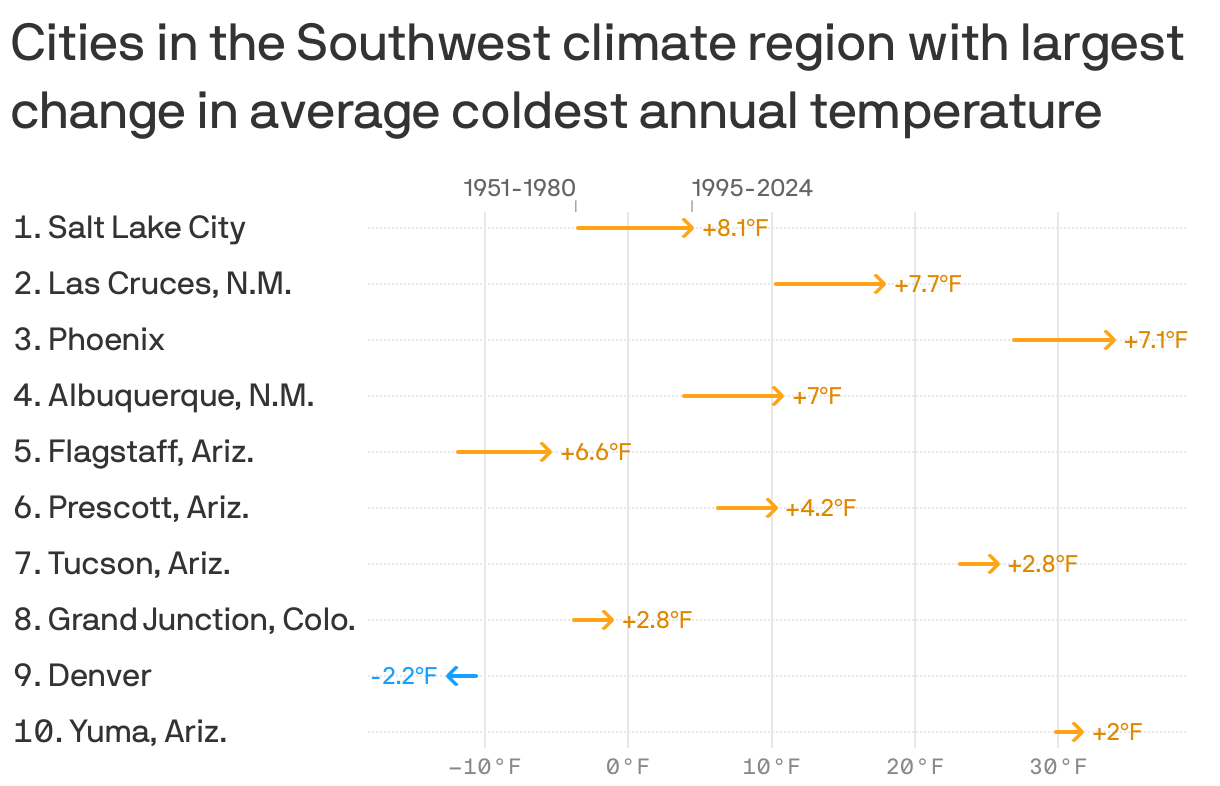
Salt Lake City saw one of the nation's biggest increases in average coldest temperatures since the 1950s.
Why it matters: Shifts of this magnitude change which plants and insects can thrive here — along with the other impacts of climate change.
Driving the news: Salt Lake's 30-year average yearly coldest temperature from 1995 to 2024 was 4.4°F — more than 8 degrees higher than the average from 1951-1980.
- That's the sixth biggest jump among the 243 U.S. locations analyzed by Climate Central, a research and communications group.
What they're saying: "Although such shifts could expand growing ranges for high-value crops such as almonds, oranges and kiwis, they could also expand ranges for harmful weeds and pests," Climate Central says, citing the invasive kudzu vine and the brown marmorated stink bug.
Case in point: A pomegranate bush and a persimmon tree are happily growing in my backyard even though they're historically considered warmer-weather fruits.
- But biologists say rising temperatures have also rolled out the welcome mat for the balsam woolly adelgid, an insect that's threatening Utah forests.
Between the lines: "Hardiness zones" — guidelines that tell gardeners when and where the temperature will allow a given plant to thrive — have been shifting each decade.
- Much of the U.S. was categorized into warmer plant hardiness zones with the latest USDA map update in 2023, as Axios' Jacque Schrag reported at the time.
- Most of Salt Lake City has been labeled "Zone 7b" since 2012, with average low temperatures around 5° to 10°.
Zoom out: The 30-year average coldest temperature for 1995 to 2024 compared to 1951 to 1980 was higher in 97% of the 243 locations reviewed.
- Among the locations with an increase, the coldest annual temperature was 3.7°F higher on average.
- The group's analysis is based on data from NOAA's Regional Climate Centers.
By the numbers: Reno, Nevada (+9.7°F); Anchorage, Alaska (+9°F) and Traverse City, Michigan (+9°F) had the biggest increases in average coldest temperature between the two 30-year periods.
The big picture: "Averaged regionally, the coldest temperatures have warmed the most in cities across Alaska (+7.8°F), the Northwest (+4.7°F) and the Southwest (+4.3°F)," Climate Central notes.
What's next: The group also used climate modeling and NASA data to project future change between the 1995-2024 30-year period and the 2036-2065 period.
- It predicts that the 30-year average coldest temperature will rise in each of the 243 locations analyzed between those periods, with an average gain of 5.6°F.
The bottom line: Salt Lake's average coldest temp is expected to rise by almost 6 more degrees, so pick out a spot in the yard for that orange tree and get ready to fight more bugs.