Climate change indicators hit record levels in 2024, UN study finds

Add Axios as your preferred source to
see more of our stories on Google.
A new scientific report depicts a rapidly warming Earth, with widespread consequences such as sea level rise, melting glaciers and extreme weather events.
Why it matters: The World Meteorological Organization's State of the Global Climate 2024 report is designed to inform policymakers of the status of the climate system.
- It depicts a planet with a high — and increasing — fever due to record high levels of human-caused greenhouse gases.
Zoom in: The United Nations agency's annual report, which dates back to 1993, doesn't contain many surprises for those closely following climate science. But it drives home how widespread and unprecedented climate change's effects already are.
- On carbon dioxide, the report finds that current levels of the main long-lived greenhouse gas is at a record high of 151% of preindustrial levels back in the year 1750.
- This is the highest level of CO2 in at least 800,000 years, and likely long before that, the report found.
- Current levels of methane, a powerful, short-term warming agent, are 265% of preindustrial levels, the report shows.
Temperatures will continue to increase as long as carbon dioxide levels continue to increase, with a halt in warming taking place if and when emissions reach net zero.
Context: The report ticks through several key climate change indicators, from sea ice extent to glacier mass loss and sea level rise.
- Researchers found that glacier mass loss during the 2021-2024 period was the most negative-three year glacier mass balance on record.
- Globally, WMO shows that each of the past 10 years were among the 10 warmest on record.
- This is unprecedented in the instrument temperature record dating back to the late 1800s, said Chris Hewitt, director of the climate services division at the WMO, during a Tuesday press call.
In addition, each of the past eight years has set a new record for ocean heat content.
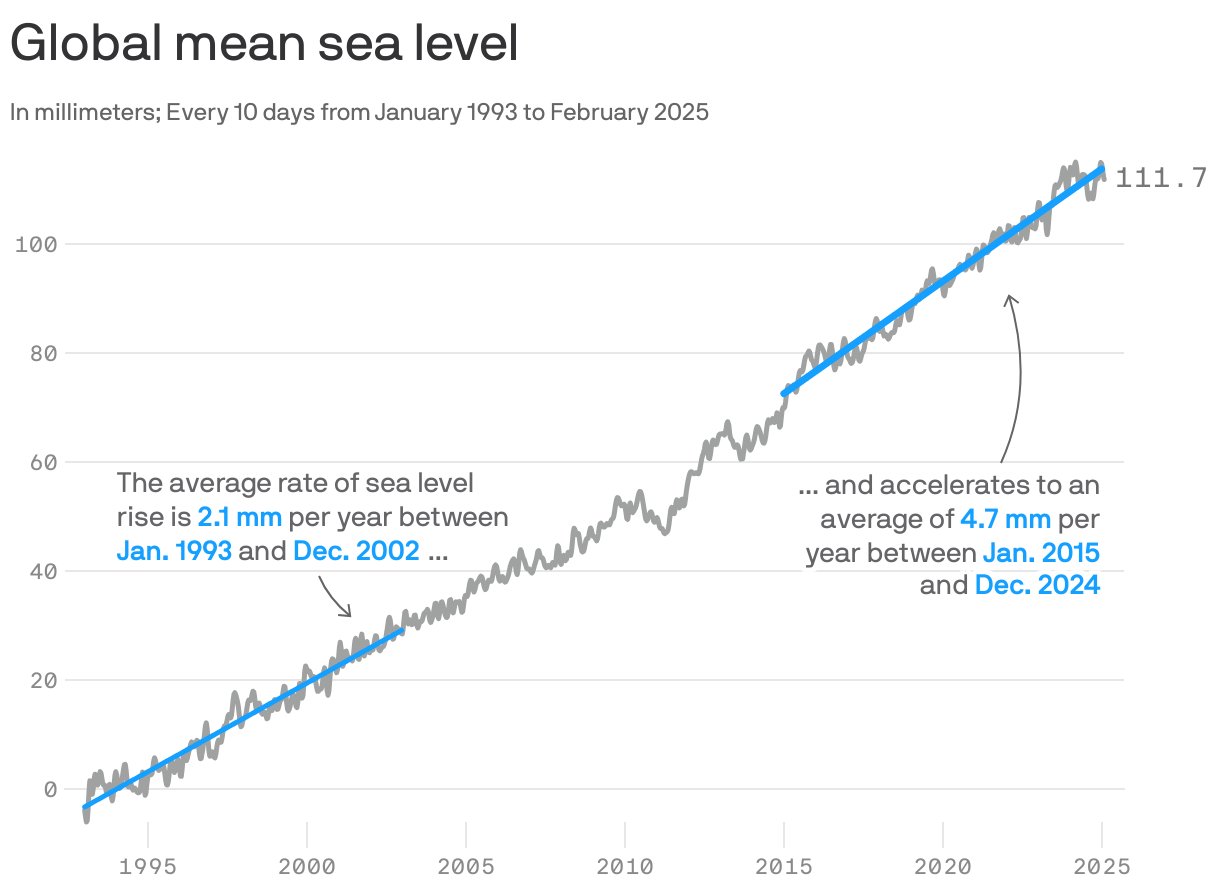
The intrigue: When it comes to sea level rise, the report finds that oceans are now rising faster than they had been just a few decades ago, imperiling low-lying coastal areas.
- According to the WMO, "The long-term rate of sea-level rise has more than doubled since the start of the satellite record," going from 2.1 mm per year during the 1993-2002 period, to 4.7 mm per year between 2015-2024.
- Scientists attribute the faster warming rate to both warming and expanding ocean waters as well as increasing ice melt in Greenland and Antarctica, which adds freshwater into the sea.
As has been occurring in most recent years, ocean heat content hit a record high in 2024, which is a clear signal of how it is absorbing extra heat from human-caused climate change.
- The oceans absorb about 90% of the extra heat added to the atmosphere, with much of it going into the top 2,000 meters of the sea.
Between the lines: The report shows that 2024 did exceed the 1.5°C anomaly compared to pre-industrial levels but cautions that this has yet to occur during the long term.
- The 1.5°C target in the Paris Agreement is an aspirational goal designed to hold global warming to levels with a lower chance of triggering tipping points in the climate system.
- The target is also viewed as posing less of an existential risk to low-lying small island states.
- At least one recent study has found that the long-term 1.5°C threshold may already have been eclipsed.
In addition, according to the report, the number of people displaced by extreme weather and climate events were the highest in the past 16 years.
Yes, but: Data on displacement is complicated and difficult to track, given that people can have multiple reasons for leaving their homes, in both the developed and developing world.
What they're saying: "While a single year above 1.5 °C of warming does not indicate that the long-term temperature goals of the Paris Agreement are out of reach, it is a wake-up call that we are increasing the risks to our lives, economies and to the planet," said WMO Secretary-General Celeste Saulo.
