Paris climate target nearer than thought as Earth heats faster

Add Axios as your preferred source to
see more of our stories on Google.
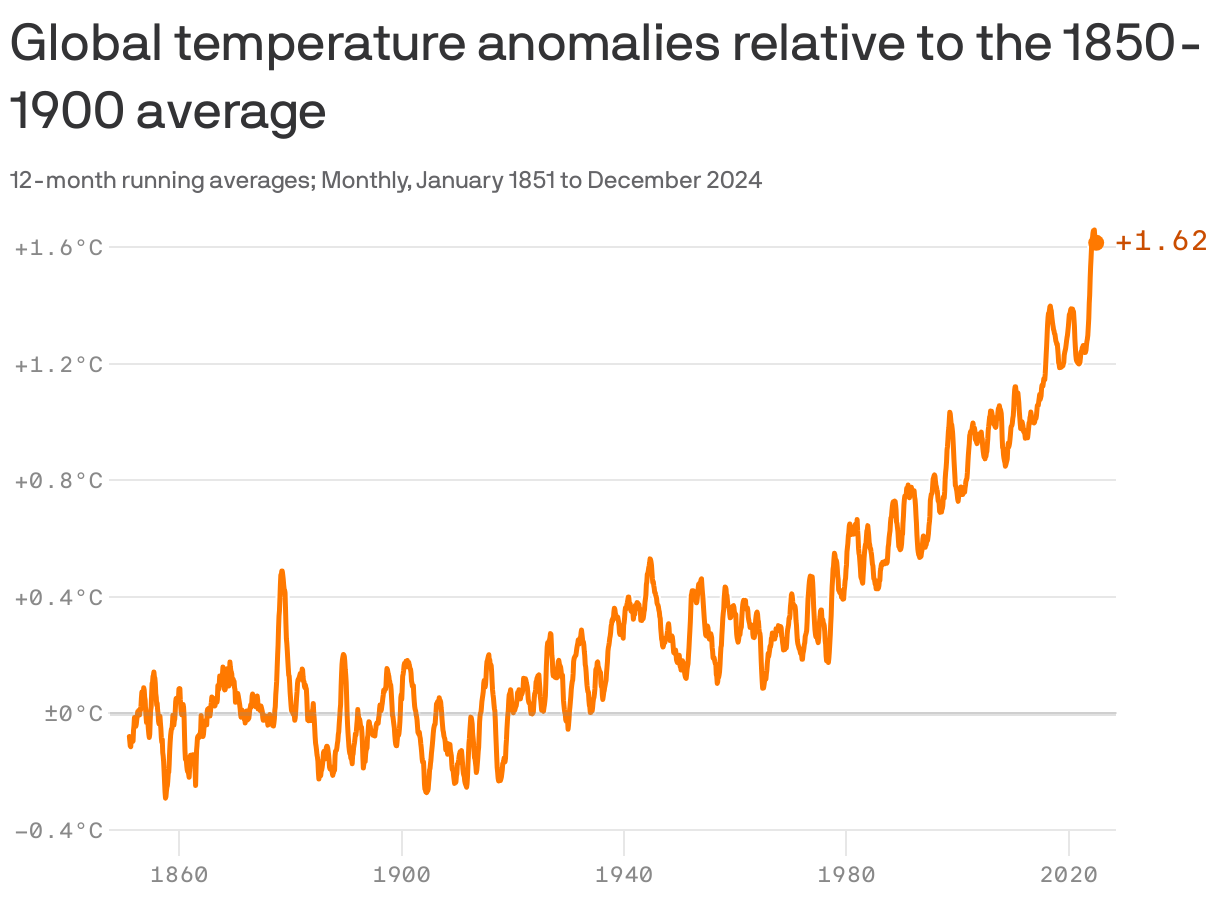
Two new studies show the world is nearing — or may have already eclipsed — the Paris Agreement's 1.5°C aspirational target, relative to the pre-industrial era.
Why it matters: The 1.5°C long-term goal, while largely symbolic, marks a point at which the ramifications of warming further are likely to become far more significant for humans and ecosystems.
- Studies have shown, for example, that the likelihood of triggering tipping points in the climate system — such as the dramatic slowdown of a vital current in the Atlantic Ocean — climb more steeply after 1.5°C of warming.
Driving the news: In the first study, out Monday in the journal Nature Climate Change, Alex Cannon of Environment and Climate Change Canada finds about an 80% chance that the world has already breached the 1.5-degree target when it comes to the long-term warming level.
- The Paris Agreement defines the target as a two-decade-long period, not a single year.
- But the study shows that the first 12-month period exceeding 1.5 degrees above pre-industrial levels — generally defined as average temperatures between 1850 and 1900 — likely would occur within the period breaching the target.
- An 18-month-long period of global average surface temperatures exceeding 1.5°C above preindustrial levels would mean that under current climate policies, it is "virtually certain" that the long-term target would be overcome, the study states.
Stunning stat: January marked the 18th month in a 19-month stretch in which each month exceeded the 1.5°C threshold, according to the Copernicus Climate Change Service.
How they did it: The study examines recent climate observations and modeling projections to determine long-term warming under different levels of greenhouse gas emissions.
What they're saying: "While it's an interesting study, I think it is premature to conclude we have already passed 1.5C given the differences in estimates of warming since pre-industrial across different temperature records," said climate scientist Zeke Hausfather.
- Hausfather, who wasn't involved in the new research, noted that the Cannon study relies on one of the hottest global temperature datasets.
Yes, but: The second study, published Monday in the same journal, found that near-Herculean efforts to achieve emissions cuts would be needed now to avoid exceeding the 1.5-degree goal.
- Without such cuts, 2024 would lie within the first 20-year period with an average warming of 1.5°C, the study found.
Zoom out: Small island nations, worried about sea level rise and extreme weather events, advocated for the aspirational 1.5-degree goal in the Paris Agreement's text.
- The slogan "1.5 to stay alive" is often displayed on banners and pins at annual UN climate summits, mainly among representatives from developing nations.
Reality check: Whether the 1.5-degree target has been exceeded is a distraction from the proper focus: rapidly bringing down emissions of planet-warming pollutants such as carbon dioxide, experts told Axios.
- As scientists are quick to point out, every increment of warming avoided would lessen climate change's effects, even if temperatures climb above the more ambitious Paris target.
- "Missing it is not the end of the world, either literal or metaphorical," said Andrew Dessler of Texas A&M University, who also is independent of the newest work. "Rather than a numeric target, our goal should be stabilizing the climate as quickly as possible."
Kim Cobb, director of the Institute at Brown for Environment and Society, added: "Crossing 1.4C is a failure. Crossing 1.6 is a failure. And every increment thereafter, considering what we knew 30yrs ago about the dangers of continued fossil fuel emissions."
- "But peak fossil fuel emissions are in reach, this year or next, and that is a tangible win we can secure for the history books, if we keep our eyes on the prize," said Cobb, who wasn't involved in the new research.
