Utahns are among the nation's worst tippers

Add Axios as your preferred source to
see more of our stories on Google.
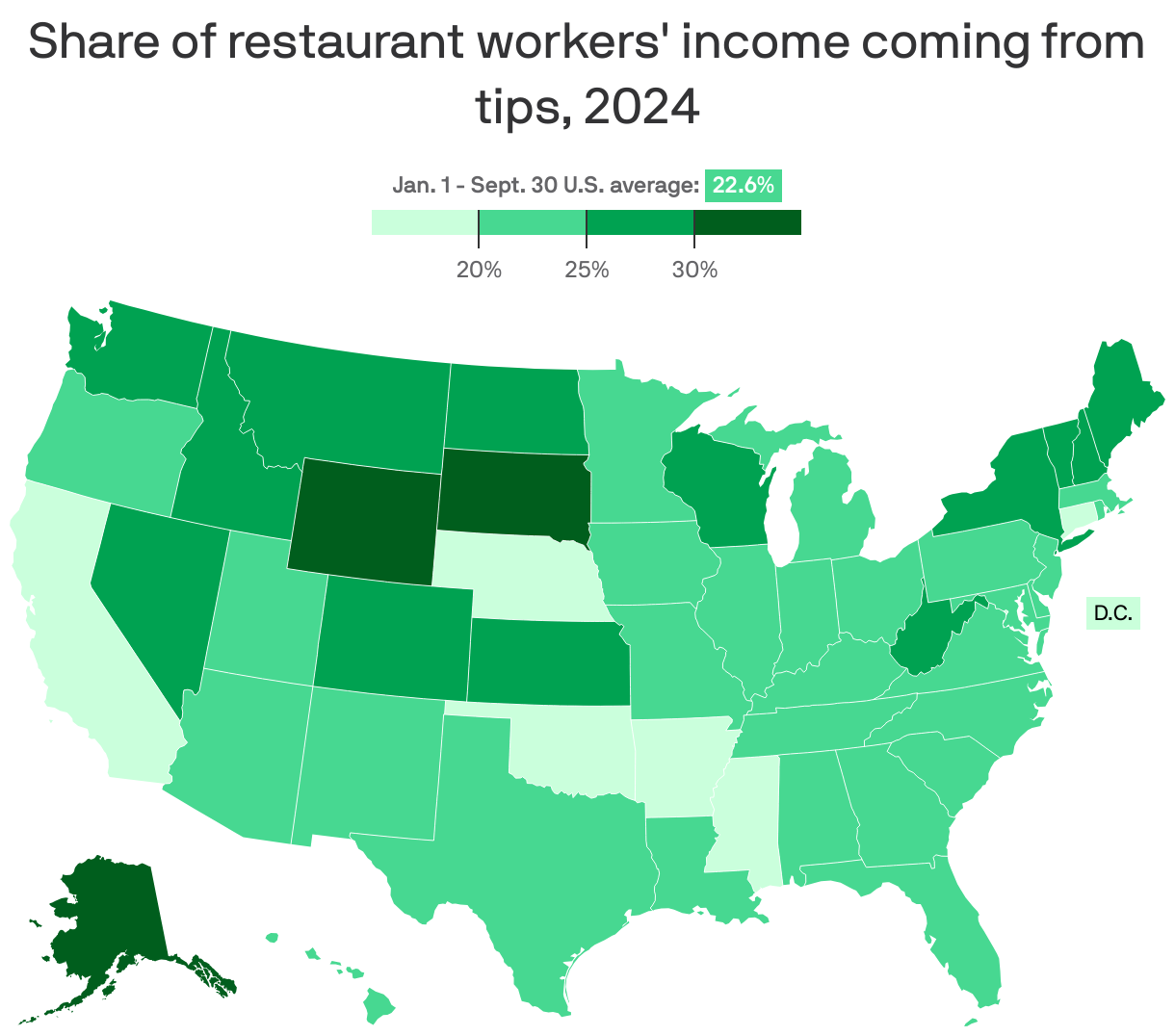
Utah diners left less than 15% gratuity on average in October, based on payroll data analyzed by the payments company Square.
By the numbers: With an average tip of 14.64%, Utah ranked the 4th lowest in the nation, behind only California, Hawaii and Washington, D.C.
Catch up quick: Utah has long been notorious for poor tipping, even as tipping culture has spread.
- Servers and bartenders are getting tipped more frequently for services — like takeout orders — that used to go without gratuities, Axios' Emily Peck reports.
The intrigue: Tips are so low in Utah that they make up a below-average share of restaurant workers' pay — 21.9% — even though Utah's minimum wage for tipped employees is $2.13 an hour.
- That's the same as the federal minimum tipped wage — an amount so low that most states have raised the floor. A bill this year to raise the minimum wage didn't address tipped wages, and it died without debate.
By the numbers: In October, tips made up 23% of restaurant worker pay nationally — up from 14% in 2019, according to Square's report.
The big picture: The restaurant business fell off a cliff in the pandemic, but it bounced back fast. Americans went back to dining out, and restaurants scrambled to hire, driving up wages and prices.
- In recent months, the industry has seen a slowdown. But overall, restaurants have seen an increase in sales volume over the post-pandemic years that has translated into more customers per hour — and more tips, says Ara Kharazian, research lead at Square.
Reality check: Relying more on tips leaves workers in a more precarious position.
- "If you're a restaurant worker who's already in an industry subject to a lot of ups and downs, a large component of your income coming from tips isn't gonna simplify that," says Kharazian.
Between the lines: One of President-elect Trump's more popular campaign proposals was to eliminate taxes on tips.
- Looking at this data, that would mean exempting nearly a quarter of restaurant workers' income from taxes — a meaningful chunk.