Utah teen mental health creeps toward post-COVID improvement


Add Axios as your preferred source to
see more of our stories on Google.
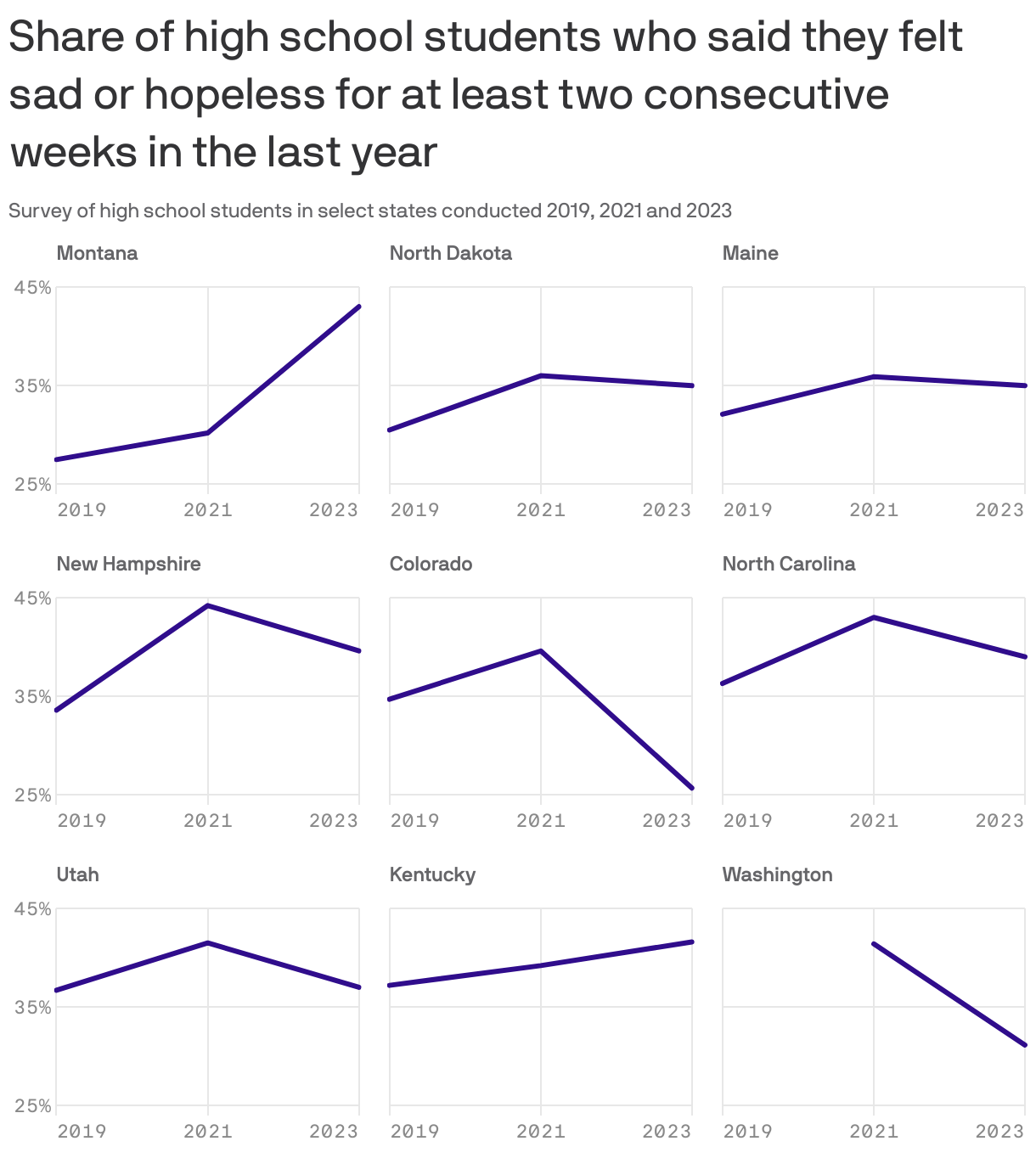
Youth mental health has begun to improve in Utah after the pandemic brought an increase in crises, new data shows.
Why it matters: The COVID-19 pandemic laid bare students' struggles as well as a fractured system to help them navigate recovery.
State of play: Of nine states with 2023 federal data reviewed by Axios, seven reported declining rates of sadness and hopelessness — including in Utah.
By the numbers: 37% of Utah teens polled during the CDC's 2023 Youth Risk Behavior Survey reported feeling sad or hopeless for at least two consecutive weeks of the previous year.
- That's down from 41.5% in 2021, and almost back to a pre-pandemic level of 36.7% in 2019.
Reality check: Rates of sadness and hopelessness had already jumped sharply before 2019.
- From 1999 to 2013, rates hovered around 26%. Between 2013 and 2017, they shot up to 33% and continued rising until 2021.
What they're saying: Overall, dedicating more resources to student well-being during the pandemic has started to pay off, Kathleen Ethier, director of the CDC's Division of Adolescent and School Health, told Axios.
- "These improvements — they're not huge, but they are important," she said.
Zoom out: The number of students in Colorado who feel sad or hopeless almost daily dropped to 26%, the lowest level since the survey's 2013 inception when it was 24%.
- In Washington, more students reported having adults to turn to when feeling depressed — 59% (2023) from 50% (2021).
- In North Carolina, the percentage of high school students who seriously considered suicide dropped to 18% (2023) from 22% (2021).
Yes, but: Montana saw a large spike, from 30.2% in 2021 to 43% in 2023.
Caveat: These survey findings are not yet comprehensive, and the CDC is expected to publish national results later this year.