Utah moms are younger than national average, but near middle of the pack

Add Axios as your preferred source to
see more of our stories on Google.
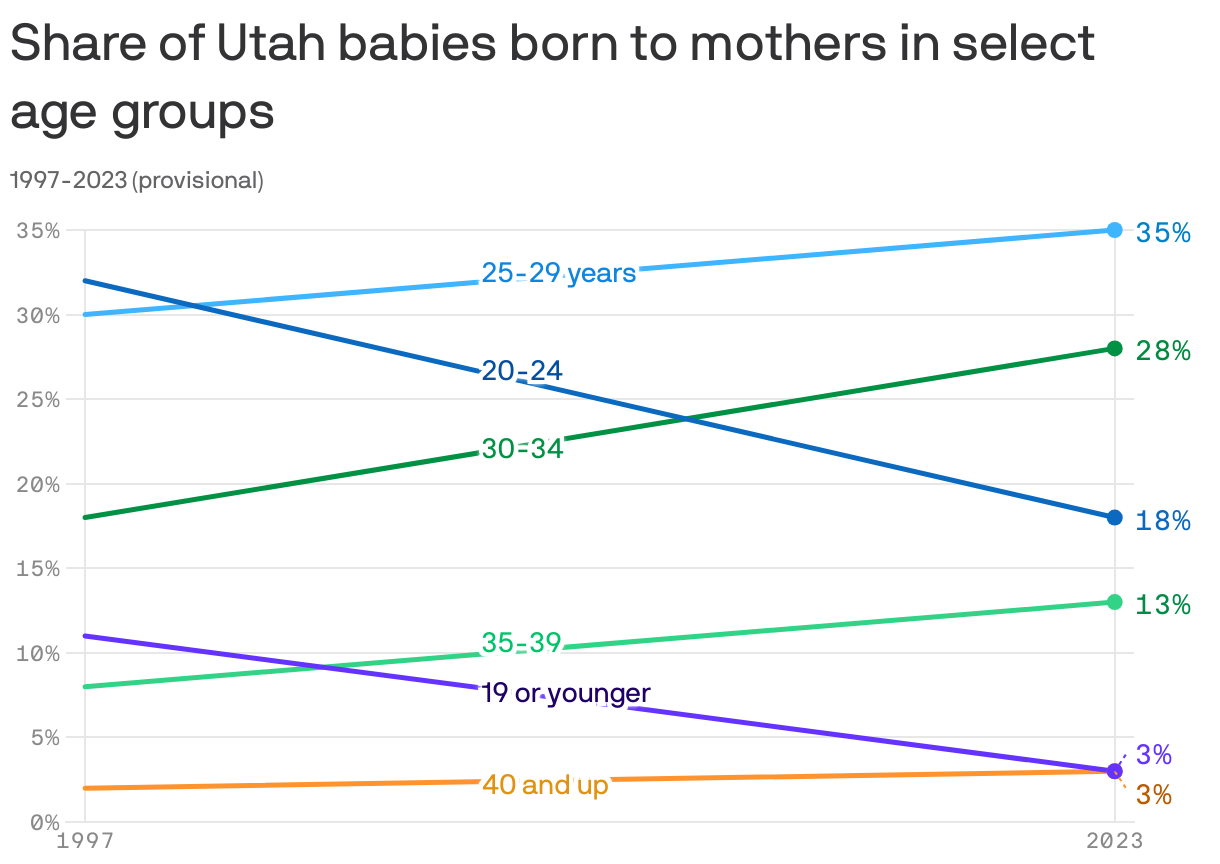
Utah's mothers are relatively young — but not as far from national norms as you might guess.
By the numbers: The average age of Utah moms who had babies in 2023 was 28.93 years — tied with Ohio as the 18th-youngest, according to provisional CDC data.
- The national average age was 29.58, ranging from 27.31 in Mississippi to 31.74 in Washington, D.C.
The intrigue: Utah's moms aren't the nation's youngest, even though the state is known for its young families.
- That reputation is due in large part to religious teachings that encourage early marriage and childbearing.
Zoom in: Moms 19 and younger accounted for just 2.7% of 2023 births in Utah — the nation's third-lowest share and well below the national rate of 4%.
- Moms younger than 25 made up 21.1% of Utah's births last year — the same as the national share.
Yes, but: Utah had the nation's biggest share of births to mothers aged 25 to 29 — the state's most common age range for childbirth, at more than 35%.
- By contrast, the most common age range nationally was 30 to 35.
Between the lines: While Utah children are no more likely than babies elsewhere to be born to young mothers, they are less likely to be born to older mothers.
- 51.4% of U.S babies were born to moms in their 30s and older, compared to only 43.6% in Utah.
The big picture: In the last few years, age 35 has gone from the start of "geriatric pregnancy" to potentially a maternal-age sweet spot, Axios' Carly Mallenbaum reports.
- 35-year-olds received more prenatal monitoring and had a small decrease in prenatal mortality compared to those even a few months younger, according to a 2021 JAMA Health Forum study.
- Some research suggests that being 35+ and pregnant could lead to better brainpower after menopause and a smaller gender wage gap.
Reality check: Pregnancy risks do increase with age. But the effects are much more pronounced after age 40, compared to 35.
- New ACOG guidelines emphasize that pregnancy risks should be considered among patients in five-year age groups — ages 35–39, 40–44, etc. — instead of in one big advanced maternal age group.
The trendline: While "geriatric" pregnancies are less common in Utah, the share of births here to moms younger than 25 is half what it was a quarter-century ago, according to an Axios analysis of CDC data.
The fine print: The data accounts for all births — not just a mother's age at first birth.
- With the nation's largest average family size, many of Utah's births in a given year are to moms who already have kids.
- Utah also has the nation's lowest percentage of births to unmarried mothers, which likely contributes to the low rate of teen births, driving up the average age.