Trump can send National Guard to Portland, appellate court rules

Add Axios as your preferred source to
see more of our stories on Google.
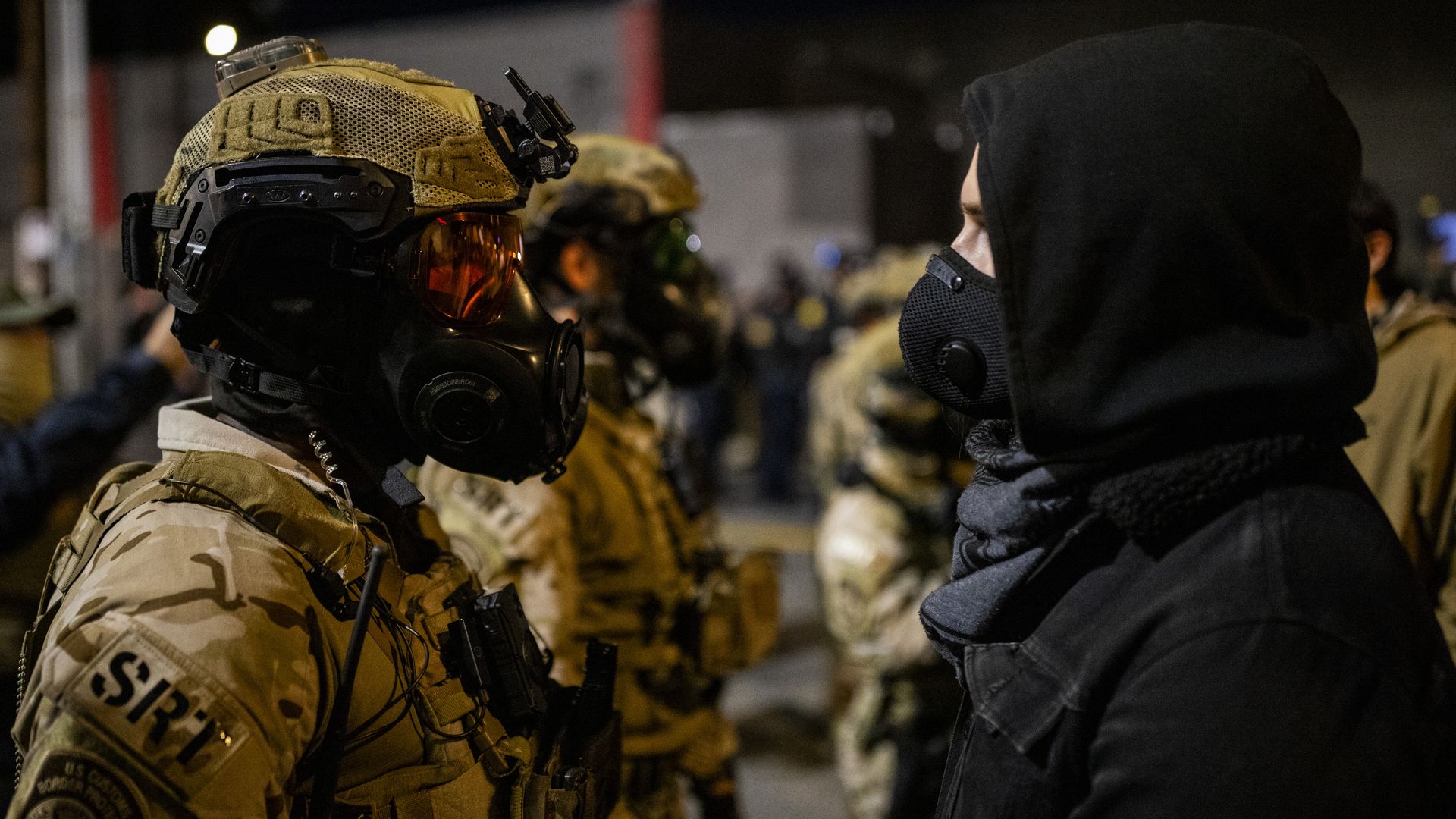
A federal officer stands across from a protester outside the South Portland ICE facility. Photo: Stephen Lam/San Francisco Chronicle via Getty Images
President Trump is one step closer to sending the National Guard to Portland after the 9th Circuit Court of Appeals overturned a lower court order barring the deployment.
Why it matters: Monday's decision sets the stage for troops to take to Portland streets to protect an ICE facility in the city from long-running protests.
The latest: It remains unclear when National Guard boots could be on the ground in Portland, as the ruling applies only to the first of two restraining orders issued by a lower court.
- Attorneys for the city and state quickly filed a motion to have the ruling reconsidered by a larger panel of the 9th Circuit.
- The full circuit, made up of 29 judges, will vote on whether the case should be reheard. Briefs from both sides are due by Wednesday.
What they're saying: "After considering the record at this preliminary stage, we conclude that it is likely that the President lawfully exercised his statutory authority," the 9th Circuit judges wrote in their 2-1 ruling.
The other side: "Today's decision is not merely absurd," dissenting Judge Susan Graber wrote. "It erodes core constitutional principles, including sovereign States' control over their States' militias and the people's First Amendment rights to assemble and to object to the government's policies and actions."
Between the lines: During oral arguments earlier this month, the judges had tough questions for Stacy Chaffin, an attorney representing Oregon.
- "What I'm struggling with is, the president gets to direct his resources as he deems fit, and it just seems a little counterintuitive to me that the city of Portland can come in and say 'No. You need to do it differently,'" Judge Ryan Nelson said.
- The panel was made up of two judges appointed by Trump in his first term, Nelson and Bridget Bade — the majority in the ruling — and one President Clinton appointee, Graber.
Catch up quick: Trump said last month that he was authorizing the use of National Guard troops "to protect War ravaged Portland, and any of our ICE Facilities under siege from attack by Antifa, and other domestic terrorists."
- The city and state filed for a temporary restraining order seeking to block the deployment, and U.S. District Court Judge Karin Immergut ruled the circumstances on the ground did not warrant the intervention of the National Guard.
- Trump's description of Portland as "war ravaged" was "simply untethered to the facts," Immergut wrote in a 31-page opinion blocking the deployment of Oregon troops to Portland.
The Trump administration quickly appealed the decision to the 9th Circuit, but also attempted to circumvent the judge's ruling by deploying federalized troops from California and Texas.
- In a second hearing earlier this month, Immergut issued another restraining order barring troops from any state from being sent to the Rose City.
State of play: Lawyers for the city and state told the court that Trump's "actions infringe on Oregon's sovereign power to manage its own law enforcement activity and its own National Guard," and "they do so based entirely on inaccurate information."
- Chaffin conceded that there had been acts of violence earlier in the summer, but that protests had been mostly "calm and sedated" recently and any criminal activity had been "appropriately handled by law enforcement resources."
Lawyers for the Department of Justice argued that Immergut "impermissibly second-guessed the Commander in Chief's military judgments," in briefs submitted to the 9th Circuit, per the Oregonian.
- "This is hardly the peaceful and sedate crowd that plaintiffs tried to make it out to be," DOJ lawyer Eric McArthur told the court during arguments. "These are violent people, and if at any point we let down our guard, there is a serious risk of ongoing violence."
The big picture: "Today's ruling, if allowed to stand, would give the president unilateral power to put Oregon soldiers on our streets with almost no justification," Oregon Attorney General Dan Rayfield said in a statement. "We are on a dangerous path in America."
Editor's note: This is a breaking news story. Check back for updates.