Fatal overdoses climb in Oregon despite national decline


Add Axios as your preferred source to
see more of our stories on Google.
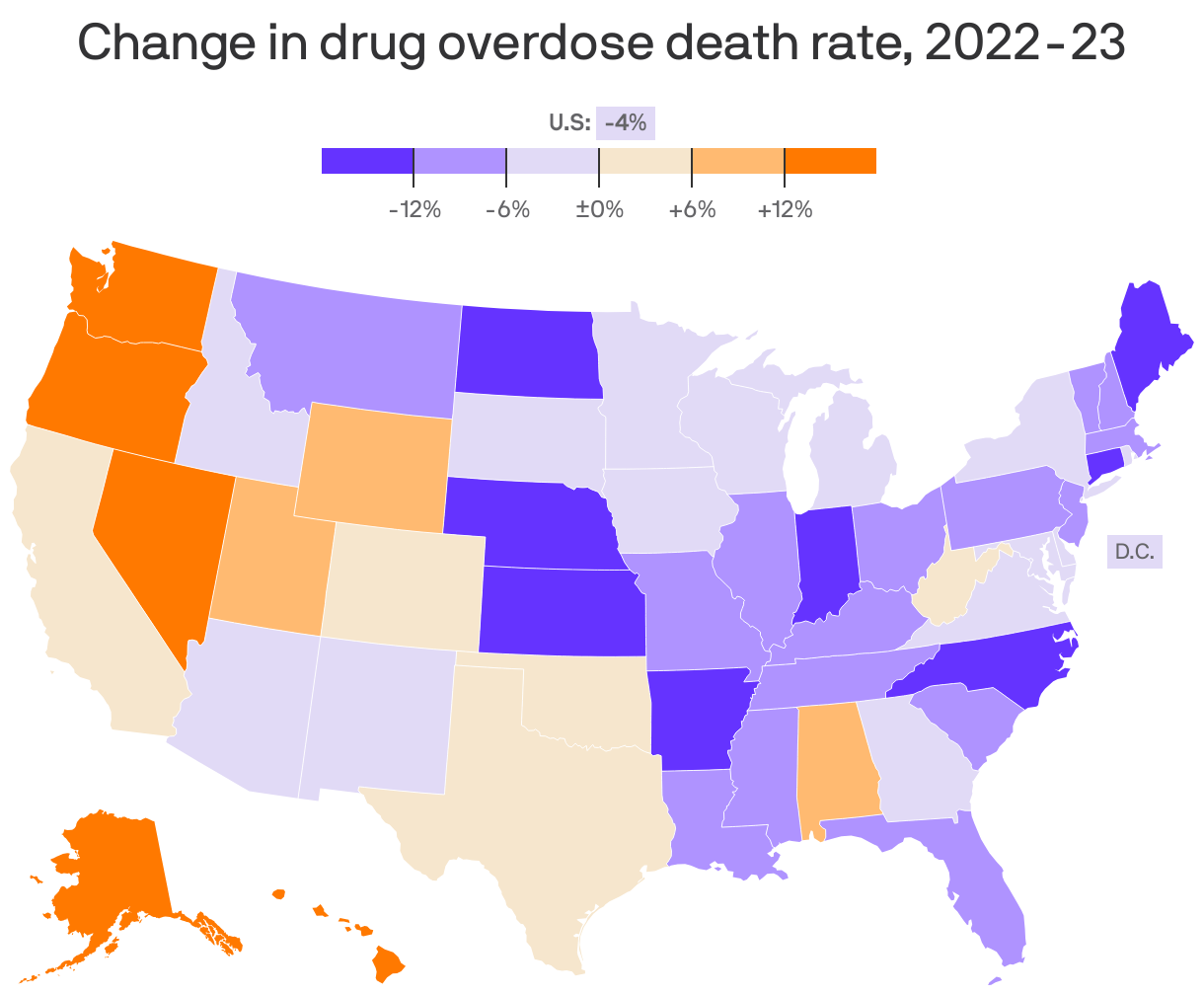
The rate of people dying due to drug overdoses continues to increase in Oregon, even as most other states see signs of progress.
Why it matters: Overdose deaths seem to be falling around the country as pandemic-era isolation ebbs and access to life-saving medications like naloxone grows in many places, but not here.
By the numbers: Oregon saw 31.1 overdose deaths per 100,000 people in 2022, according to the Centers for Disease Control and Prevention, but that number rose to 40.8 in 2023, a change of 31.2%.
- That was second only to Alaska, which saw a change of 44% over that same period.
- Nationally, the age-adjusted rate of U.S. fatal drug overdoses fell from 32.6 per 100,000 people in 2022 to 31.3 in 2023, the CDC says.
- The rate for synthetic opioids specifically — including fentanyl — dropped from 22.7 to 22.2.
Zoom in: A rise in overdoses led state lawmakers to reverse Oregon's first-in-the-nation drug decriminalization law — Measure 110 — last year.
- Subsequent research showed that the increase in overdoses was likely due to the introduction of fentanyl, not Measure 110.
- Regardless of the cause, overdose deaths still were pervasive enough to be cited as one of the factors that caused a dip in life expectancy in Oregon.
Between the lines: A recent report from specialty lab Millennium Health highlighted a "rising tide" of heroin co-use among fentanyl users, as well as fentanyl and stimulant co-use — part of the "fourth wave" of the overdose epidemic.
The latest: After five years of skyrocketing opioid overdose deaths in the state — from 318 in 2019 to 1,394 in 2023 — last year offered a glimmer of hope that the crisis might be ebbing.
- Through the end of October, the latest data available, Oregon had seen 392 deaths, according to the Oregon Health Authority.