Portland's youths are earning more than their parents


Add Axios as your preferred source to
see more of our stories on Google.
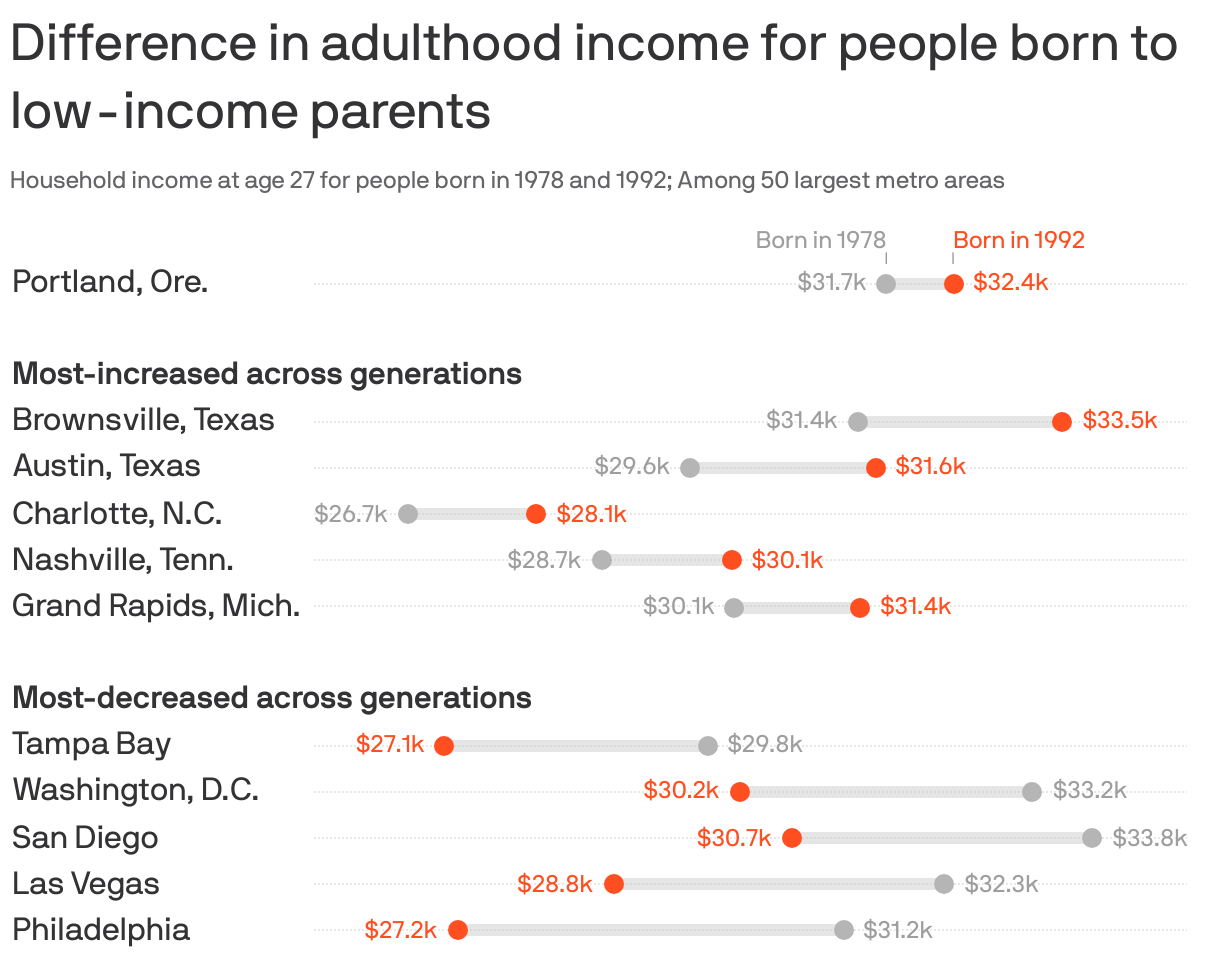
People born to low-income families in Portland tend to be a little better off than their parents, a new analysis finds — but not across Oregon as a whole.
Why it matters: Intergenerational mobility — the idea that you'll do better than your parents, and so on — is core to the American dream, but is far from a guarantee.
Driving the news: Portlanders born to low-income families in 1992 were earning more at age 27 than others born poor in 1978 at that age, according to an analysis by the U.S. Census Bureau and a Harvard University research group.
By the numbers: People born to low-income Portland families in 1978 averaged $31,700 per year — adjusted for inflation — by the time they were 27.
- By 2019, when people born to low-income Portland families in 1992 reached 27, their average earnings rose to roughly $32,350 — a 2% increase.
- Overall, Portland ranked ninth out of the nation's 50 largest metro areas for upward intergenerational mobility, one spot ahead of San Jose, California — the only two West Coast cities in the top 10.
The big picture: In 38 of the 50 biggest metros, Americans born to low-income families in 1992 were doing worse at age 27 than those born in 1978 at that age.
Between the lines: The geography of mobility has shifted dramatically, especially when breaking down the data by race.
- "By 1992, upward mobility for low-income white children in the coasts and in the Southwest fell markedly to rates on par with those observed in Appalachia and other areas that historically offered the lowest chances of upward mobility," the researchers write.
- Yes, but: "Black children born in 1992 still had poorer prospects of rising up than white children in virtually every county in America, because initial Black-white disparities were so large."
Case in point: Even though Black children born in '92 from the poorest households in Portland earned nearly 5% more than their '78 counterparts, their average household income by age 27 was significantly less than other racial groups, except Native Americans.
- For example, Black, low-income families born in '92 earned $22,000 a year in 2019, while Hispanics brought in $33,000, Asians $36,000 and white families $31,000.
The intrigue: Upward mobility varies wildly on a county-by-county basis in Oregon.
- Children born to low-income families in rural counties, such as Wallowa, Lake and Josephine counties in 1992 earned 20%, 15% and 11% less, respectively, than those born in 1978.
Go deeper: You can explore more data about how intergenerational mobility has fared across Portland — and by neighborhood — at The Opportunity Atlas, a web tool researchers published.