What to know about ranked choice voting

Add Axios as your preferred source to
see more of our stories on Google.
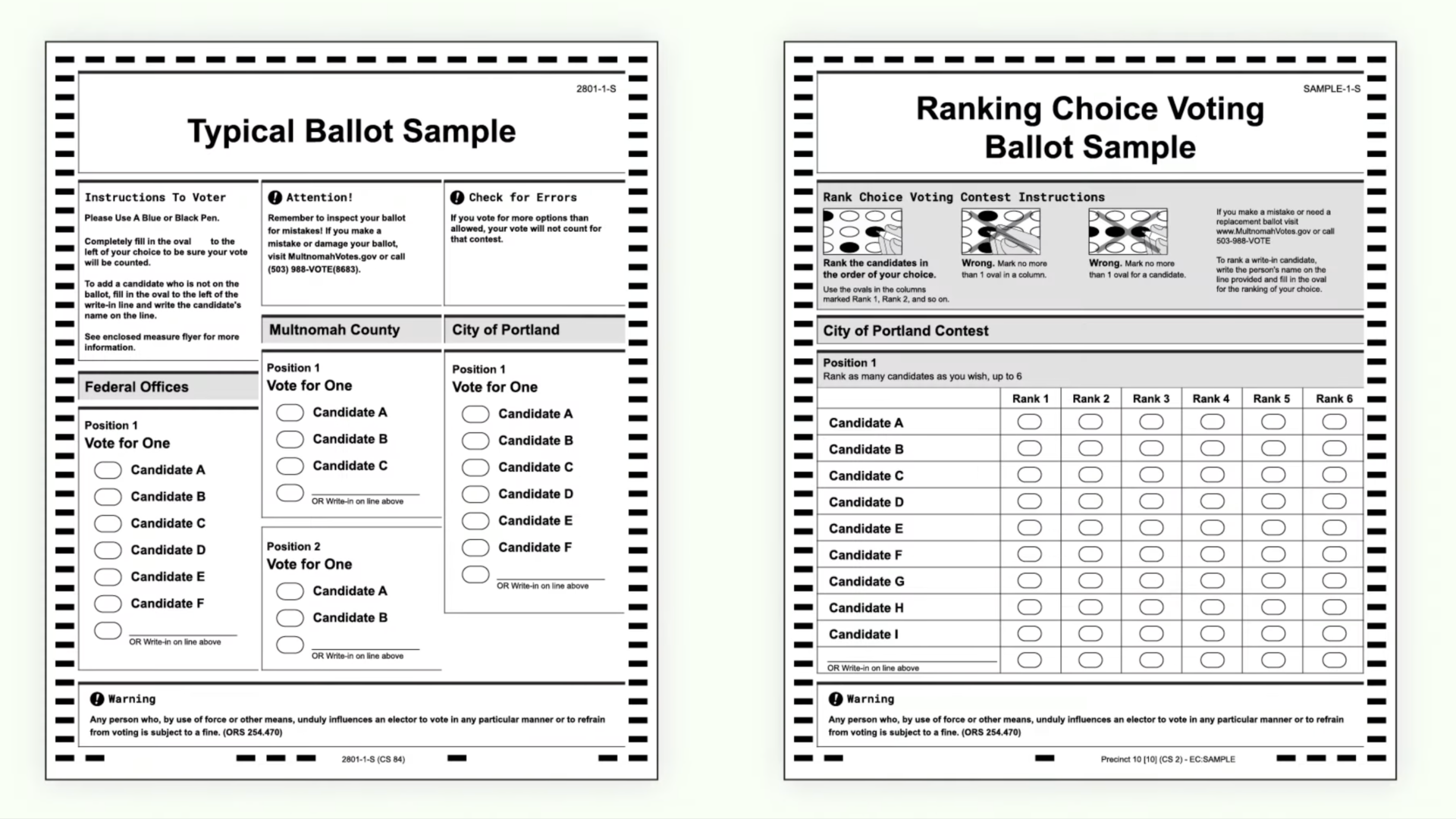
Left: A ballot voters often used in the past. Right: A ranked choice ballot sample. Photo: Multnomah County Elections
Portland voters have more decisions to make than ever before on their November ballots as the city introduces ranked choice voting for the first time.
Why it matters: Ranked choice voting allows voters to select more than one candidate and eliminates the need for runoff elections, according to Tim Scott, director of Multnomah County Elections, which oversees Portland's elections.
- "It allows voters to more fully express their vote," he told Axios.
Driving the news: The county has been conducting mock elections with the new voting software and procedures since January, Scott said.
- It recently wrapped a weeklong trial run for hand counting ranked-choice voting ballots for when the difference between the top two candidates is less than 1/5 of 1%.
Catch up quick: Portlanders approved dramatic changes to city governance and local voting in 2022, setting up a rapid timeline for full transition by 2025.
- In the new system, 12 elected City Council members will pass laws and a chief administrative officer will run the city's daily operations, while the new mayor will act as the public-facing voice for the city and break ties on the council.
- Voters also OK'd ranked-choice voting, moving all Portland elections from May to November and eliminating the need to hold primaries.
How it works: In citywide office races — including mayor, auditor and for City Council — instead of selecting just a single candidate, voters will be able to rank up to six in order of preference.
- For mayor and auditor, a candidate will win if they receive more than 50% of first-choice votes.
- If no candidate reaches that threshold in the first round, the candidate with the lowest votes is eliminated. Then, the voters who selected the eliminated candidate as their top choice have their votes transferred to their second pick, and so on until a winner is declared.
- Candidates running for Portland's City Council will need more than 25% of the vote to secure a seat. Candidates from Portland's four new districts will be running for one of three seats per district.
Between the lines: The new ballots will be grid-style where you'll still fill in ovals for candidates — there'll just be a lot more of them.
- While you can rank up to six candidates, you don't have to.
- Plus: You'll still be able to write in candidates and choose a rank for them.
- If you make a mistake, you can correct it or request a new ballot.
The big picture: Ranked-choice voting is commonly used in cities, counties and states throughout the country, including San Francisco, Salt Lake City, Minneapolis and New York City.
What's next: Portland voters will receive two ballots in November — one ranked-choice ballot for city offices, and another non-ranked-choice ballot for county, state and national races.
- Multnomah County will move to ranked-choice voting for its county elected offices in 2026.
The bottom line: The first round of results on Election Night will come at 8pm, while updated results will come 24 hours later to ensure the new system's accuracy.