Portland resists built-to-rent bandwagon



Add Axios as your preferred source to
see more of our stories on Google.
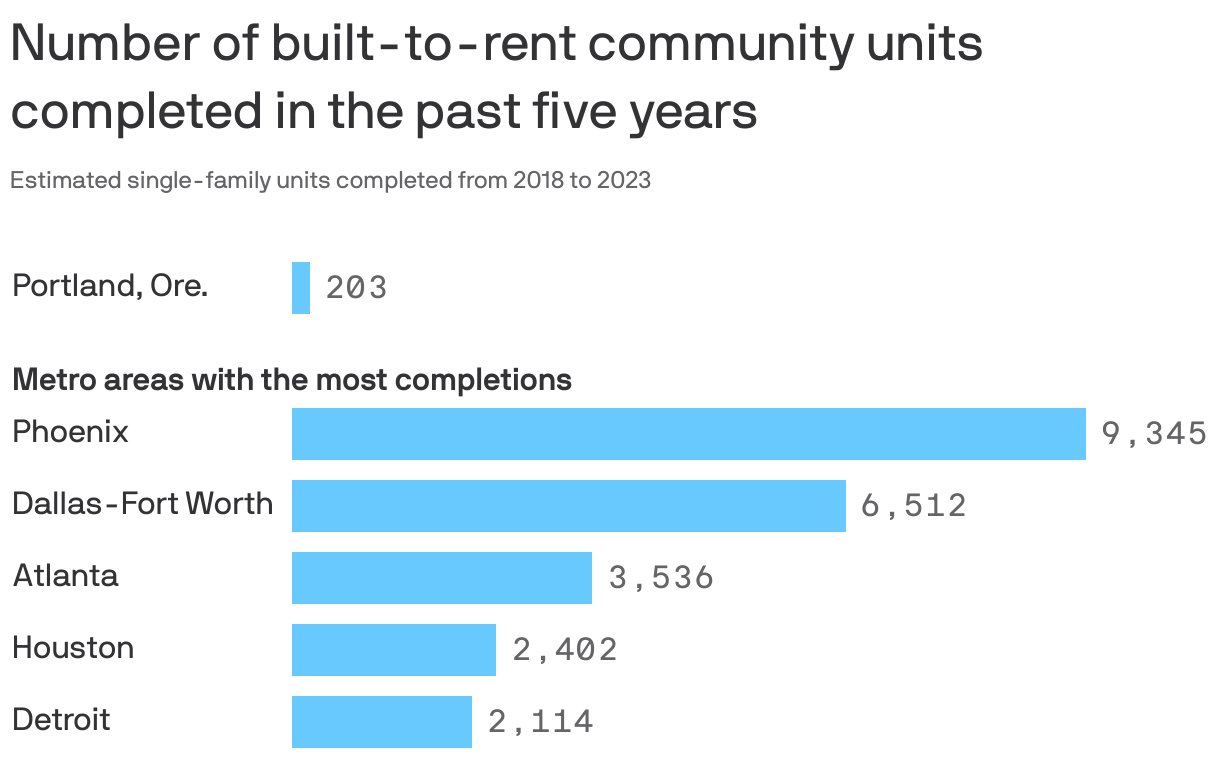
Despite a chronic need for affordable housing, the national trend to build houses for rent, not for sale, hasn't gained traction in the Pacific Northwest.
Why it matters: With mortgage rates perched near record highs for the year, there has been a proliferation of such housing in many communities across the U.S.
- They offer residents property management perks without down payments or long-term commitments — and no mortgages.
By the numbers: In 2023, the U.S. saw 27,500 build-to-rent houses completed, an all-time high. That's 75% more than the year before and triple the number in 2021, according to a recent RentCafe report.
- Seattle has 2,462 single-family rental units altogether, with 411 of those completed from 2018-2023, per the data.
- Another 718 units are in the planning stages, according to data sent to Axios from the National Rental Home Council (RHC).
- Portland saw 203 units completed between 2018-2023 and has 1,183 finished units total and 120 more planned, per RentCafe and RHC data.
Reality check: David Howard, the director of RHC, told Axios that population growth in cities such as Portland and Seattle is not as robust as it used to be and could be partly why developers are skipping the PNW.
- "Given the fact that financing has become more challenging over the past 12-18 months with rising interest rates, etc., developers may be more cautious (in these) markets," Howard said.
Zoom in: Both states could be out of favor for this kind of development due to policy decisions by state and local lawmakers, some PNW housing experts say.
- Washington's Growth Management Act was "intended to prevent subdivision sprawl in rural areas," Greg Smith of Seattle YIMBY told Axios, "but it also makes it much more expensive to buy land outside the city."
- Oregon's limits on annual rent increases also worry built-to-rent developers, Howard said.
What they're saying: "I think developers have just gravitated toward other markets where there perhaps is more certainty," Howard said.