Unstumped: Why Portland's westside got downtown

Add Axios as your preferred source to
see more of our stories on Google.

Illustration: Allie Carl/Axios
Why is Portland's central business district on the west side of the Willamette? An Axios Portland reader wanted to know.
Why it matters: Central business districts — including Portland's — have typically been the recipient of all kinds of resources and attention, from government headquarters and cultural institutions to skylines symbolizing much larger areas and communities.
Catch up quick: Before any white pioneers laid claim to what's now downtown Portland, a small section was known as "The Clearing" — an overnight stop for river travelers on the west bank of what Native Americans called the Mult-no-mah.
- By the mid-1840s indigenous people had cleared about an acre of land there "by cutting brush and trees for campfires," according to the voluminous Portland history written by former city auditor Jewel Lansing.
Details: William Overton and Asa Lovejoy made the first settler land claim — on the west side of the river — and commercial development followed.
- "A blacksmith, hotels and boarding houses, saloons, dry goods shops, docks, wharves," soon were part of that early westside settlement, Oregon Historical Society reference librarian Renato Rodriguez tells Axios.
- "At the time there were no bridges to the east side nor was there much commercial development there at all."
Of note: The east side was swampier than the west, although that didn't stop settlers from filing early claims there too.
- East Portland was its own city for 20 years before it merged with Portland in 1891.
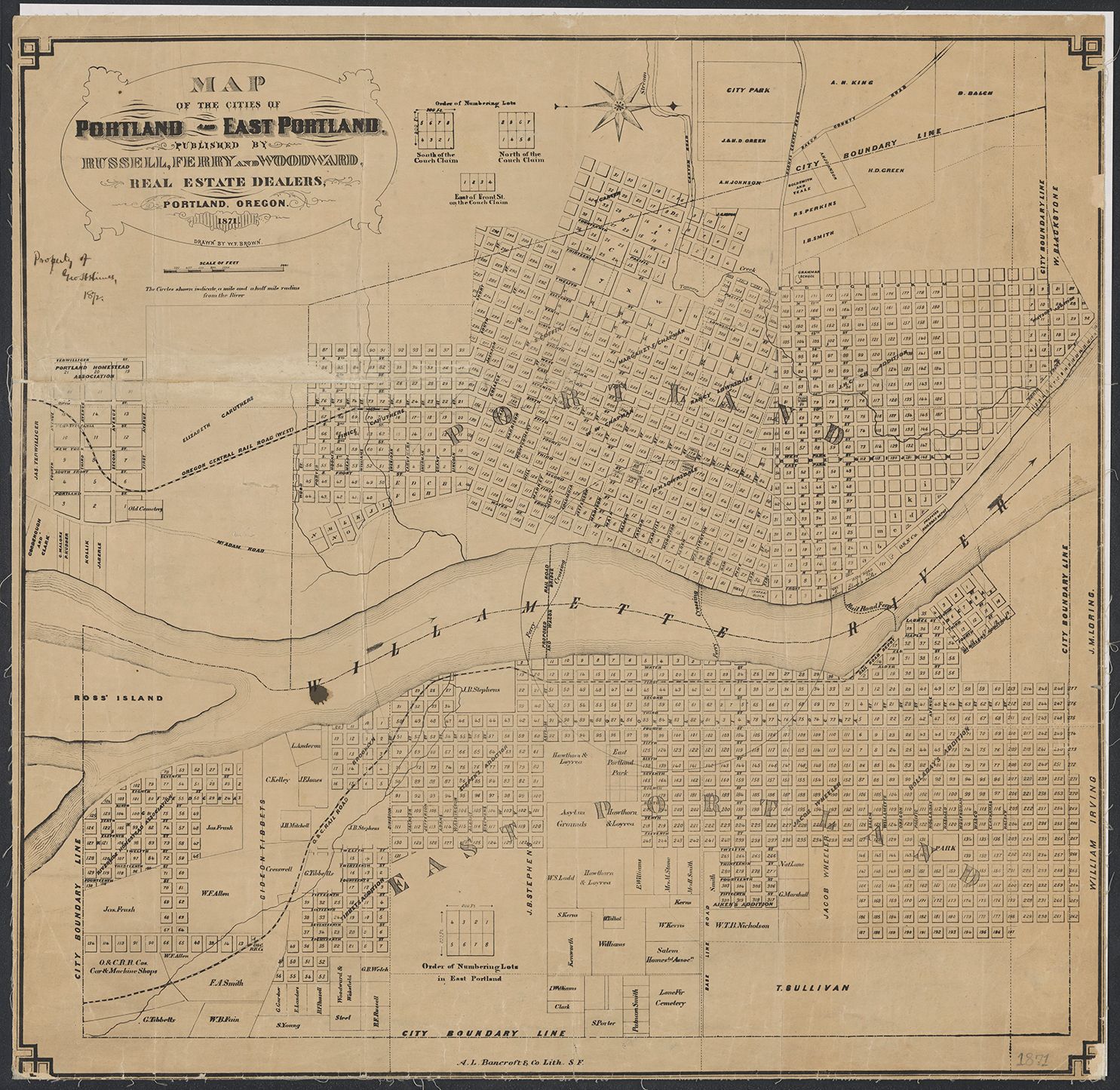
Yes, but: Westside landowners still held onto power, with 10 of the 15 seats on a powerful new Port Commission reserved for them.
Zoom in: Then a railroad deal sealed the west side's prominence, per Lansing's history.
- Eastside rail developer Ben Holladay won critical federal support in 1869, beating a westside company.
- He then said that, for $100,000, he'd finish lines on both sides of the river — and put a shared central station on the west.
- Westsiders raised the cash in a matter of months.
The intrigue: "East Portland might well have developed into the downtown core of Portland had westsiders not responded with their dollars in 1871," Lansing wrote.
The bottom line: Downtown planning stayed focused strictly on the westside as late as 1972 but by 1988, the concept of Portland's "central city" had expanded upstream and across the river.
- Portland's current Central City plan includes the central eastside, the Lloyd district and parts of the Albina neighborhood.
Ask Unstumped any Portland question — [email protected]