Arizona cities seek to curb urban camping

Add Axios as your preferred source to
see more of our stories on Google.
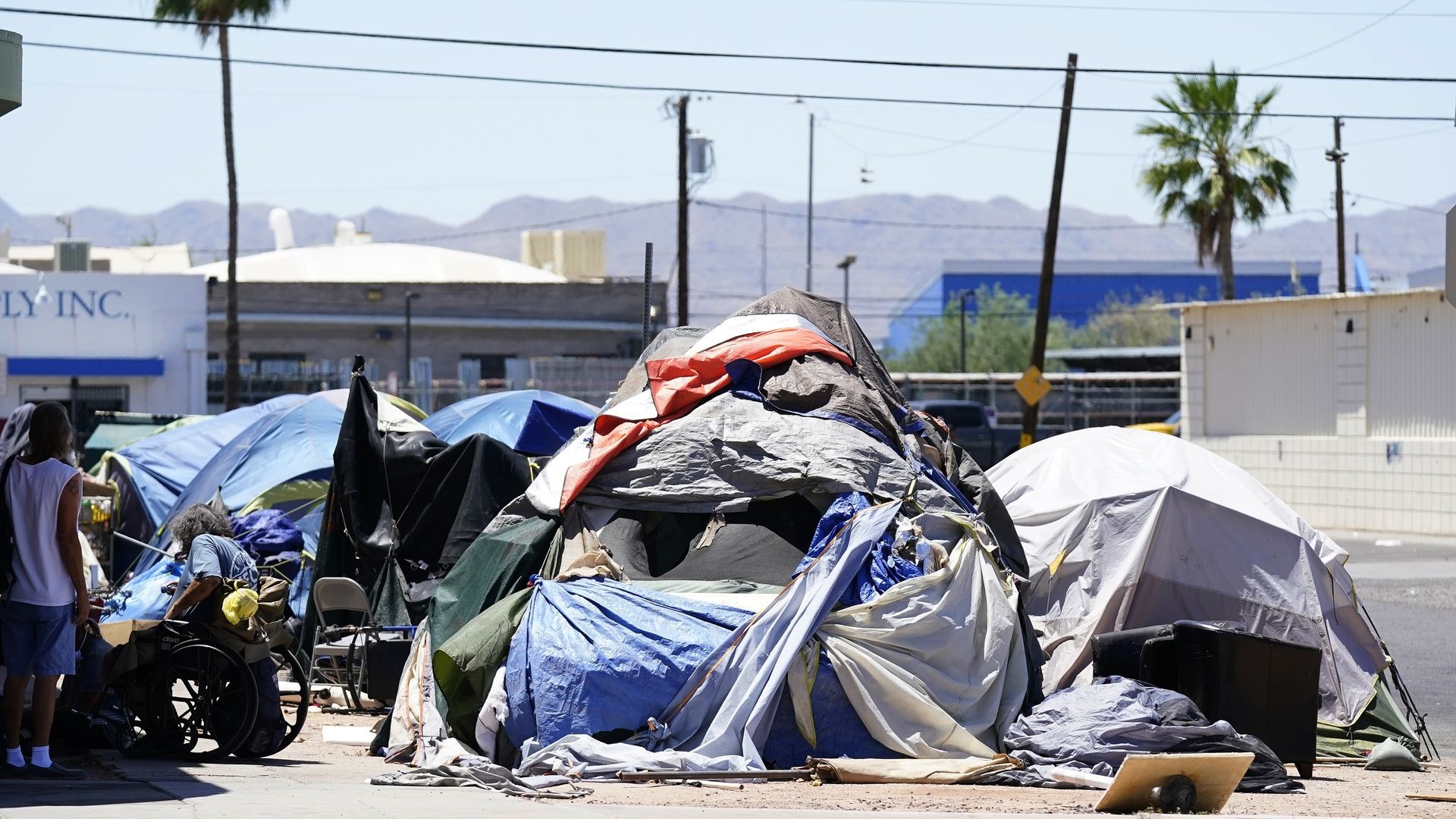
Photo: Ross D. Franklin/Associated Press
Several Valley cities have taken action this year to crack down on urban camping in the wake of the landmark U.S. Supreme Court ruling on how local government can address homelessness.
Catch up quick: The Supreme Court ruled in June that cities can criminalize sleeping or camping in public places, even if no other shelter is available.
- The decision, stemming from an ordinance in Grants Pass, Oregon, reversed a 2018 ruling by the 9th Circuit U.S. Court of Appeals that barred cities from arresting or citing people for sleeping outside if there were no available shelter beds.
State of play: A half-dozen cities in the Phoenix area this year have passed, strengthened or committed to stricter enforcement of urban campaign bans.
- The Phoenix City Council in May banned camping within 500 feet of schools, child care facilities, homeless shelters and city parks.
- Scottsdale in August eliminated a requirement that police confirm there's available shelter space before citing someone for violating its urban camping ban.
- Last month, Surprise reinstated its ban, followed about two weeks later by Goodyear.
The latest: Mesa last week expanded its urban camping ban, which already applied to city parks, to include all city-owned property.
- Tempe implemented "strict enforcement" of its urban camping ordinance. Rather than having 24 hours to comply with orders to move, people must do so within about an hour.
Catch up quick: Voters last month overwhelmingly approved Proposition 312.
- Under Proposition 312, if a city or town doesn't enforce "nuisance" laws related to homelessness, like illegal camping, loitering and public urination, or if the municipality "maintains a public nuisance," property owners can request a property tax refund to cover expenses they incur as a result.
Yes, but: Valley cities that have taken steps to crack down on homeless encampments have largely done so as a result of the Grants Pass decision, not Proposition 312.
- Three of the cities that took action this year did so before the election, while Goodyear and Mesa specifically cited the Supreme Court ruling as the impetus for their policies.
Between the lines: Tempe pointed to both Proposition 312 and the Grants Pass decision as the rationale for its strict enforcement policy.
- Tim Burch, Tempe's director of community health and human services, noted that Grants Pass allowed cities to take certain actions, while Proposition 312 imposes explicit requirements.
- As such, Proposition 312 was the bigger impetus in driving Tempe's strict enforcement policy, he said.
Flashback: Phoenix residents in 2022 sued the city over a large homeless encampment near the downtown Human Services Campus known as "The Zone."
- After a judge ruled against the city, Phoenix began clearing the encampment in May 2023.
Zoom out: Proposition 312, the Grants Pass ruling and the urban camping crackdowns come as the Valley, like the nation at large, grapples with a massive homelessness problem.
- The issue has been compounded by skyrocketing housing costs.
- Mayors across the country are calling for increased federal funding for affordable housing, while local developers, nonprofits and others seek to implement solutions for people experiencing homelessness.