Phoenix experienced its hottest and driest summer on record

Add Axios as your preferred source to
see more of our stories on Google.


Phoenix experienced its hottest summer on record with an average temperature of 97 degrees — more than 3 degrees warmer than the 30-year average between 1991 and 2020, per an analysis of NOAA data.
Why it matters: Human-caused climate change is expected to continue raising summer temperatures, and the Valley has demonstrated it's not prepared to shield its most vulnerable residents from deadly heat.
- At least 295 people died of heat-related causes in Maricopa County this summer. The medical examiner is investigating another 298 suspected heat deaths.
Flashback: Phoenix Sky Harbor recorded 31 straight days of at least 110 from June 30 to July 30. It was the longest heat wave ever recorded in Phoenix.
- The city saw a record 19 days with overnight low temperatures at or above 90, an all-time record warm low temperature of 97, and a record-setting 17 days with highs at or above 115 degrees in July, according to the National Weather Service forecast office in Phoenix.
- And we were the first major city in the country to reach an average monthly temperature higher than 100, with an average July temperature of 102.7.
The intrigue: Gov. Katie Hobbs declared an extreme heat emergency on Aug. 11, and the state opened two large cooling centers at that time.
- The announcement came as the governor faced criticism for not doing enough to protect people during the historic heat wave.
The big picture: We weren't alone. Numerous states experienced a much hotter than average summer, Axios' Erin Davis and Andrew Freedman report.
- A persistent area of high pressure, also known as a heat dome, stretched across the southern tier of the country, greatly contributing to the unusually hot conditions across the southern U.S.
Zoom out: This past summer featured the warmest June, July and August on record globally, with temperatures reaching some of the highest values ever recorded on a global basis.
What we're watching: Hobbs' emergency order directed state agencies to develop a comprehensive heat plan by March 2024 and advocate for more federal Low Income Home Energy Assistance Program (LIHEAP) funding.
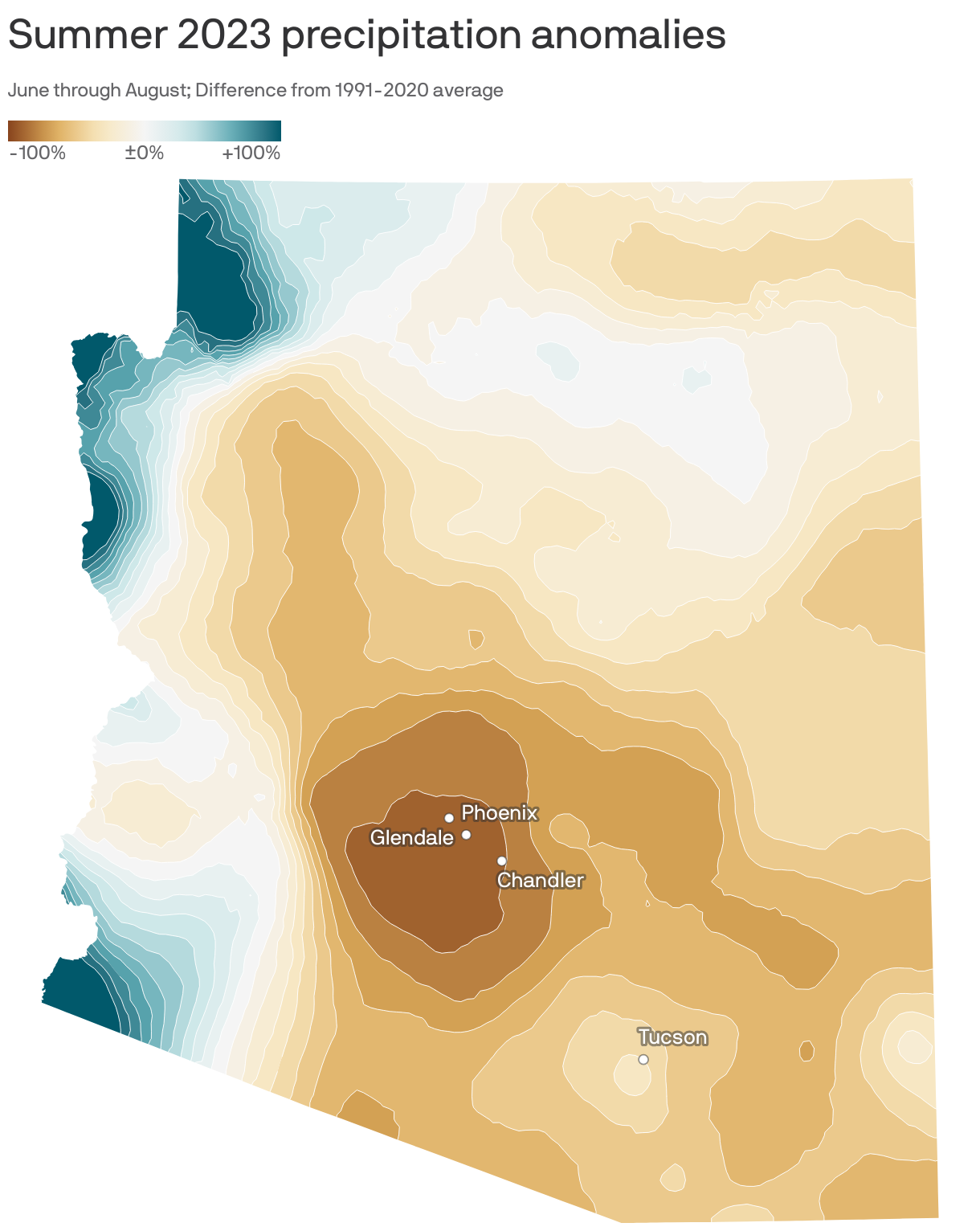
Meanwhile, we also had the driest summer on record, recording 0.15 inches of rainfall at Sky Harbor between June 15 and Sept. 30, according to the National Weather Service
- The average monsoon season sees 2.43 inches.
- Previously, the driest summer since recording began in 1895 was in 1924 with 0.36 inches.
The intrigue: Our unusually wet winter improved the short-term drought outlook across the state, but the lack of summer rain brought back extreme conditions, per the Arizona State Climate Office.
- Arizona and other Western states that are part of the Colorado River Basin are in the midst of a 23-year megadrought that ranks as the region's worst in 1,200 years.
Between the lines: Some parts of the Valley saw slightly more rain.
- Some areas of northeast Mesa got more than 3 inches — the most recorded anywhere in metro Phoenix.