Heat islands raise temps for most Philadelphians


Add Axios as your preferred source to
see more of our stories on Google.
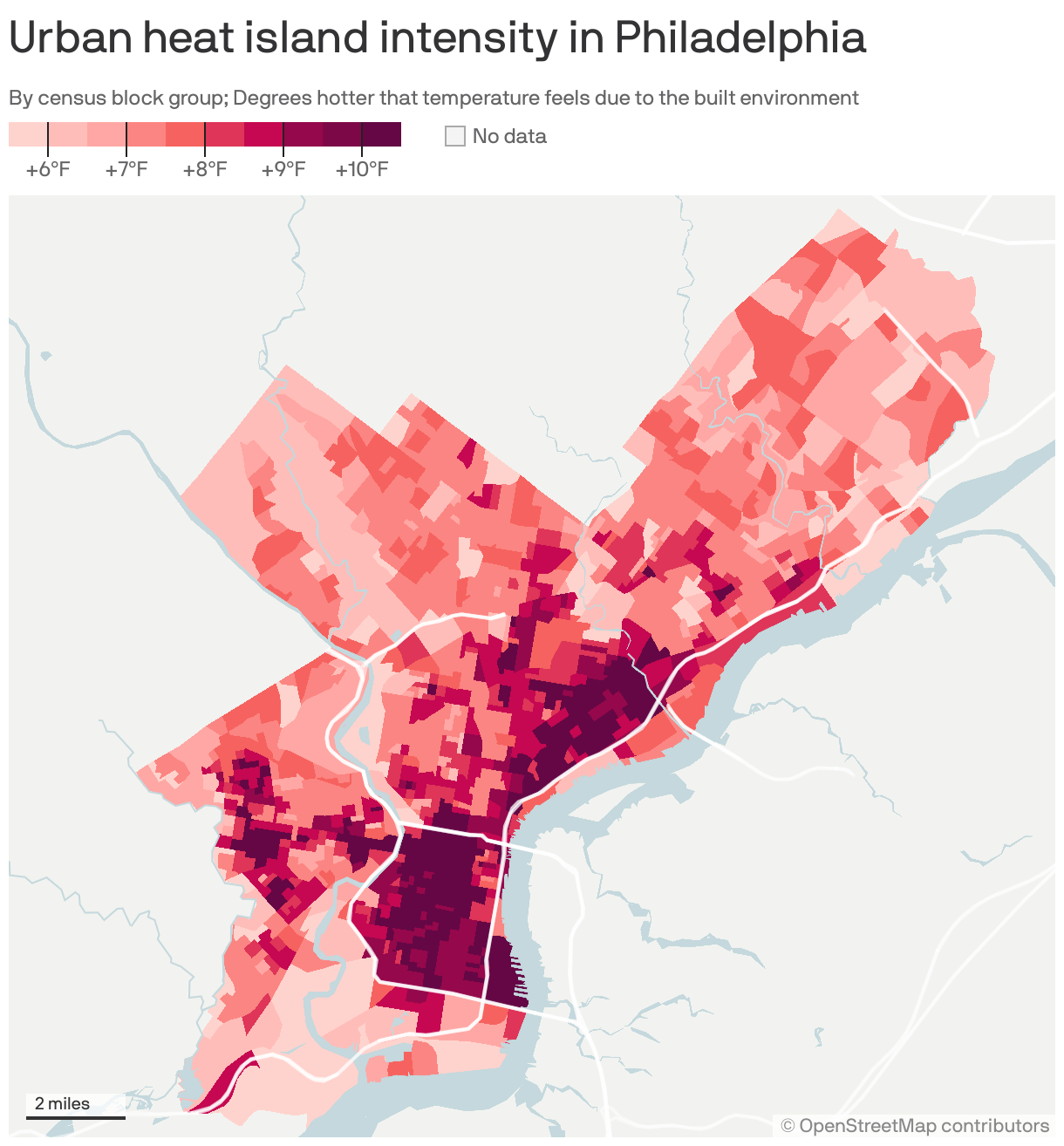
As dangerously high temps hit Philadelphia and the U.S. this summer, a new analysis finds urban "heat islands" significantly exacerbate such extreme weather.
Why it matters: More than half of Philadelphians live in heat islands — hotspots with higher temperatures compared to surrounding areas, according to Climate Central.
- That can make parts of the city feel unlivable during heat waves, which are getting longer and more frequent in the region.
The big picture: Urban heat islands (UHIs) are boosting temperatures within 65 major U.S. cities that are home to 50 million people, or 15% of the total U.S. population, per Climate Central's analysis.
- Nearly 34 million, or 68% of those people, were found to live in environments where UHIs were capable of boosting temps by at least 8°F.
How it works: Heat islands are created when roads, buildings, parking lots and so on "trap" heat.
State of play: In Philadelphia, 52% of the population lives on blocks where heat islands make temps feel an average of 8.1° hotter.
- Meanwhile, 16% live where it feels at least 10% hotter than average temps.
Between the lines: Low-income neighborhoods in Philly tend to be hotter due to fewer trees and green spaces while also being exposed to more asphalt surfaces.
Zoom out: U.S. cities in the Climate Central analysis whose citywide UHI effects can increase temperatures the most include New York (9.6°), San Francisco (9.1°), and Newark, New Jersey (9°).
Caveat: Scientists factor the heat island effect into their climate change monitoring and projections, and it does not explain the sharp uptick in global average temperatures, melting glaciers, record ocean warmth and more.
What they're saying: "The entire planet is warming due to human-caused climate change, but the built environment further amplifies both average temperatures and extreme heat in cities," per a Climate Central statement announcing the new data.
What we're watching: This summer has already seen several prolonged heat waves (like last week's), and one of its warmest Junes on record — holding true predictions for an unusually hot season.