Northwest Arkansas' summer night temps creep higher


Add Axios as your preferred source to
see more of our stories on Google.


Power couple Olivia Newton John and John Travolta likely weren't thinking of climate change when they sang about "Summer Nights" in the '70s. But those evenings have been getting warmer across Northwest Arkansas and much of the U.S. for 50 years amid climate change, a new analysis shows.
Why it matters: Higher overnight temperatures can have health consequences for vulnerable groups, as well as increased demand for air conditioning.
- That, in turn, can strain electrical grids and increase energy demand, fueling a vicious cycle with more greenhouse gas emissions.
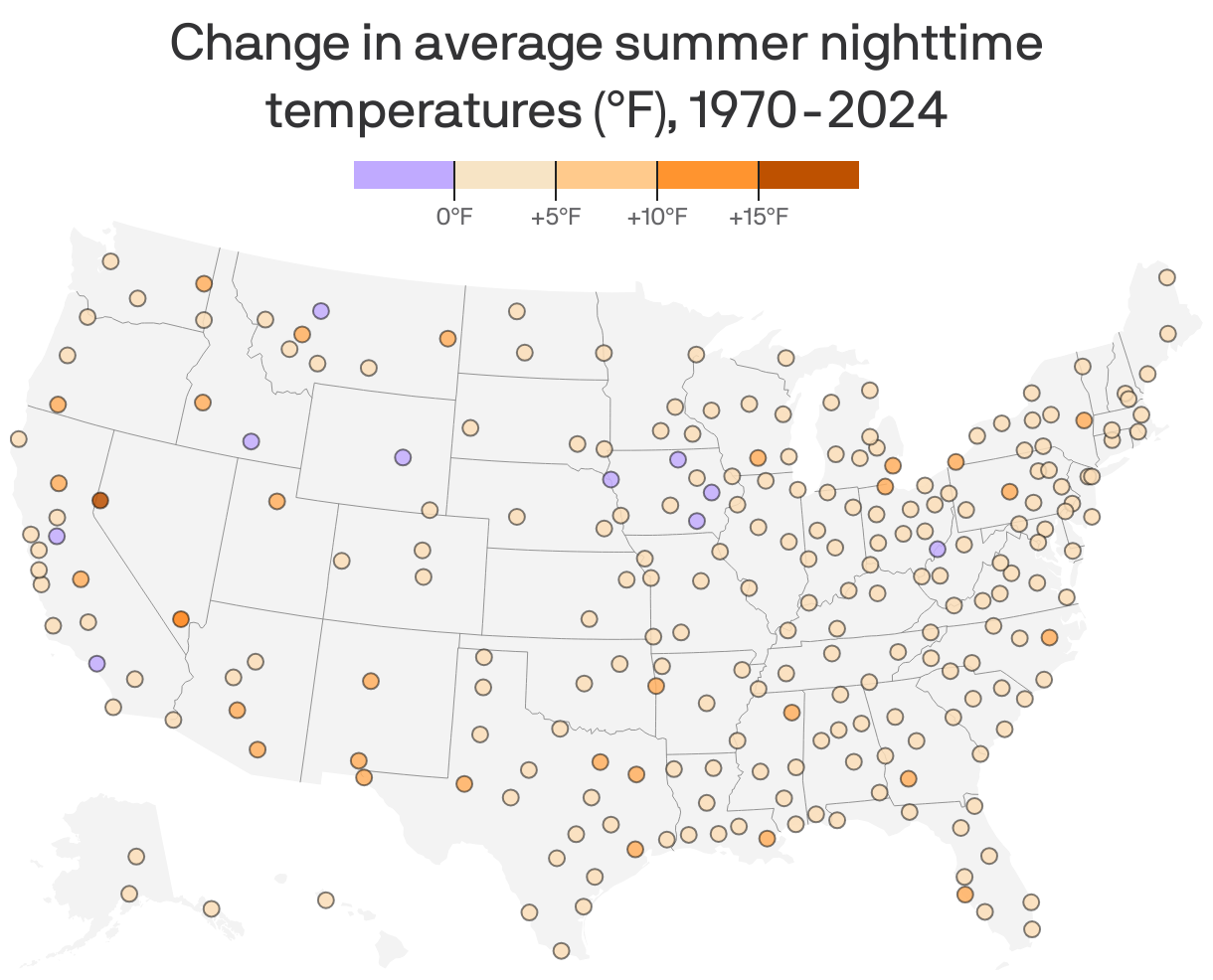
Driving the news: Average summer nighttime temperatures increased between 1970 and 2024 in 96% of 241 locations analyzed in a new report from Climate Central, a research and communications group.
- Among cities with an increase, temperatures rose by 3.1°F on average.
Zoom in: Northwest Arkansas' minimum temperature rose 2°F on average.
- It's 3.2°F in Little Rock and 1.8°F in Tulsa, Oklahoma.
Zoom out: Reno, Nevada (+17.7°F), Las Vegas (+10°F), El Paso, Texas (+8.9°F) and Salt Lake City (+8.2°F) saw the biggest increases.
What they're saying: "There's a lot of work ahead of us, and we don't have all the answers," Brian Beffort, sustainability manager for Reno's Washoe County, recently told the Las Vegas Review-Journal.
- "I'm focused on trees because they check the most number of boxes: They clean the air. They prevent stormwater. They cool things off ... There's a lot of planning that we need to do. But that's not the only intervention that we need."
Between the lines: Hundreds of U.S. cities are experiencing more frequent warmer-than-average summer nights "with a strong climate change fingerprint," Climate Central says.
- That's based on the group's "Climate Shift Index" — a method for measuring the impact of climate change on local daily temperatures — and the 1991-2020 climate normals.