Rate of Black med school students declines

Add Axios as your preferred source to
see more of our stories on Google.
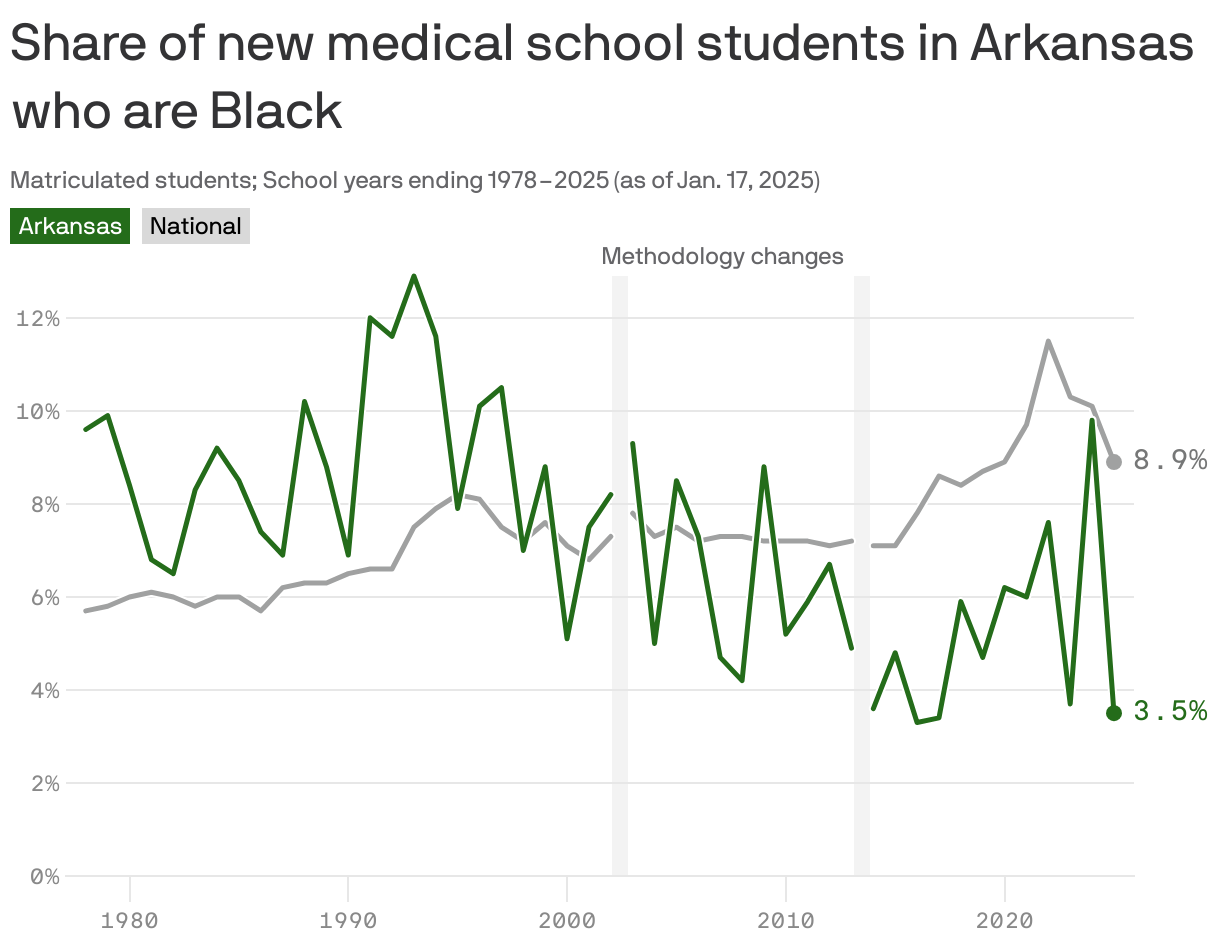
The number of enrolled first-year Black medical students has dropped in Arkansas, new data shows.
Why it matters: "Having Black physicians is good for everybody's health," says Norma Poll-Hunter, senior director of the Association of American Medical Colleges' human capital portfolio.
By the numbers: In Arkansas, 3.5% of new medical school students this school year are Black, compared to 9.8% last school year, according to the Association of American Medical Colleges (AAMC), which has collected data on this topic since 1978.
- Context: Last year's rate was on the higher end, with the largest proportion of Black medical school students in Arkansas since 1997 at 10.5%. But this year's rate is still among the lowest the state has seen in recent years.
- Meanwhile, nationally, only 5% of doctors in America are Black — compared with 14% of the general population.
The latest: The recent national dip in Black med school student enrollment follows the Supreme Court decision to strike down affirmative action in higher education.
The declines are "much larger than we would expect," even taking the Supreme Court decision into account, Poll-Hunter tells Axios.
Zoom out: Over the years, factors that may have impacted Black med school student admission rates include:
- The influential 1910 Flexner Report. Without it, 29% more African American physicians would've graduated in 2019 alone, one JAMA study projects.
- The Civil Rights Act of 1964. It banned segregation in hospitals and higher education.
- The 1972 federal Health Careers Opportunity Program (HCOP). It led to a 70% increase in minority students in health professions between its launch and 1980, according to CDC data.
- The 2020 pandemic. That's when there was a national spotlight on the Black Lives Matter movement (and racism in medical institutions), health care was particularly top of mind, and there was a reduction in med school admission costs. The next year, there was an uptick in the number of Black med school students.
The idea that Black physicians have a positive impact on patients is more than anecdotal.
- When Black babies in Florida were delivered by Black doctors (instead of non-Black doctors), they had better survival rates, a study in PNAS found.
- When African American men in Oakland were treated by Black male doctors, they were much more likely to opt for more preventive services, according to an NBER study. Researchers projected that a workforce with more Black doctors could result in a 19% reduction in the racial gap in deaths from heart conditions.
- One study from GW's Milken Institute School of Public Health found that Black and Latino family physicians were more likely to treat patients with Medicaid than their white and Asian counterparts.
What we're watching: The Alice L. Walton School of Medicine opens this fall in Bentonville.