Fewer new Black, Hispanic med students post-SCOTUS ruling

Add Axios as your preferred source to
see more of our stories on Google.
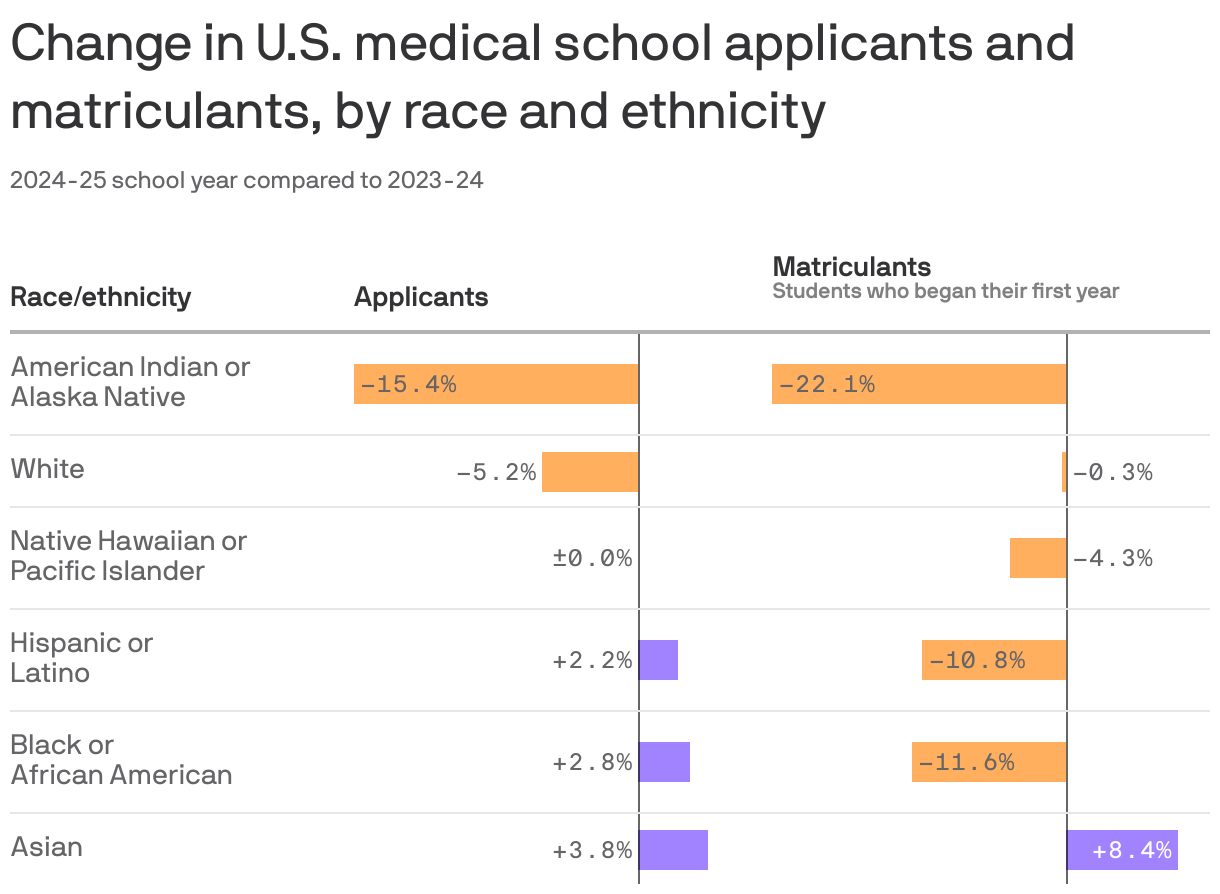
Enrollment of first-year Black and Hispanic medical students fell sharply in the year after the Supreme Court struck down affirmative action in higher education, according to new data from the institutions.
Why it matters: Research shows that a racially diverse physician workforce can improve patient outcomes.
- About 5% of doctors in America are Black, compared with 14% of the general population. About 6% of doctors in the U.S. are Hispanic versus about 20% of the general population.
What they're saying: The declines are "much larger than we would expect," even taking the Supreme Court decision into account, Norma Poll-Hunter, senior director of the Association of American Medical Colleges' human capital portfolio, told Axios.
By the numbers: 11.6% fewer Black students and 10.8% fewer Hispanic students began their first year at an M.D. degree-granting institution this year compared with a year earlier, according to the AAMC.
- But the schools saw a 2.8% and 2.2% increase in Black and Hispanic applicants, respectively.
- The current first-year class of M.D. students is about 51% white, 32% Asian, 11% Hispanic and 9% Black.
- American Indian or Alaska Natives and Native Hawaiian students account for less than 1% each. Just over 4% of students identify as from other groups. Students could self-identify as multiple races.
Medical schools saw a nearly 13% increase in new students who identified their race as "other," and a more than 9% increase in students whose race and ethnicity were unknown.
Zoom in: Higher education institutions are dismantling their DEI initiatives as those programs become targets of Republican officials. That could further erode medical school diversity going forward, Poll-Hunter said.
- "At the undergraduate level, when you undermine the resources available to all students ... then you undermine our future health care workforce at an earlier stage," she said.
- The Supreme Court's 6-3 ruling meant schools could no longer consider race in admissions. But they still can take into account criteria like the economic status and education level of applicants' parents, whether or not they were raised by a single parent or if they attended public schools in certain cities.
- Medical schools are continuing to work on comprehensive admissions processes, Poll-Hunter said. Programs that introduce primary school and undergraduate students to medical careers and prepare them to be competitive applicants will be crucial to building a robust physician workforce, she added.
Percentages of medical students from underrepresented groups have remained low in states that outlawed affirmative action before the Supreme Court decision.
- The University of California, Davis, is a notable outlier that has become significantly more diverse following decades of work after the state banned affirmative action, Stat News has reported.
Yes, but: Diversity is increasing at osteopathic medical schools, which train medical students using a somewhat different and more holistic curriculum, according to data published in October from the American Association of Colleges of Osteopathic Medicine Application Service.
- About 14% of this year's first-year medical school class at D.O.-granting institutions identifies as an underrepresented minority, including Black, Hispanic, American Indian or Native Hawaiian — up from 11% last year.
Patients report more satisfaction with their care when they share a racial or ethnic identity with their doctor, a 2020 study found. Black and Latino doctors are also more likely to accept Medicaid than physicians of other races, according to a study published last year.
Zoom out: Overall, nearly 51,950 people overall applied to M.D.-granting medical schools for this school year, a 1.2% decrease from last year. About 24,170 students were accepted, a 0.7% increase from the previous cycle.
- For the eighth year in a row, women outnumber men in the first-year medical school class.
- The current first-year class may also be less socioeconomically diverse than last year's, AAMC data shows. There was a slight drop in the percentage of matriculating students who have parents with less education than a bachelor's degree, going from 21.3% to 20.7%.
