High schools help develop future health workers

Add Axios as your preferred source to
see more of our stories on Google.
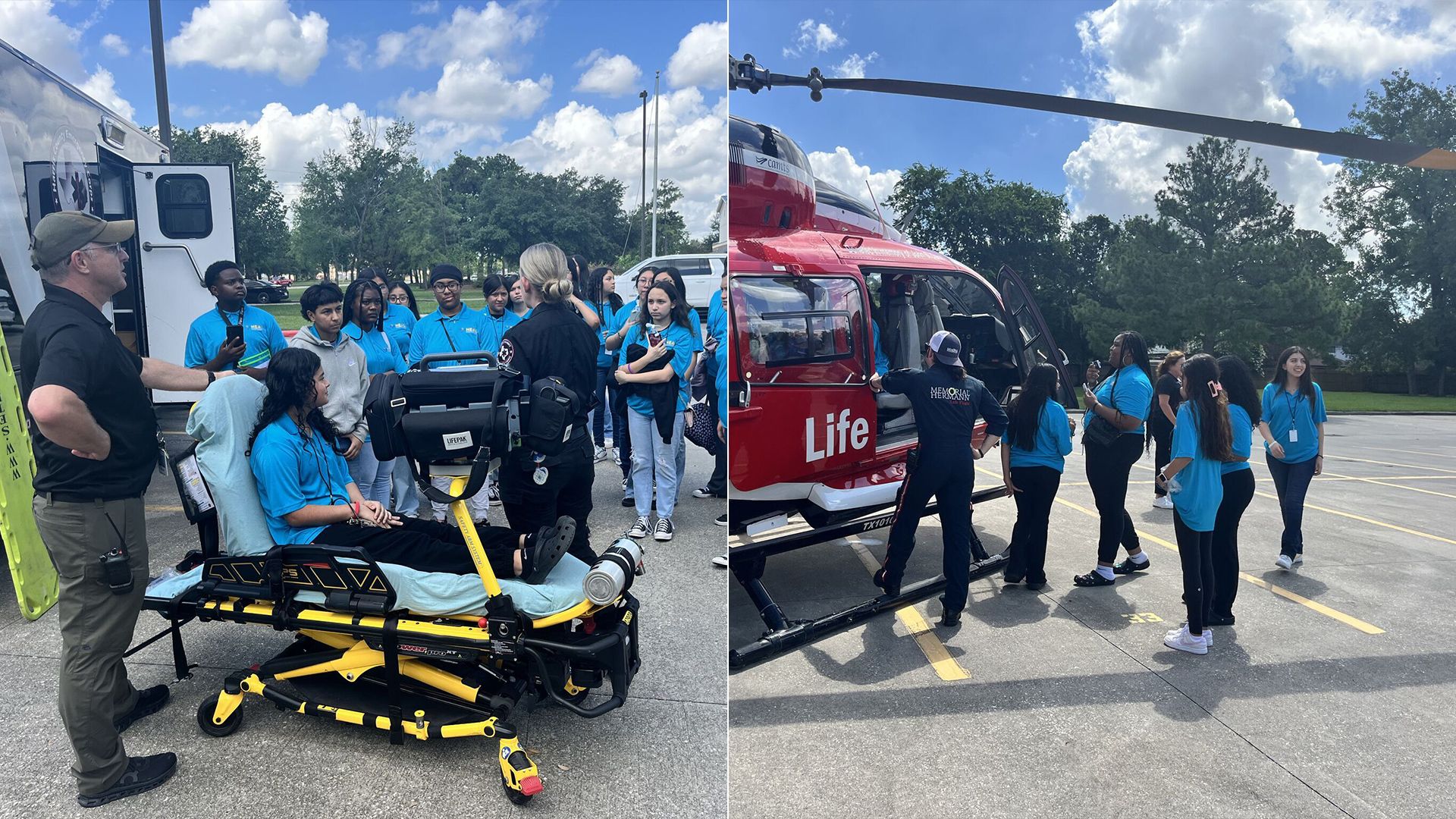
Incoming ninth graders at Health Education and Leadership High School in Houston learn about health care equipment. Photos: Courtesy of Memorial Hermann Health System.
A fix to chronic health care worker shortages could be taking shape in some high schools across the country.
Why it matters: Vocational programs immerse students as early as the ninth grade in local health systems, hoping to create a career path for a new generation of pharmacists, lab techs, and nurses right out of high school.
Driving the news: In Houston, a new partnership between Memorial Hermann Health System and Aldine Independent School District launched its first class of ninth graders.
- The Health Education and Leadership High School is one of four such programs opening this fall with backing from Bloomberg Philanthropies.
- Students will specialize in disciplines such as nursing, physical therapy, medical imaging, pharmacy, or health care administration. They'll have opportunities to volunteer, eventually take paid part-time jobs at the health system and earn credit toward certification, said Brian Sisk, Memorial Hermann's senior vice president and chief nursing executive.
Where it stands: Bloomberg Philanthropies directed $250 million for 10 programs that will launch across the country over the next two years.
- The organization wanted to increase opportunities for students who don't necessarily want a four-year college degree while cultivating a talent pipeline for local hospitals, which are often the largest employers in town, said Howard Wolfson, education program lead.
- Some partnerships build on existing technical education programs. Charlotte-based Atrium Health partnered with the local school district to revamp a high school for health sciences.
- "Charlotte is growing, and we need to grow our healthcare workforce," said Kirstin Ashford, vice president of Atrium Health Foundation. "That's one of the biggest things that was attractive to us."
Zoom out: Other health industry players are also investing in high school students. Walgreens in February announced an effort to address pharmacist shortages through means including teaching high schoolers about careers in pharmacy.
- The federal government also gave a grant to the University of Arkansas for Medical Sciences last month to introduce ninth-grade students to data science and medical technologies like stethoscopes, ultrasound, infrared, and CT imaging.
Flashback: Technical education programs focused on health care have been around in the United States since at least the 1950s. But interest and investment tend to ebb and flow with workforce shortages, said Jean Moore, director of the Center for Health Workforce Studies at the State University of New York at Albany.
- "When shortages are extreme, people begin to say, 'Maybe we should start letting people know about opportunities early on."
- By 2036, the U.S. will be short more than 337,000 nurses, 88,000 addiction counselors, 62,000 physicians, and 5,000 pharmacists, according to the federal government.
Reality check: Preparing adolescents for health care jobs is important, but it's not a silver bullet to fixing America's health care staffing woes, Moore added.
- Other strategies could include more visas for medical workers from abroad and incentives for newly minted doctors and other professionals to live in outlying areas.
