What's next for Louisiana's National Guard deployment

Add Axios as your preferred source to
see more of our stories on Google.
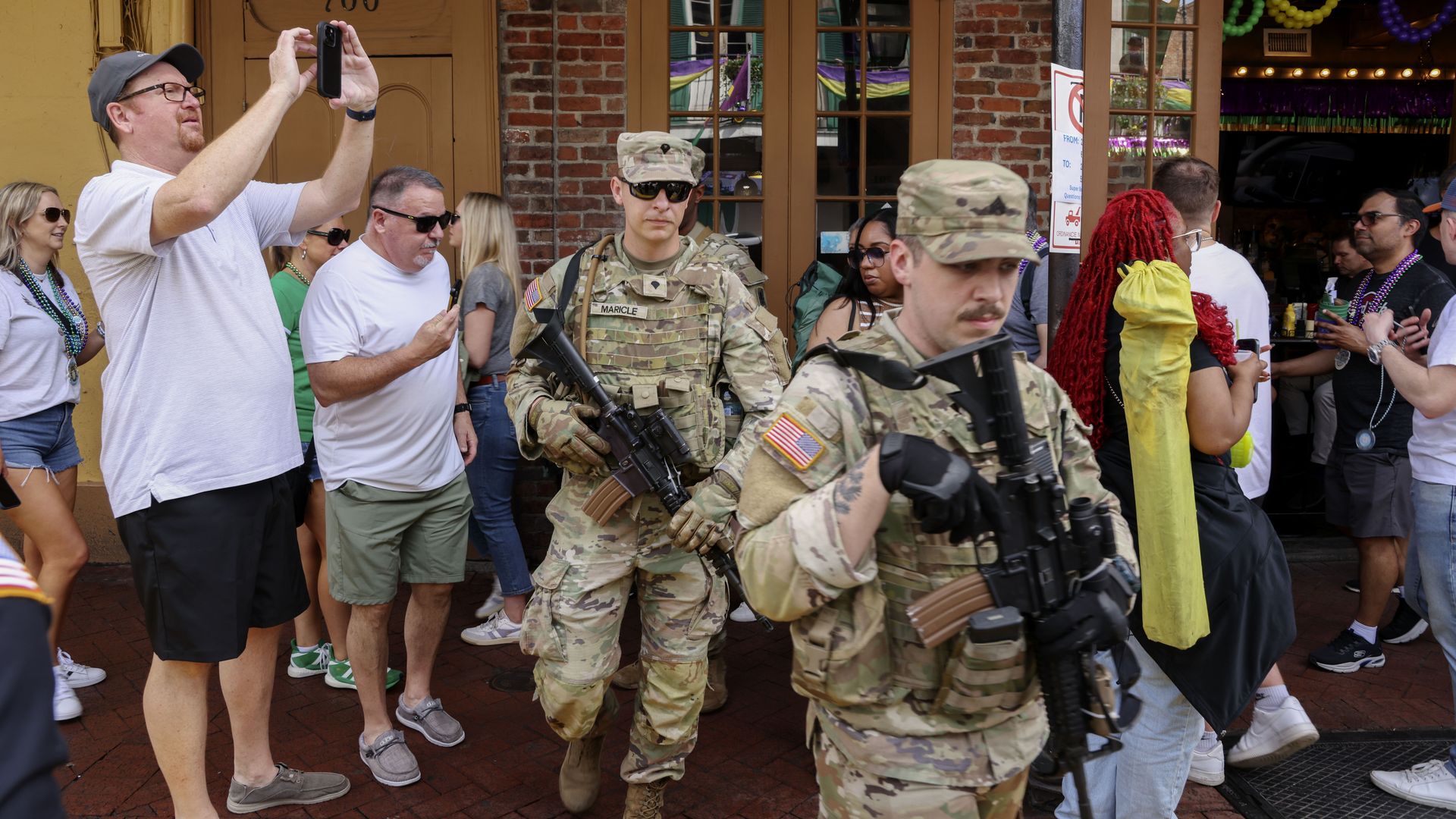
National Guardsmen were deployed in the French Quarter following the Jan. 1. Bourbon Street terror attack. Photo: Sandy Huffaker/Getty Images
Gov. Jeff Landry expects President Trump's approval on his Monday request for National Guard soldiers to bolster law enforcement throughout Louisiana.
Why it matters: If approved, the deployment would represent somewhat of a break from the resistance that has met Trump's eagerness to use federal troops elsewhere in the U.S.
The latest: FBI director Kash Patel met with Landry and Louisiana State Police Col. Robert P. Hodges in New Orleans on Tuesday, according to posts on X.
- Also Tuesday, Trump told top military officials that troops should view "dangerous" American cities as "training grounds." Go deeper.
The big picture: After saying for weeks that he would welcome a National Guard deployment in Louisiana, Landry made his request Monday.
- The Trump-backed plan, which Trump frames as a means of handling high crime in primarily Democrat-led cities, began in Washington, D.C., where locals heavily resisted the deployment.
- Other cities and states, like California, Chicago and Portland, Oregon, have been similarly unreceptive to the arrival of federal troops.
Yes, but: Landry has instead rolled out the welcome mat.
- "Who would not want help in combating criminals on your streets?" Landry pressed during a Monday appearance on Fox's "Hannity," during which he announced he'd made the formal request for National Guard troops. "Who does not want their communities in their cities to be safe?"
- Landry went on to take credit for New Orleans' drop in violent crime since he took office, attributing it to his deployment of National Guard soldiers during Super Bowl LIX and Mardi Gras after the Jan. 1 terror attack.
Zoom in: Landry requested federal assistance to deploy up to 1,000 members of the Louisiana National Guard.
- That's just over 11% of the 9,000 or so service members who stand ready to deploy, Lt. Col. Noel Collins of the Louisiana National Guard tells Axios. The full enlistment roster sits at about 11,000.
- "We remain prepared to support once we're ordered," she says, adding that "this will not hinder our ability to respond to hurricanes or other emergencies."
The other side: While the official line from City Hall and NOPD has also been that any assistance would be welcome, NOPD assistant superintendent Hans Ganthier noted Tuesday that violent crime has been trending down in New Orleans since NOPD put "strategic plans" in place in 2023.
- Attributing that success to a national trend "takes away from the work of the men and women of the New Orleans Police Department," he said. "I know we have help as well, we have [Louisiana State Police] here, we have had the National Guard, and we collaborate with everyone, and we have prosecutors that do a good job."
- City Council leaders and mayoral hopefuls have decried a National Guard deployment. Go deeper.
The intrigue: In D.C., the National Guard was not authorized to make arrests, Axios' Mimi Montgomery reports.
- Instead, the service members detained people until local law enforcement arrived, broke up fights, assisted seniors, helped find a missing child, and even contributed to community beautification projects.
What we're watching: It's not yet clear whether the Louisiana National Guard could make arrests, as they have after emergencies like Hurricane Katrina, says Paul Rainwater, a retired Louisiana National Guardsman and former gubernatorial adviser.
- Some local leaders "want police to focus on high-crime areas so guardsmen can be deployed downtown to help deter crime," Rainwater says. "It also allows the National Guard to participate in intelligence gathering and communications that the local police force might not have either."
- As for now, "we don't have mission-specific requirements at this time," Collins says.