Dallas-Fort Worth's worsening air quality


Add Axios as your preferred source to
see more of our stories on Google.
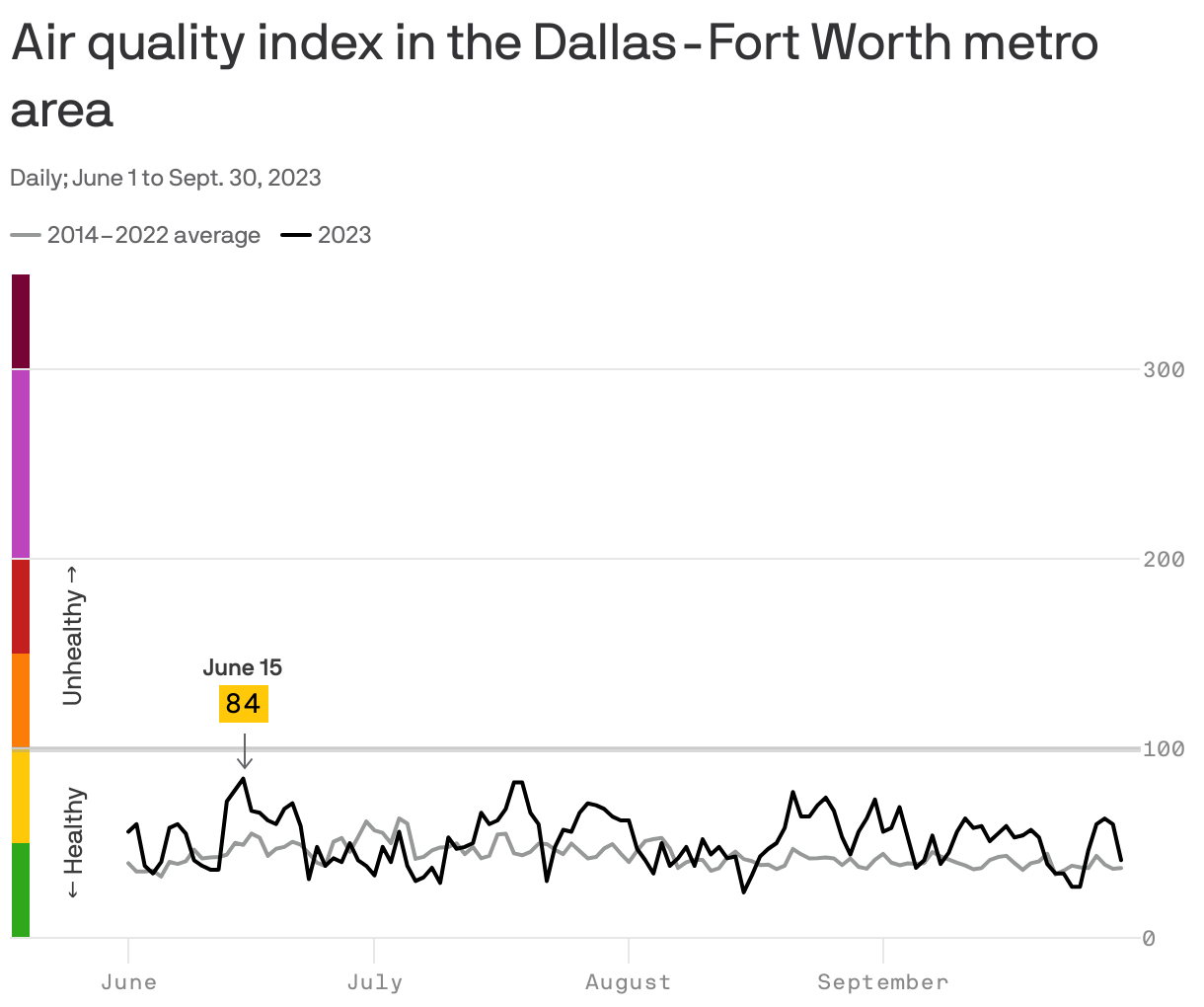
Overall air quality in Dallas-Fort Worth was worse this summer compared to previous years, in part because of Canadian wildfires.
Why it matters: Exposure to fine-particle pollution (PM2.5) from wildfire smoke irritates the throat and eyes.
- It contributes to long-term mortality by exacerbating heart disease and respiratory illness.
The big picture: The 2023 wildfire season more than doubled the previous record for fire-related air pollution in the U.S., Axios' Will Chase, Erin Davis and Kavya Beheraj report.
Threat level: The average American was exposed to 66% more air pollution than in 2021, the second-most polluted year, according to data from the Stanford Environmental Change and Human Outcomes Lab.
Zoom in: The average air quality index (AQI) in Dallas-Fort Worth was 51.9 between June and September.
- This is 1.2 times higher than the same time period in 2022.
Of note: The air quality index is based on fine-particle pollution, ozone levels and other gases.
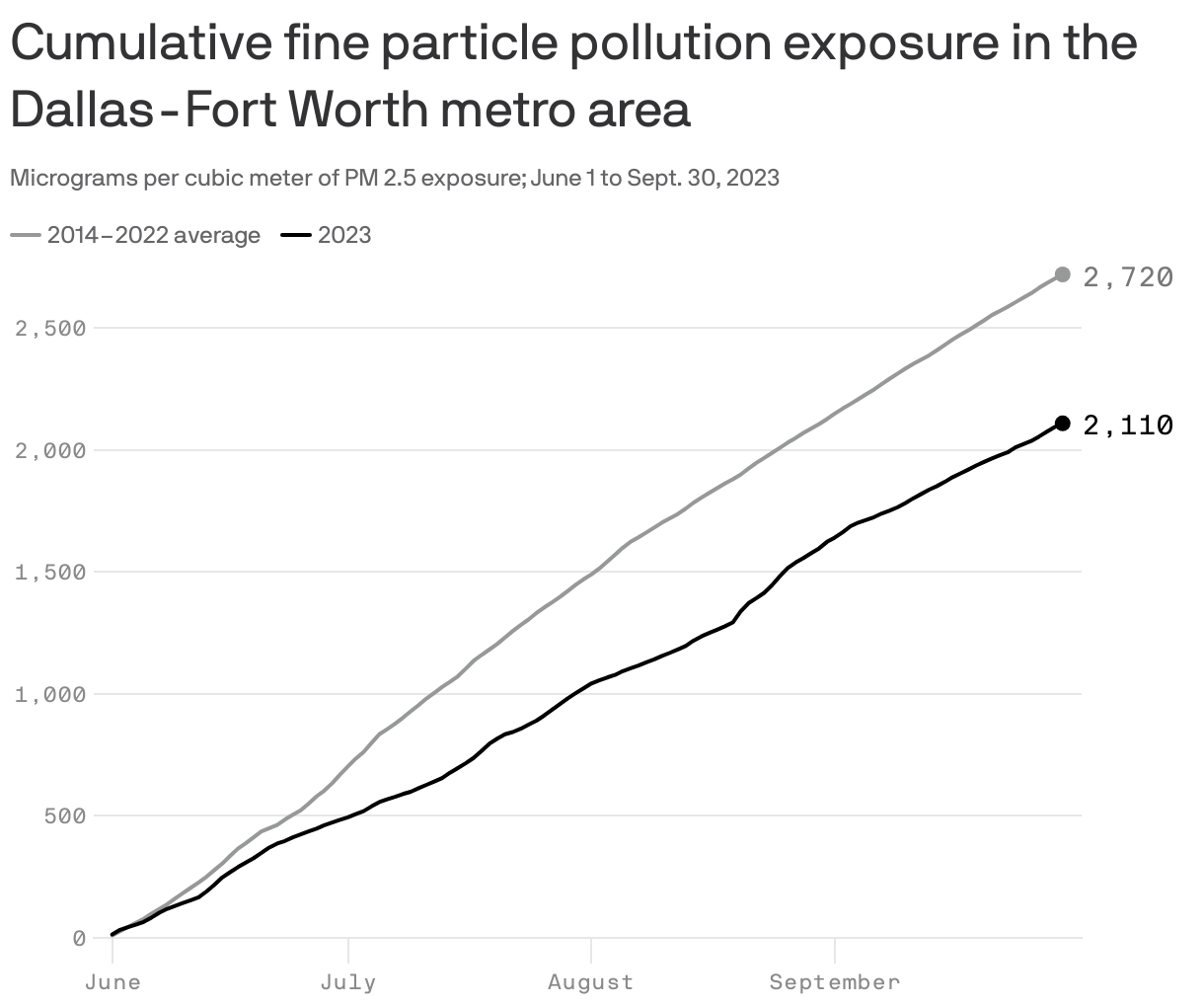
Yes, but: Overall, the Dallas-Fort Worth region's fine-particle pollution was lower this summer compared to the average of the previous eight years.
- Between June and September, D-FW residents experienced 2,110 micrograms per cubic meter of fine particle pollution, down from the 2,720 average between 2014 and 2022.
Reality check: This has the equivalent effect on your health as smoking 96 cigarettes.
Go deeper: How Canada's wildfires devastated U.S. air quality