Illinois Republicans face fundraising crisis after 2026 midterm losses

Add Axios as your preferred source to
see more of our stories on Google.
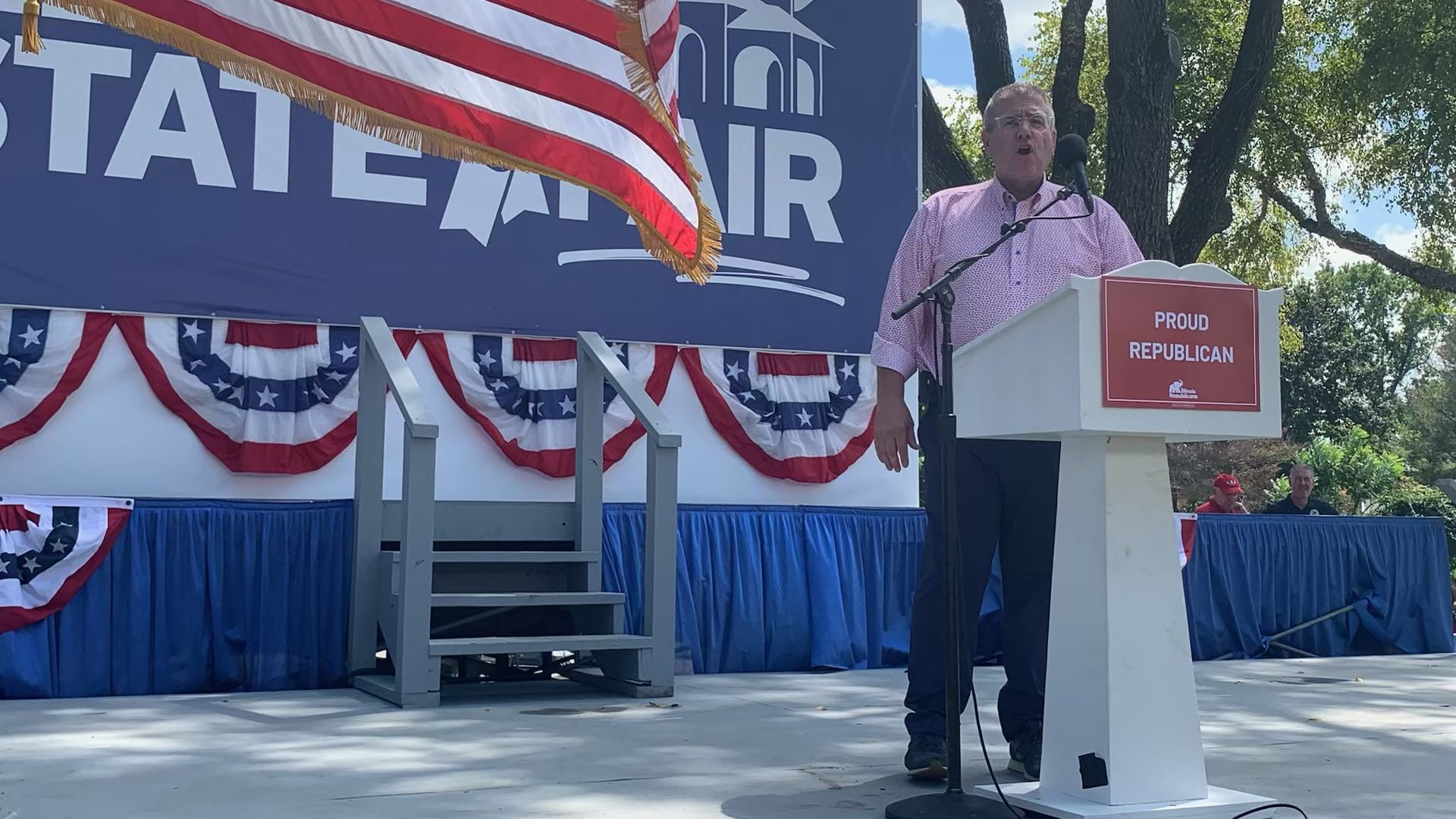
GOP gubernatorial candidate Darren Bailey speaks at the Illinois State Fair in August. Photo: Justin Kaufmann/Axios
Illinois Republicans are licking their wounds after getting drubbed in the midterms, a defeat many GOP donors apparently saw coming long before Election Day.
Why it matters: The party that once dominated Illinois politics is struggling not only to win elections but also to attract the wealthy donors who once bankrolled its campaigns.
Case in point: Conservative megadonor Richard Uihlein, who poured more than $50 million into Republican Darren Bailey's 2022 campaign and an allied political action committee, contributed just $6,900 directly to Bailey this time around.
By the numbers: Bailey entered the final month of his unsuccessful campaign against Gov. JB Pritzker with about $432,000 in the bank, compared with Pritzker's $44.4 million.
- That's not a typo. That's a nearly $44 million difference.
- Bailey raised about $1.2 million in the third quarter, while Pritzker spent nearly $24 million during the same period.
The big picture: Longtime Republican pollster Rod McCulloch says the party's traditional donors have grown weary of pouring millions into losing campaigns.
- "The donor class of the Republican Party decided some time ago that Illinois was a lost cause," McCulloch said on the "Crisis Cast" podcast.
- He pointed to major Republican investments in Richard Irvin's unsuccessful 2022 gubernatorial primary campaign and Paul Vallas' losing 2023 Chicago mayoral bid as examples of donors getting burned.
- McCulloch said some of those same donors continue to spend heavily in other states while largely sitting out Illinois races.
Zoom in: McCulloch attended a Republican gathering in Dallas, where Bailey and running mate Aaron Del Mar sought to connect with potential financial backers.
- McCulloch said national donors appeared just as skeptical about investing in Illinois as local contributors.
- "They really have to start from scratch," he said.
Flashback: Before President Trump's first term, Republicans held the Illinois governor's office and a U.S. Senate seat. Both flipped to Democrats during his first term and have remained in Democratic hands since.
- Republicans have also lost ground in Chicago's collar counties. The party has struggled to translate Trump's political movement into statewide victories.
What they're saying: Del Mar, who serves as Cook County Republican Party chair, acknowledges the party needs to rebuild its fundraising operation but says wealthy donors also bear some responsibility.
- "You can't build a competitive statewide organization if the people with the resources to help only show up when victory looks certain," Del Mar tells Axios.
- He says Republicans need to rebuild donor relationships, invest in infrastructure and develop candidates earlier rather than starting over every election cycle.
Reality check: Illinois GOP chair Bob Grogan has acknowledged that Republicans relied too heavily on a handful of wealthy contributors, telling Capitol News Illinois in July that the party needed to build its organization rather than simply raise more money.
- "[W]e are not like one really smart consultant away from winning back the suburbs or getting out of the superminority," he said.
What's next: The party launched a recurring small-donor membership program earlier this year.
The bottom line: With the 2028 presidential election approaching, Republicans face questions about how to rebuild their brand, recruit candidates and convince donors that Illinois is worth the investment.
- "You can't win elections you're unwilling to invest in," Del Mar says.