City Council to crack down on bike lane parking

Add Axios as your preferred source to
see more of our stories on Google.
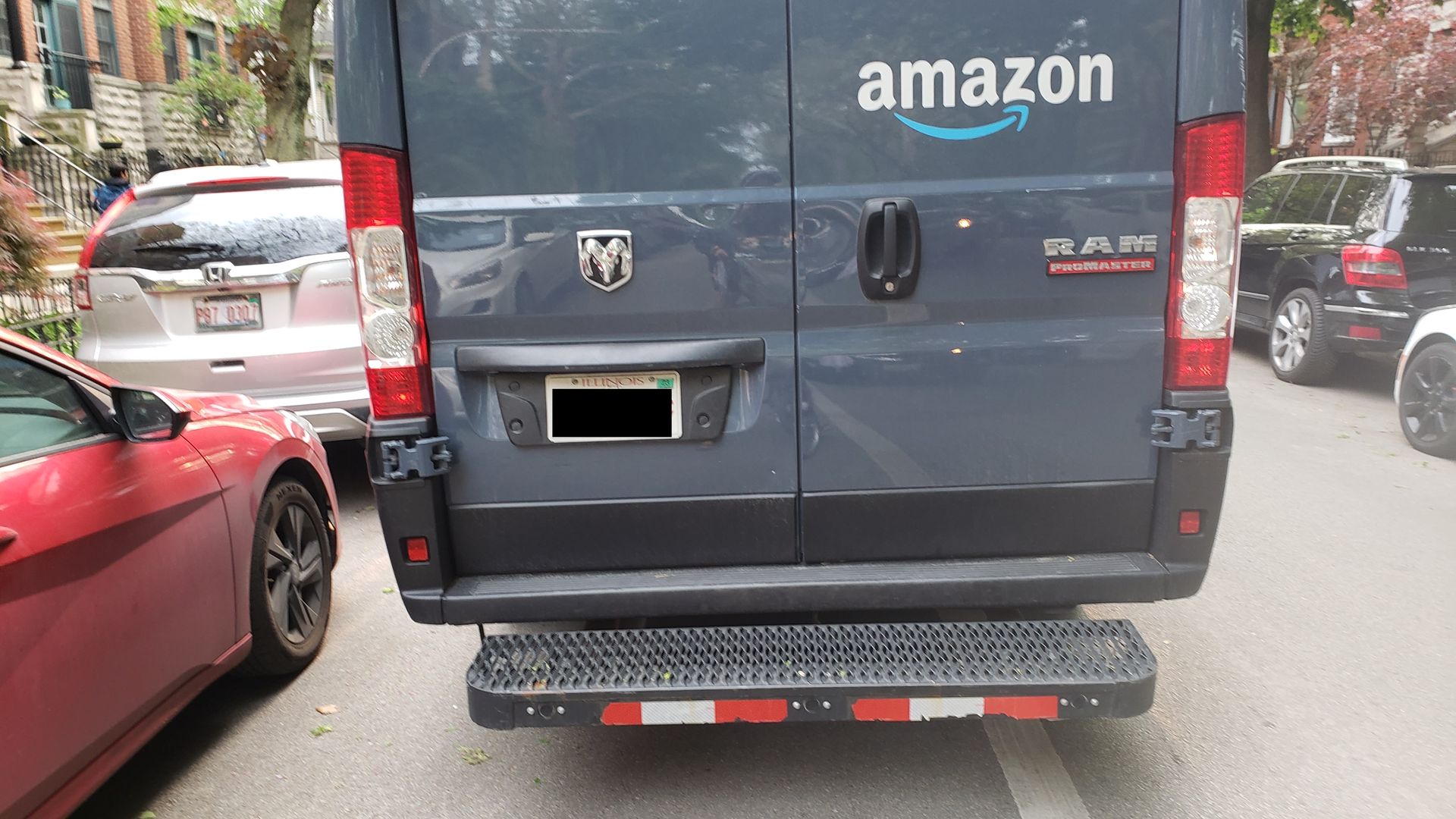
Amazon truck parked in a bike line on a Chicago side street. Photo: Monica Eng/Axios
Double-parking in Chicago is about to get a lot riskier under an expected expansion of the city's Smart Streets pilot program.
Why it matters: The program, which uses cameras on CTA buses to help ticket people parked in bus and bike lanes, is aimed at speeding up bus service and protecting cyclists in the wake of obstructed bike lane-related deaths including toddler Lily Shambrook's.
- Its expansion is likely to please traffic safety advocates and annoy delivery drivers and double-parkers.
State of play: The City Council is scheduled to vote on a citywide Smart Street expansion Wednesday.
- With more than 30 co-sponsors already on board, the measure is widely expected to pass.
Catch up quick: In fall of 2024, the city launched a two-year Smart Streets pilot bounded by Roosevelt, North and Ashland.
- First offenders got a warning but second-time citations cost $90 for bus lanes and $250 for bike lanes.
- City vehicles in the program can also gather photos for meter violations.
By the numbers: As of May 2026, the city had issued 16,802 citations for illegal bus or bike lane parking, equaling $2.6 million in fines. Vehicles linked to Amazon, FedEx or UPS paid $460,000 of those fines, according to a Tribune analysis.
Between the lines: While the council move might seem like a cash grab, Ald. Daniel La Spata (1st) notes that 84% of drivers who received warnings never got an actual ticket and 64% of those who got a first ticket never got a second.
- "This is even better for compliance than revenue, and I think that's what Chicagoans want from us," La Spata tells Axios.
The other side: While no alders at last week's traffic safety committee meeting objected to enforcement expansion, Alds. Brian Hopkins and Jason Ervin urged robust public notification before the stepped-up enforcement.
Follow the money: Revenue projections for 2027 suggest the city will net $6.1 million from an expected 207,000 tickets.
- When the rollout is finished in December 2028, city officials expect it to cost $7.4 million and operate along 363 miles of bike lanes, or less than 10% of Chicago streets.
- The CTA is currently operating 52 cameras but can increase them to 100.
What's next: If passed Wednesday, Smart Streets enforcement would stretch to Foster, California and Pershing by mid-2027; to Devon, Pulaski and 51st by December 2027; and to the rest of the city by the end of 2028.
Editors note: A previous version of this story incorrectly said some Smart Street cameras are on stationary poles but they are still being considered.