Advocates race against clock to stop medical-aid-in-dying law

Add Axios as your preferred source to
see more of our stories on Google.
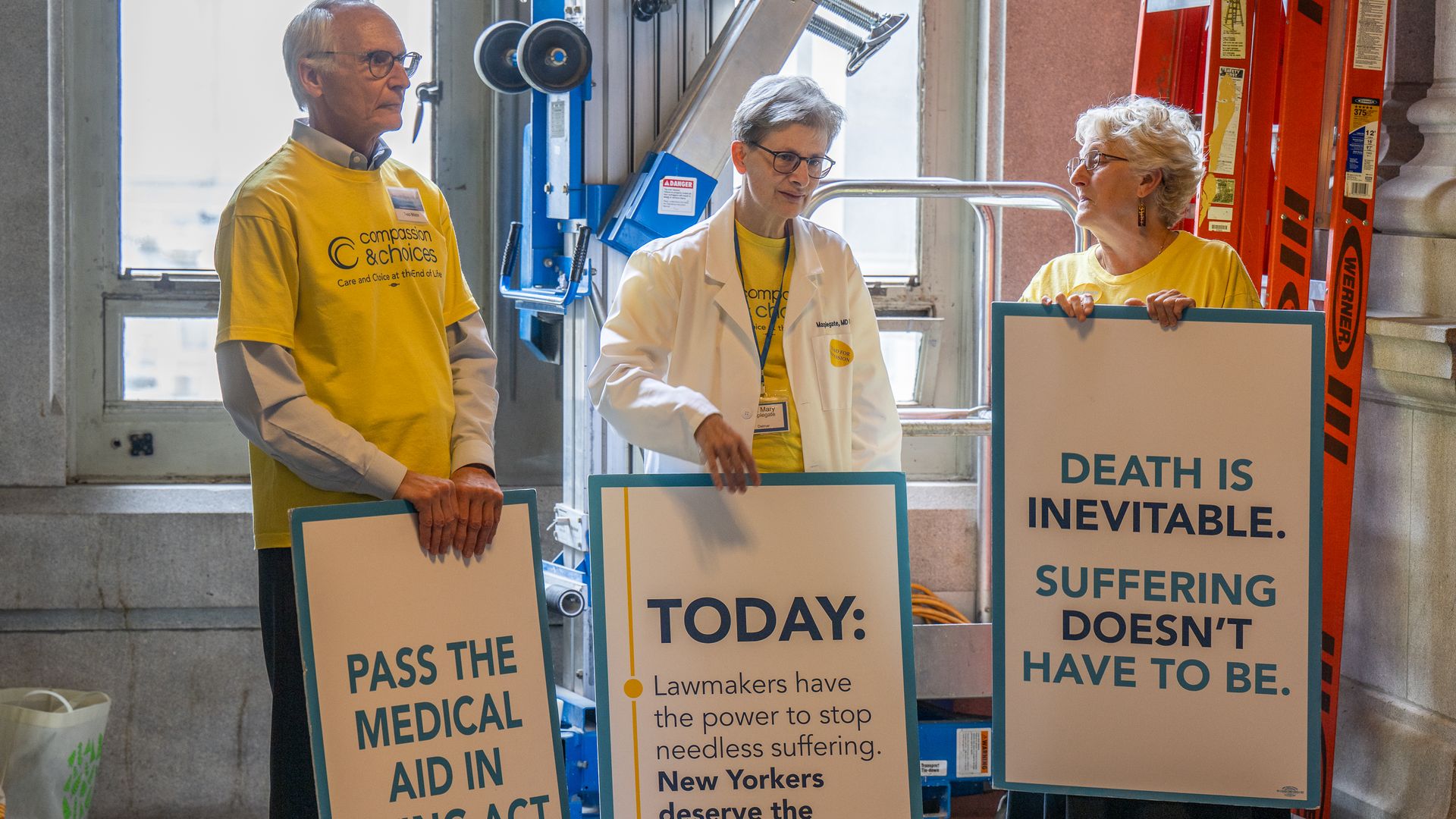
Advocates for the Medical Aid in Dying Act in 2023 in New York. Jim Franco/Albany Times Union via Getty Images
Legal challenges to Illinois' medical-aid-in-dying law are coming down to the wire as the law is set to go into effect Saturday.
Why it matters: A federal judge denied disability rights advocates' motion to block the state's new law, but some are still fighting it on religious grounds.
Catch up quick: Two people with life-threatening disabilities, Ebony Payne and Pam Heavens, joined disability rights organizations and a doctor in suing Gov. JB Pritzker in June.
- They said the new law opens the door for individuals' disabilities to be considered life-threatening when they may not be and could cause health care professionals to encourage patients to end their lives.
The latest: U.S. District Judge John J. Tharp Jr. of the Northern District of Illinois on Thursday denied the plaintiffs' motion for an injunction.
- Tharp ruled that the plaintiffs failed to establish they have a future injury traceable to the law's implementation and that they did not demonstrate irreparable harm without an injunction.
The other side: "As someone with disabilities, I am disappointed that it removes the duty of physicians in Illinois to 'do no harm' and sets up a system where a physician can assist in killing a patient without oversight or accountability," plaintiff Ebony Payne told Axios in a statement.
- "The judge gave our legal team 30 days to show why the case should not be dismissed, and I plan to work with them in seeking justice to stand up for my rights and the rights of other vulnerable patients."
Earlier this month, Chicago Archbishop Cardinal Blase Cupich and a group of Catholic nuns also sued Illinois officials over the law, arguing it violates their religious beliefs.
- A status hearing on that case is set for November.
- A group of physicians and Catholic Church leaders filed a separate lawsuit last month and were granted a temporary restraining order, barring state officials from penalizing the plaintiffs for refusing to discuss medical-aid-in-dying care with patients while the case continues to play out in court.
Zoom in: Pritzker signed the bill, also referred to as "Deb's Law," in December 2025.
- Qualified patients must have a terminal illness that will result in death within six months, as determined by two doctors, be informed of all their end-of-life options, and make written and oral requests to receive the aid-in-dying medication.
- They must have the mental capacity, confirmed by their physician, to make medical decisions.
- Deb's Law makes it a felony to coerce another person to medically end their life.
No physician, health care provider, or pharmacist is required to participate in aid-in-dying, but they must inform patients of all end-of-life care options.
Zoom out: Medical aid in dying is legal in 13 states and Washington, D.C.
Editor's note: This story has been updated with a comment from Ebony Payne.