What to know about Chicago's tipped wage debate

Add Axios as your preferred source to
see more of our stories on Google.
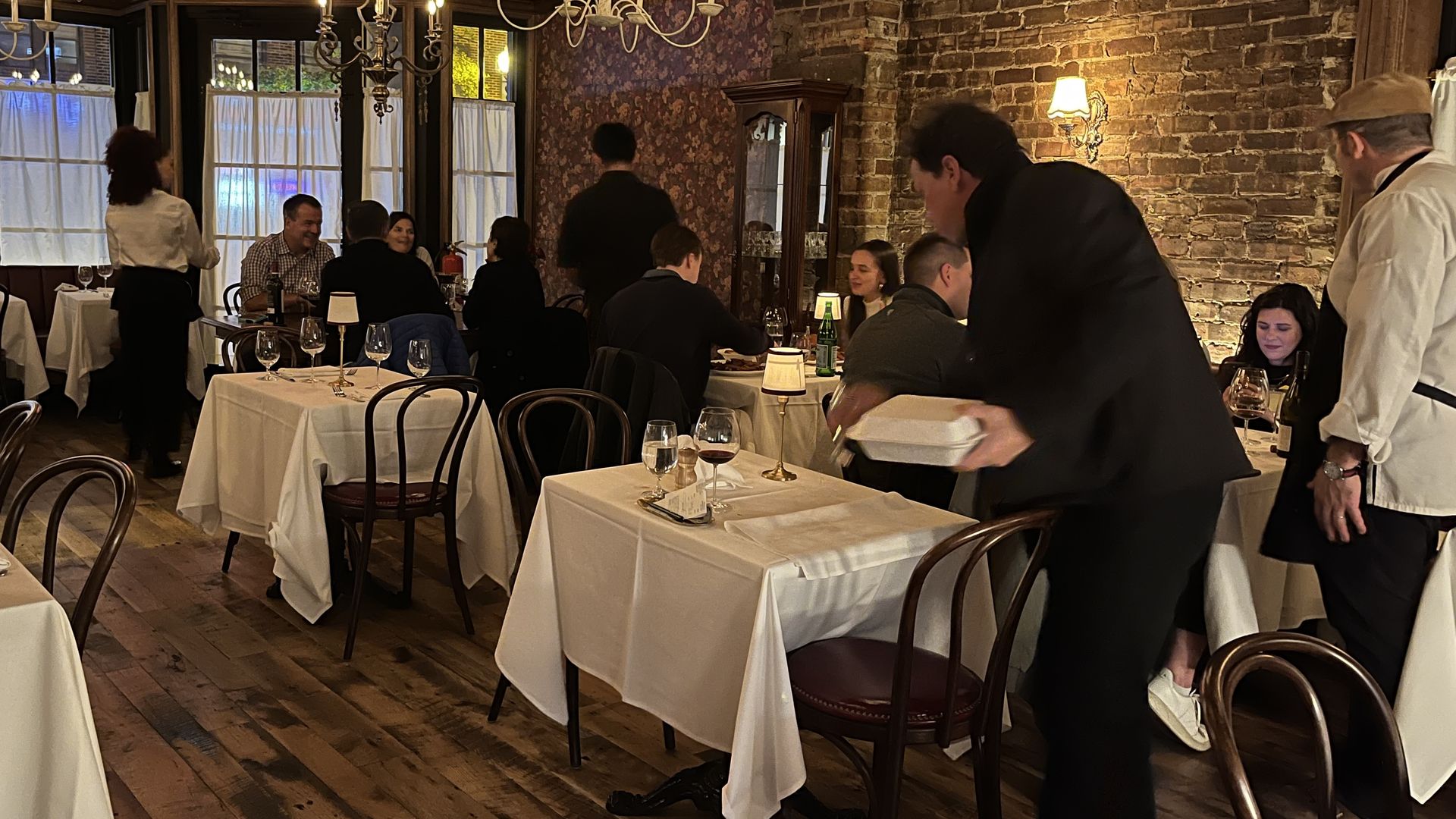
Servers work the room at a restaurant in Lincoln Park. Photo: Monica Eng/Axios
Chicago Mayor Brandon Johnson last month blocked a City Council decision to pause scheduled increases in the city's tipped minimum wage.
Why it matters: The veto keeps wage hikes moving forward, with ripple effects for workers' paychecks, restaurant costs and menu prices.
The big picture: For decades, the service industry has operated under a two-tiered system in which tipped workers get paid a lower "subminimum" base wage before tips.
- In 2023, the City Council voted to gradually raise the subminimum wage (currently $12.62) until it reaches parity with the regular minimum wage, ($16.60) by 2028.
What they're saying: Ald. Sam Nugent (39th) told Axios 30 Council members voted to slow the wage increase because of "the devastating impacts it's having on both our neighborhood restaurants and workers — people are losing jobs, they're getting hours cut and restaurants are closing."
The other side: Johnson said he vetoed the measure to protect workers and to fight attempts to undermine them.
Between the lines: Both sides cite figures to defend their case.
- Johnson boasts that 83% of Chicago restaurants renewed their licenses over the last two years and that the city has issued 1,574 new licenses for retail food establishments, including convenience stores.
- The Illinois Restaurant Association (IRA) cites state data showing 3,300 year-over-year job losses in the leisure and hospitality industry in a period when all other sectors saw gains.
Driving the news: Supporters of the City Council's subminimum wage pause have nine days to find four more alders to join their side and override Johnson's veto at the City Council's April 15 meeting.
- But the issue is so complicated, with so many moving parts, that diners and politicians could be forgiven for not grasping it all. So we've broken it down into some basic data points and questions.
Big questions:
Will bringing the wages to parity create a net gain for servers? That depends on whom you ask and where they work.
- The IRA says its surveys show 87% of servers like the current system, noting that employers already must make up the difference if servers' tips plus wages don't equal $16.60 an hour.
- Bronzeville Winery owner Eric Williams told the Sun-Times he's had to cut his servers from 10 to six in the wake of the hikes. IRA CEO Sam Toia told Axios to expect more restaurants to do the same.
- Plus, this year, Illinois workers can declare up to $25,000 in tips tax-free on their federal filings.
Will Chicagoans tip less in the wake of wage parity?
- The IRA notes that California, which achieved parity decades ago, reports the lowest tip averages in the nation at 17%, while Illinois stands at 19%.
- In an unscientific Axios Chicago poll, 28% of respondents said they'd already started tipping differently six months into the city's wage hike.
- Reps for the national One Fair Wage campaign, which pushed Chicago's parity law, note that the tipping system has roots in slavery, but they don't discourage tipping.
Zoom out: Subminimum wages fluctuate drastically across the country, with hourly rates as high as $17.13 in Washington state and $16.90 in California, but just $2.13 in Indiana and eight other states.
What's next: If Johnson's veto survives next week's council meeting, Toia says he'll set his sights on Illinois House Bill 4263, which would regulate the issue at the state level.