Downtown Chicago rarely sees curfew enforcement

Add Axios as your preferred source to
see more of our stories on Google.
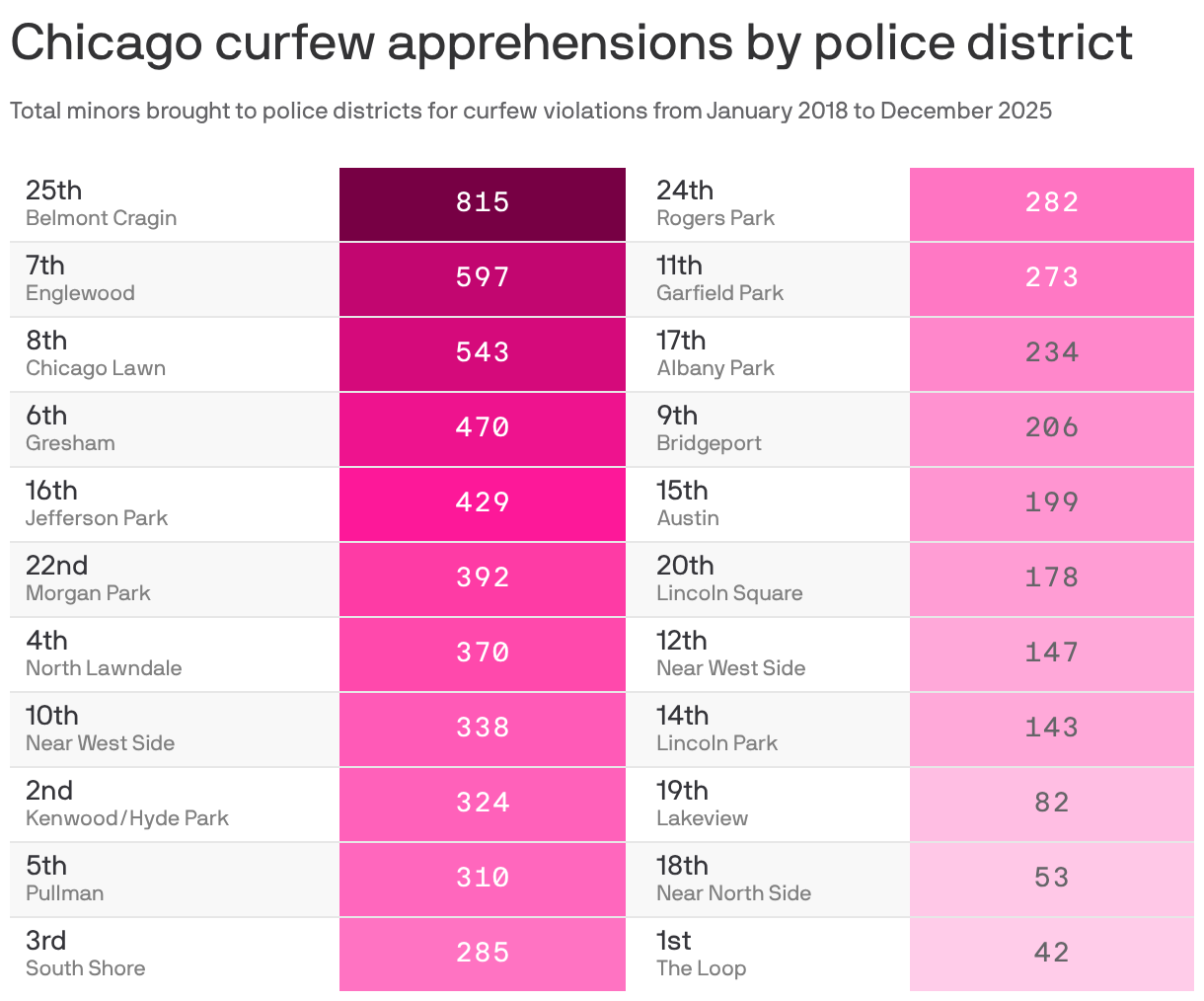
Over the last year, the Chicago City Council has spent hours debating the need for tighter curfew laws to address teen "takeovers," largely in the Loop and downtown.
Why it matters: Opponents have warned that earlier curfews would just boost, what they assumed were, already frequent apprehensions by downtown police.
- But downtown curfew apprehensions remain rare.
Reality check: Chicago police pick up fewer youths for curfew violations in downtown and the Loop than in any other district of the city.
- On average, Loop police have made just five curfew apprehensions a year since 2018, according to CPD data Axios obtained through open records laws.
- By contrast, police in the 25th district that covers the largely Latino Belmont-Cragin area, picked up more than 100 minors a year for curfew violations.
What they're saying: "It completely destroys the false narrative that the curfew ordinance is motivated by a desire to keep teenagers from coming downtown, something opponents have inaccurately claimed," downtown alder and curfew ordinance sponsor Brian Hopkins tells Axios.
How it works: Under Chicago curfew laws, police can ask minors to disperse after 10pm. If the youths refuse, police can take them to the nearest police district, where they must be picked up by a parent or other responsible adult.
- This apprehension is not considered an arrest. No mug shot. No fingerprints. No record.
- While police can levy curfew fines of up to $500, Hopkins doesn't believe it's ever happened. CPD told Axios to file a FOIA for a definitive answer. So we did, but haven't heard back yet.
The latest: Hopkins' still-evolving ordinance would allow officials to call a curfew 30 minutes before enactment and requires consultation between the city's top cop and a deputy mayor.
- The full City Council is expected to vote on it next week.
- Meanwhile, officials have charged a 17-year-old in the mass shooting that occurred in front of the Chicago Theater last November.
Between the lines: Hopkins says downtown numbers remain low, in part, because many teens come there for jobs or ticketed events, which exempt them from curfew rules.
- Ald. Gilbert Villegas says the high numbers in his Belmont-Cragin community are due to the smaller groups of kids who might be out after curfew.
- These smaller groups are "easier to pick up versus downtown groups where there might be 150 or 200 people, making it harder to manage."
The intrigue: While CPD records don't include the race of curfew apprehendees, data shows enforcement strongest in majority Latino and Black neighborhoods, but also in largely white Jefferson Park.
- Meanwhile, majority Black Austin showed one of the lowest curfew enforcement rates.
Monica's confession: In 1984, while foolishly attending a Loyola University frat party near the beach, I was picked up by CPD for a curfew violation, and was shoved into the back of a squad car.
- I don't remember any dispersal warnings, but I do recall finding my kindergarten best friend (who'd switched schools) in the back seat, weeping.
- We sat in the police station catching up until my angry mom arrived to drive us home.
- She gave us an earful in the car, and anytime I tried to explain, mom accused me of "having diarrhea of the mouth." Not fun. And I didn't violate curfew again.
What's next: The council is expected to vote on the latest curfew proposal on Feb 18.