Chicago tests just 0.01% of homes for lead in water

Add Axios as your preferred source to
see more of our stories on Google.
Illustration: Sarah Grillo/Axios
Elgin officials recently found high levels of lead in the water of 70% of the homes they tested, prompting the western suburb to give filters to residents whose homes are connected to lead lines.
Why it matters: Elgin found these dangerous lead levels by testing 101 homes, or about 0.25% of the suburb's households.
- Chicago tests a much smaller percentage of its homes — 0.01%. To reach Elgin's ratio, the city would have to test about 2,800 homes every six months, not the 100 it tests today.
- Elgin has an estimated 8,094 lead lines, while Chicago has more than 400,000.
Driving the news: Chicago Department of Water Management officials told Axios they have no intention of increasing their sample size, but this week Mayor Brandon Johnson told Axios that he believes "we should test all over the city."
Catch up quick: Despite well-documented flaws in its methodology, Chicago had for decades verified the safety of local water by testing just 50 homes every three years. Most of those 50 homes were owned by current and former city workers who lived on the far Northwest and Southwest sides.
- Compelled by new federal rules, the city doubled its sample size last year to 100 homes, but participants still skew heavily toward city workers in affluent neighborhoods with low incidents of childhood lead issues, according to a new Axios analysis.
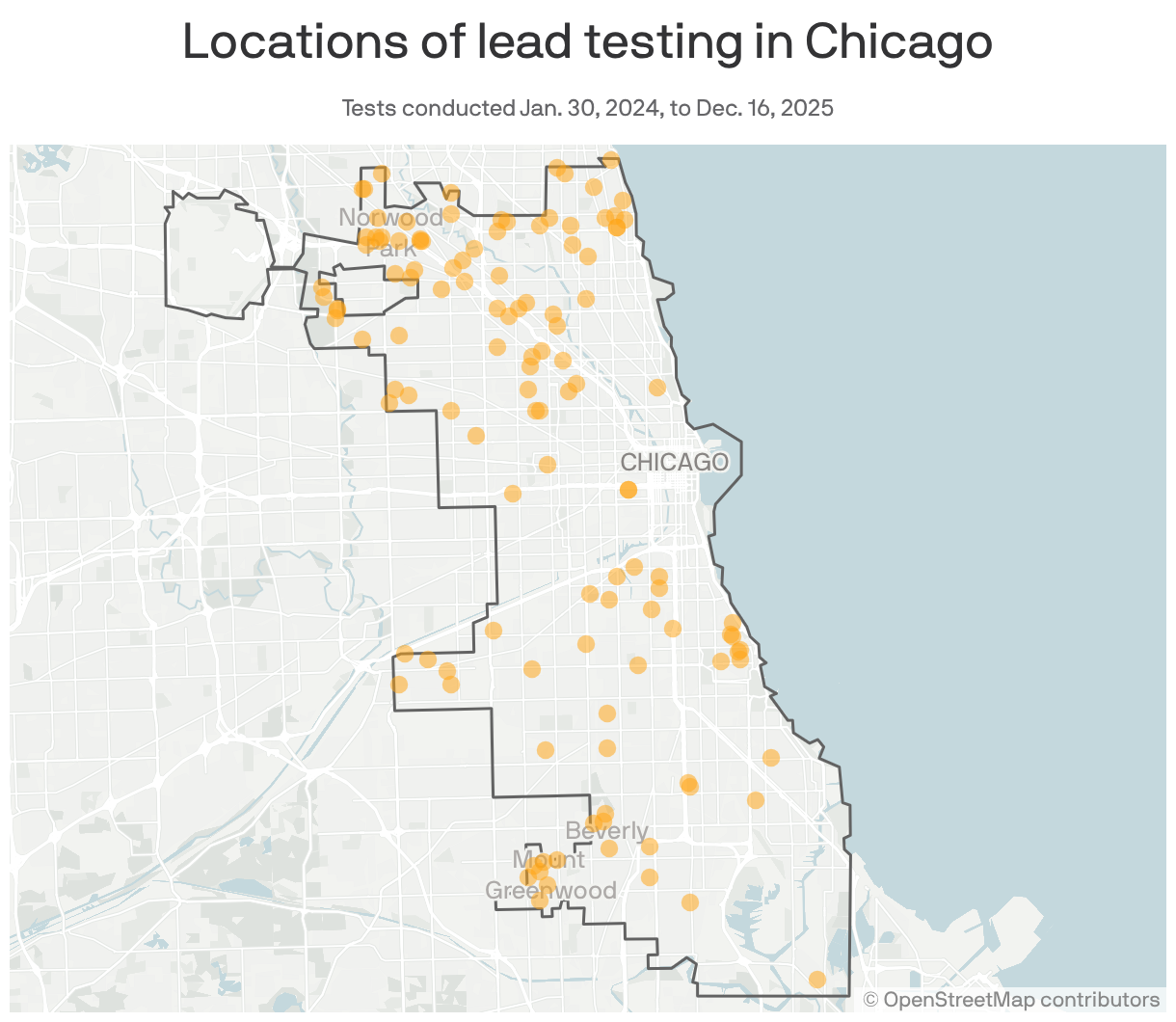
By the numbers: A little more than half the city's current samples — 39 on the far Northwest side (including Norwood Park, Dunning and Jefferson Park) and 12 on the far Southwest Side (Mount Greenwood and Beverly) — come from neighborhoods with the lowest incidents of children with high lead levels in their blood.
- By contrast, neighborhoods with the gravest childhood lead issues — including Englewood, Auburn Gresham, Greater Grand Crossing, Austin and Pullman — each have one or zero homes included in the water department sampling pool.
Friction point: Water management officials continue to defend their sample size, saying, "Statistically, there is no benefit going beyond 100 homes for a compliance pool," because results change little "once the pool gets beyond 50 homes."
- City water officials base this on internal data, which they have not subjected to external scientific review.
The other side: "It is not appropriate to generalize a 'diminishing returns' rule for sampling efforts from the results distribution of one system," water engineer Elin Betanzo told Axios. "If they intend for this analysis to serve as the technical basis for establishing a maximum sample size going forward, the appropriate path would be to subject it to external scrutiny."
- Virginia Tech professor Marc Edwards concurs and pointed Axios to his research showing that a system like Chicago's would need to take hundreds or even more than 1,000 samples to get an accurate picture of the city's water risk.
What's next: Axios is waiting for water officials to share the results of their latest tests, which, they say, show that fewer than 10% of samples delivered more than 9.4 parts per billion of lead.
- For reference, bottled water with more than 5 ppb would be illegal to sell, but federal law allows up to 10% of sampled tap water to have up to 15 ppb, a number that will drop to 10 ppb in 2027.
Be smart: If you live in a Chicago home that is smaller than a six-flat and was built before 1986, you likely have lead service lines.
- Find tips for reducing your lead exposure here.