Some Chicago residents want to pause delivery robots

Add Axios as your preferred source to
see more of our stories on Google.
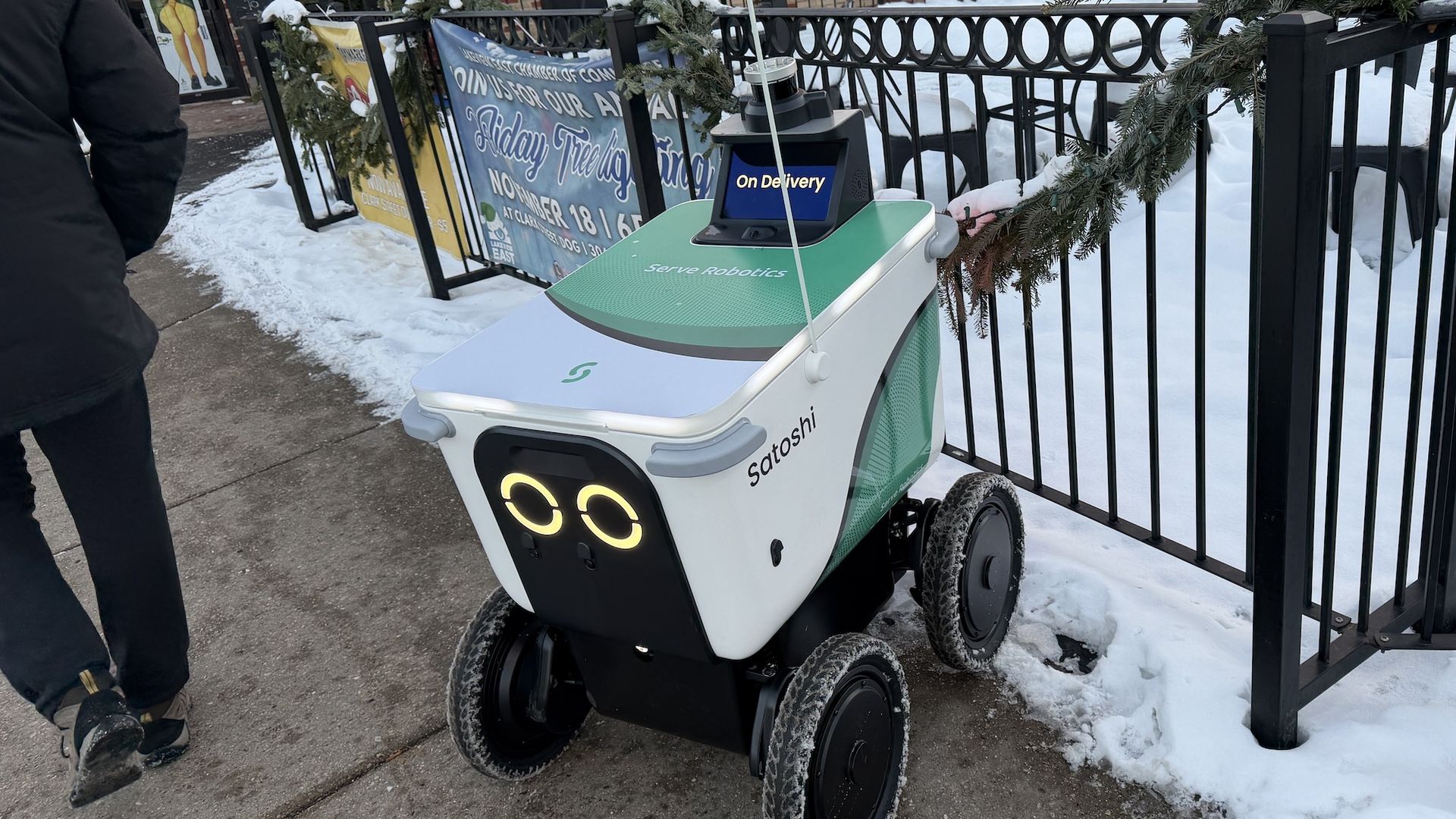
"Satoshi" in the snow. Photo: Monica Eng/Axios
Those cute boxes on wheels that whiz around sidewalks to bring you ramen and burritos are starting to wear out their welcome for some Chicagoans who think they're a safety hazard.
The big picture: Coco Robotics started operating in West Loop and Fulton Market last December, after former Mayor Lori Lightfoot introduced a Personal Delivery Device (PDD) pilot program in 2022.
- Serve Robotics launched in September with a delivery area spanning 14 neighborhoods, including Dunning, Lakeview, Austin and Humboldt Park.
Driving the news: Josh Robertson started a petition asking the city to pause the robot delivery program until the city releases safety and ADA findings, hosts a public hearing and sets clear rules.
- "Chicago sidewalks are for people, not delivery robots," the petition says.
- More than 2,350 people had signed it and over 350 submitted incident reports as of Dec. 8, the petition's website reports.
What they're saying: "The Chicago Department of Transportation (CDOT) and the Chicago Department of Business Affairs and Consumer Protection (BACP) are assessing the benefits and risks of the PDD pilot program," BACP spokesperson Elisa Sledzinska tells Axios in a statement.
- "CDOT and BACP are monitoring the performance, including impacts on safety, mobility, use of sidewalks and crosswalks alongside pedestrians and local businesses."
Zoom in: Several alders are also gathering feedback about the robots in their wards. 46th Ward Ald. Angela Clay this week asked Uptown and Buena Park residents to share their thoughts and Ald. Bennett Lawson (44th) sent a survey last month.
- Ald. Bill Conway, whose West Side ward was the testing ground for PDDs last year, tells Axios, "My team and I have only received a handful of questions from residents since delivery robots like Coco launched in the 34th Ward, including concerns about sidewalk crowding. We continue to collaborate closely with neighbors and the delivery operators to monitor the situation and how these robots are working across our community."
The other side: "Our robots help replace the 2-ton cars on the roads that currently handle about 90% of last-mile deliveries. By reducing the number of vehicles on the road, we make streets safer for pedestrians, children, and cyclists, while also cutting congestion and emissions," Serve spokesperson Malory Van Guilder tells Axios in a statement.
- "Our mission remains to make local delivery safer, more sustainable, and more cost-effective for the communities we serve, and we are committed to continuing to operate responsibly and transparently," Coco Chicago general manager Sam Rogers tells Axios in a statement.
Fun fact: Each Serve robot has its own name, and even personality, according to Van Guilder. "We regularly have people contact us to name a robot after a loved one, and we try to make it happen when we can."
The intrigue: Turns out robots are a lot like humans when trying to navigate Chicago winters. Videos and photos of the little guys getting stuck have been circulating on social media, prompting some altruistic passerbys to lend a hand.
- Serve's robots will soon have snow tires, Van Guilder says, and Coco's are already "equipped with rugged snow tires and proper insulation/exterior to handle the roughest terrain," Rogers says.
What we're watching: Whether the full council will take action on delivery robots — the pilot program ends after May 2027 without council action.