
UChicago cuts jobs, pauses humanities PhD admissions

Add Axios as your preferred source to
see more of our stories on Google.
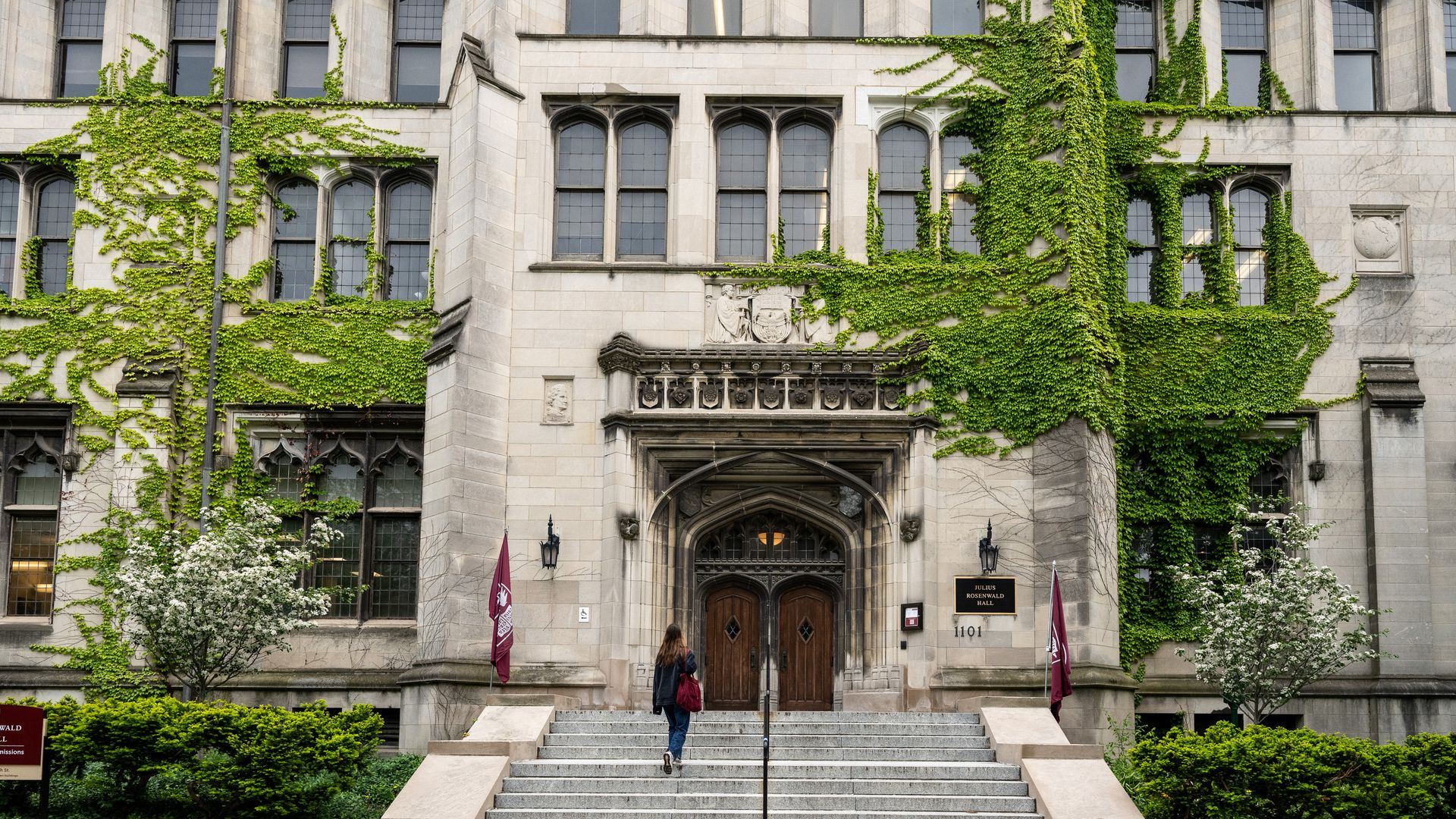
Rosenwald Hall at the University of Chicago campus. Photo: Christopher Dilts/Bloomberg via Getty Images
The University of Chicago announced a series of changes recently to help its financial future, and that has some alumni worried about its reputation in the academic world.
Why it matters: Despite not being an Ivy League college, UChicago is considered an intellectual haven for serious students, even earning the unofficial motto as the school "where fun goes to die."
- U.S. News and World Report ranked the UChicago No. 6 in its Best Colleges list released Tuesday.
The big picture: The university's decision to pause enrollment in some of its humanities graduate programs has some alumni accusing the administration of clearing a path for more AI learning that could lead to the extinction of some of the niche areas of study that attract students.
State of play: UChicago president Paul Alivisatos announced last month that the school will cut 400 employees and pause admissions to nearly 20 doctoral programs to save $100 million.
- That's part of the university's multi-year plan to balance the budget, which ran a $288 million deficit last year.
- Affected programs include social work, art history, English language and literature, romance languages and literatures, and several other language programs.
- Current graduate students in those programs will continue their studies.
What they're saying: "The PhD admissions pause is a temporary measure to help evaluate and strengthen doctoral programs in the face of rapidly changing job markets and the rising cost of doctoral education," UChicago spokesperson Gerald McSwiggan told Axios in a statement.
- "With uncertain academic job prospects in some fields, one of the University's goals is to increase the chances our PhD students leave UChicago with good academic jobs and beyond. Guided by faculty, the Arts & Humanities Division is building on its leadership in the field to create a vibrant pedagogical structure that is aligned with the latest faculty and student research."
The other side: Some alumni fear this decision indicates that the university is leaning into AI to replace some of its education.
- "While artificial intelligence dramatically amplifies our access to information and our ability to process it rapidly, it cannot replicate the wisdom, creativity and ethical reasoning nurtured by humanistic study," UChicago alumnus and Lake Forest College president Michael Sosulski wrote in an op-ed this month.
- Faculty have also called for a more transparent decision-making process that includes professors.
Critics of the move have also argued that humanities programs don't equate to the same financial demands that new science and technology labs do, for example.
Reality check: "No, we're not replacing instructors with ChatGPT (to name one strange rumor), and we're certainly not removing the arts and humanities from the center of academic inquiry," Deborah Nelson, dean of the Division of the Arts & Humanities at UChicago, wrote in a Tribune op-ed last week.
- "In any given year, we teach over 50 languages, far more than all but a few institutions — and that is not going to change."
What we're watching: How pausing graduate school admissions shapes undergraduate enrollment, which the university says is rising, and whether this change will have a permanent effect on UChicago's place as a destination for intellectuals.