30 years after Chicago's deadly heat wave, risks remain

Add Axios as your preferred source to
see more of our stories on Google.
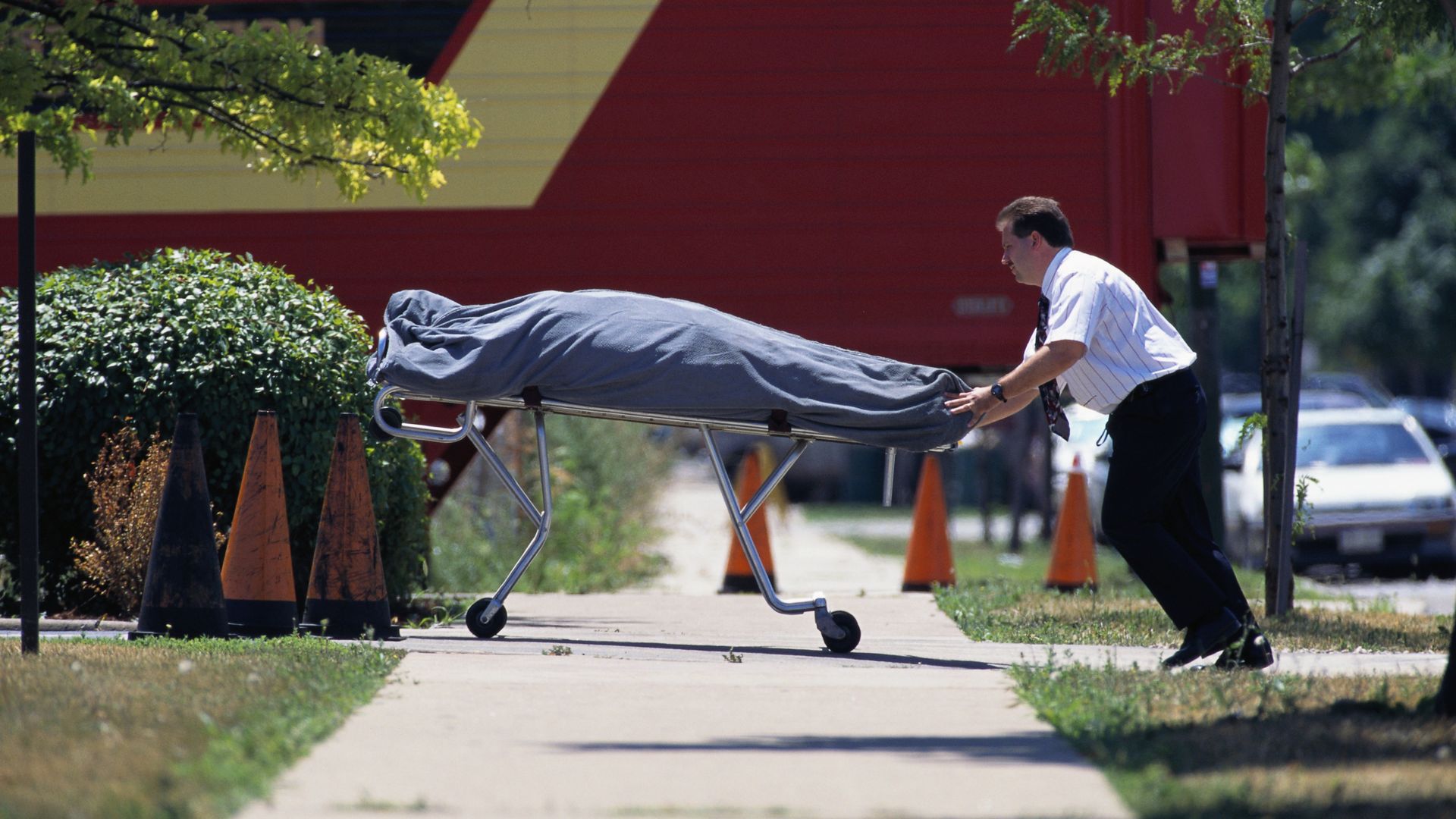
A worker moves bodies of heat wave victims into refrigerated trucks in 1995. Photo: Ralf-Finn Hestoft/Corbis via Getty Images
This week marks the 30th anniversary of the deadliest heat wave in Chicago's history.
Why it matters: Three decades later, elderly and low-income residents are still most at risk during heat waves, which are expected to worsen because of climate change.
Flashback: Beginning on July 12, 1995, temperatures in Chicago spiked over 100 degrees, and within a week, more than 700 people had died. The hottest days were July 13–14, when heat index values reached 115 degrees.
- It was most deadly for elderly, Black, low-income and isolated people who had limited access to cooling spaces and often kept windows nailed shut because they lived in areas that felt unsafe to venture outside.
- Deaths were also prominent in neighborhoods considered "heat islands," which have less vegetation for shade and more concrete and pavement that absorb the heat and warm the surrounding area.
Between the lines: At the time, the heat wave did not get the same attention as other natural disasters like tornadoes and hurricanes, with some public officials — including then-Mayor Richard M. Daley — scoffing at the imminent danger.
The intrigue: In "Heat Wave," sociologist and author Eric Klinenberg shows that adjacent neighborhoods with similar demographics — in this case almost entirely Black and low-income — fared differently.
- Englewood on the South Side had far more deaths, 33 per 100,000 residents, compared to its southern neighbor Auburn Gresham, which had 3 per 100,000 people, Klinenberg writes.
- He attributes this to "social infrastructure," as Englewood had lost population, stores and community spaces that created the connections between neighbors, thus leaving residents in that area with fewer people to check on their well-being.
State of play: The city has made improvements since 1995 to avoid another calamitous event, including an ordinance that requires air conditioning in newly constructed day cares, pre-K–12 schools and residential building projects.
- The ordinance, passed in 2022 after three seniors in Rogers Park died from extreme heat, also requires cooling systems to be operational when the heat index exceeds 80 degrees.
- The National Weather Service also has improved technology to warn cities further in advance about extreme heat, allowing city officials to prep communication and open cooling centers.
Yes, but: Except for police stations, public cooling centers, libraries and field houses close at 5pm, and heat islands remain — more than 60% of Chicago's population, or 1.7 million people, live in urban heat islands that experience temperatures 8 degrees higher than other parts of the city, according to Climate Central.
- Neighborhoods with these higher temps include Englewood and Roseland and Austin on the West Side.
- All of those neighborhoods are predominantly Black.
- The EPA advises that cities should plant more trees, create public misting stations and build more affordable housing with green roofs to combat the issue.
The latest: Late last month, hundreds of cities broke heat records, including towns in Illinois.
Threat level: Cuts to tax credits for clean energy in President Trump's megabill could raise electricity prices, which have already been steadily rising, CNBC reports, making it more difficult for households already struggling to pay the bills.
What's next: There is a screening of an excerpt from the film "Cooked: Survival by Zip Code," followed by a panel discussion about the lasting legacy of the heat wave at 5pm Tuesday at the Columbus Park Refectory.