Chicago joins ICE protests as thousands march downtown


Add Axios as your preferred source to
see more of our stories on Google.
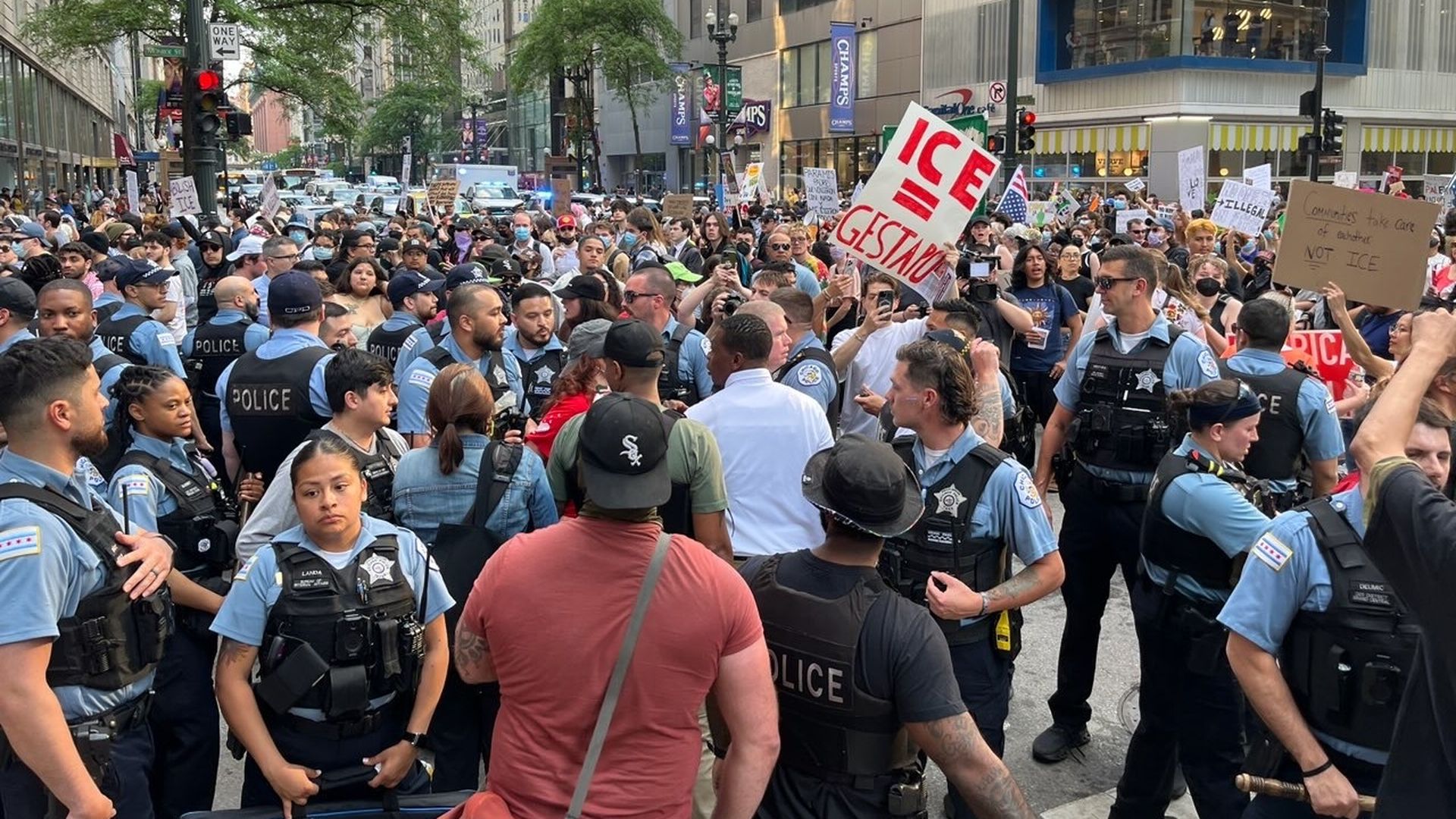
Protesters and police converge on a Chicago street on Tuesday night. Photo: Monica Eng/Axios
Protests against U.S. Immigration and Customs Enforcement erupted downtown Tuesday night with periodic clashes between police and demonstrators.
Why it matters: Demonstrations against ICE actions are stoking tensions between police and protestors at a time when President Trump has sent in the military to address similar actions in Los Angeles.
The latest: Thousands of protesters marched through the Loop, winding along DuSable Lake Shore Drive before returning to Daley Plaza.
Zoom in: The protests were mostly peaceful, though a driver struck a group of protesters on Monroe Street. No one was taken to the hospital, per NBC 5.
- Vandals spray-painted slogans on several cars parked along State Street.
- The CTA temporarily suspended bus service in and out of the loop.
Zoom out: The march comes as Protesters, police and military personnel continue to clash in downtown Los Angeles over the arrest of a union leader and immigration raids by ICE officers.
- President Trump, while speaking from the Oval Office on Tuesday, warned that protests in other cities would be "met with equal or greater force," referring to the military presence in LA.
Between the lines: For Chicagoans, Tuesday night's march, plus the LA scenes of police in riot gear, are reminiscent of protests that rattled the city in 2020 after the murder of George Floyd.
Context: SEIU leader David Huerta was arrested Friday in LA for allegedly blocking federal vehicles near an ICE raid.
- Tensions mounted around the facility where federal agents were holding Huerta, causing Trump to order in the National Guard.
Reality check: The governor historically calls in the National Guard or works with the federal government to deploy, but Trump bypassed California Gov. Gavin Newsom and local law enforcement.
- "President Trump's move to deploy California's National Guard is an alarming abuse of power," the Democratic Governors Association said in a statement.
What they're saying: "Fear is the tactic, silence is the goal," U.S. Rep. Chuy Garcia (D-Ill.) said at a Monday rally at Daley Plaza. "Ripping parents apart from their children, kidnapping people, showing up to what they thought was a routine check-in at ICE, National Guard patrolling our communities. This is cruelty with intent."
The other side: While Trump and Republicans condemn the protests, Democrats are criticizing the federal government for escalating them.
- "The chaos in California isn't an accident," U.S. Rep. Mary Miller (R-Ill.) posted on social media, referring to Gov. JB Pritzker's call for mass protests in April.
- "It's the Democrats' blueprint for America."
State of play: Chicago police have been trained for protests, especially in preparation for last year's Democratic National Convention, which saw arrests but smaller skirmishes.
- Authorities were able to regulate protests by implementing snap curfews and rigorous permitting procedures.
- "When we found out that we were getting the convention, we started training right away," Chicago Police Department Superintendent Larry Snelling said in January 2024, adding they had about a year to prepare.
Yes, but: Unplanned protests are different. Chicago police had trouble containing mass protests in 2020, which, as in Los Angeles, were followed by looting and lawlessness.
Flashback: Trump's move to call in the National Guard without a request from the governor hadn't been done since 1965, but the president has threatened several times to do the same in Chicago.
- Pritzker has resisted mobilizing the National Guard for issues like Chicago violence, even though Trump called for it multiple times during his first term.
- Trump did send about 100 federal law enforcement officers to Chicago in 2020.
The intrigue: Chicago history is littered with violent clashes between police and protesters, including the Haymarket riot in 1886, the 1968 Democratic National Convention, and the aftermath of the murder of George Floyd.
- Garcia and other leaders have blamed the recent chaos on "outside agitators."
- Then-Mayor Lori Lightfoot blamed "outside agitators" to justify raising the bridges during the George Floyd protests, and claims of "outside agitators" were the basis for conspiracy charges against Abbie Hoffman and the Chicago 7 in '68.
- "Outside agitators" were also accused of inflaming tensions during the Haymarket riot.
The bottom line: History shows that Chicago will be at the epicenter of the protests as they spread across the country.