Rising child care costs continue to burden families

Add Axios as your preferred source to
see more of our stories on Google.
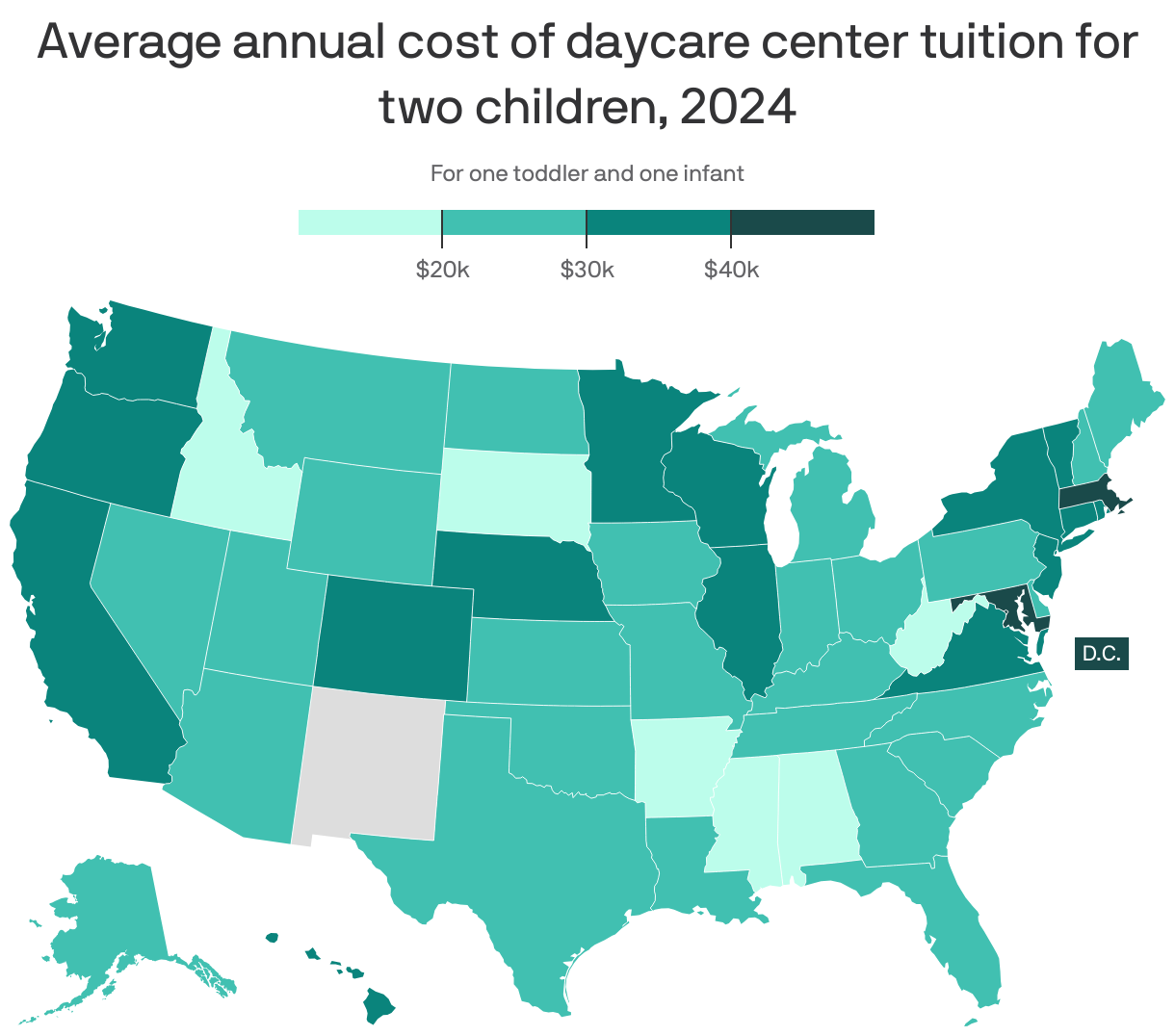
A new report finds that child care prices in the U.S. rose nearly 30% from 2020 to 2024, outpacing overall inflation.
Why it matters: Rising child care costs put a huge financial strain on families, forcing some parents — typically women — to either ratchet back their working hours or leave the labor force entirely, Axios' Emily Peck reports.
- For single parents, it can be even more burdensome.
- It's also a drag on economic growth overall.
By the numbers: The average annual cost of day care tuition in Illinois for two children — one toddler and one infant — was $37,000 last year, according to data from Child Care Aware, an advocacy group. For an infant alone, center-based child care costs nearly $20,000 annually.
- The median income for a married couple is about $137,000, meaning center-based child care for an infant would use 14% of family income.
- The median income for a single-parent family is $41,000, which means center-based child care for an infant would use 48% of family income.
Zoom out: The U.S. doesn't have publicly funded universal child care.
- However, the federal government does put money into the system for low-income kids through block grants to the states, as well as Head Start, the decades-old federal program that provides child care, nutrition assistance and other services to the nation's poorest families.
- Some worry that the White House will stop funding Head Start, but the administration has said that won't happen.
The latest: The Child Care Assistance Program (CCAP) reduces costs, but for many families in the state, it's not enough, according to a new analysis by Illinois Answers Project.
- The report points to Illinois' restrictions on eligibility for the funding and fewer providers as barriers for families.
- For example, a family of three can only earn up to $4,841 a month of the state's median income to be initially accepted into CCAP, which is below the federal maximum of $6,704, the report states.
- The total number of providers that accept CCAP payments dropped by more than 60% in the past decade, the investigation also found.
The other side: Gov. JB Pritzker is proposing $85 million more for CCAP in the next budget that lawmakers must pass by Saturday.
Yes, but: States rely on federal funding help, too, and President Trump's budget proposals look to keep the levels for child care flat next year — that's effectively a cut given inflation, says Anne Hedgepeth, senior vice president of policy and research at Child Care Aware.