Why Walgreens says unlocking products won't help solve deep financial problems

Add Axios as your preferred source to
see more of our stories on Google.
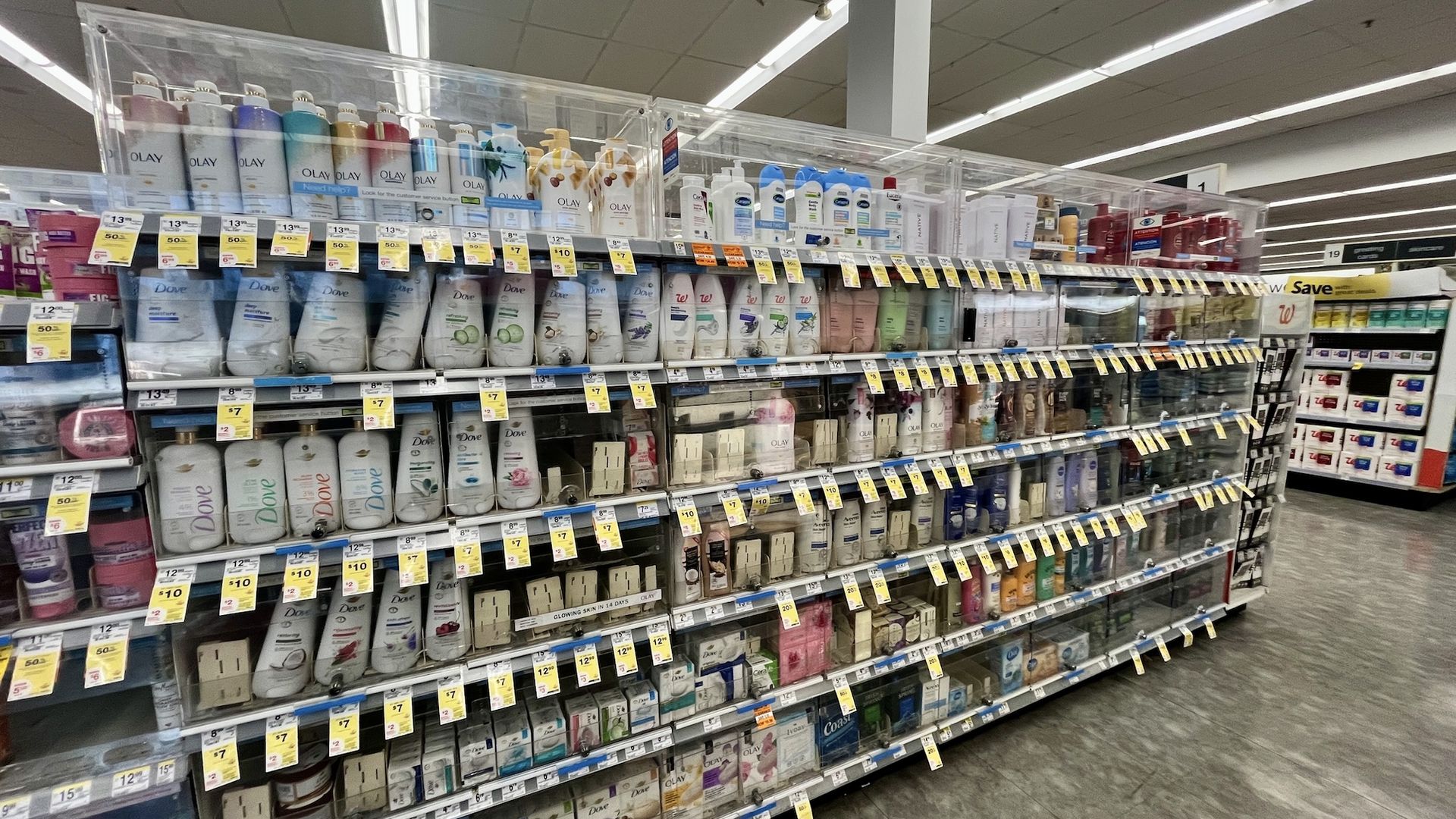
A locked display case at a Walgreens in Gold Coast. Photo: Carrie Shepherd/Axios
Walgreens is making big changes to address the $265 million quarterly net loss they reported earlier this month.
Yes, but: Don't expect those locked display cases to go away.
The latest: Walgreens Boots Alliance announced Thursday it will not pay shareholders quarterly cash dividends for the first time in 92 years in an effort to reduce debt and improve cash flow.
The big picture: Walgreens CEO Timothy Wentworth said on an earnings call earlier this month that one thing that hurts sales is what seems to be endless rows of locked cases.
- "When you lock things up … you don't sell as many of them. We've kind of proven that pretty conclusively."
Why it matters: More and more products are under lock and key at places like Walgreens, CVS and Target, making it inconvenient for customers trying to quickly grab items like toiletries and beauty products.
- A Consumer World survey of 1,100 readers found that 55% say a locked case makes them shop elsewhere while 32% will call over an associate to unlock the case.
Case in point: The Walgreens at Dearborn and Division in the Gold Coast neighborhood keeps products such as lotions, body and face wash, lubricant (but not condoms), vibrators, baby formula, detergent and cleaning supplies in locked display cases.
Reality check: The company isn't getting rid of the cases.
- "It is a hand-to-hand combat battle still, unfortunately," Wentworth said, referencing revenue lost through "shrink," which is inventory loss due to issues such as theft.
Between the lines: Locked display cases aren't meant to deter small-scale shoplifting. They address organized retail crime — the theft of multiple products with the intent of reselling them.
- Organized retail theft is a felony in Illinois and costs businesses nearly $2 billion each year, the Illinois Retail Merchants Association says.
- Walgreens locks up items based on data of what's stolen and where, spokesperson Marty Maloney tells Axios.
What they're saying: Despite "testing and gaining insights on new solutions that enhances our ability to keep inventory secure but empowers our customers to have easier access to products" locked display cases are the "most efficient solution to combat retail theft," Maloney says.
Flashback: In 2021, after "smash and grabs" became common around the pandemic, Illinois Attorney General Kwame Raoul started the Illinois Organized Retail Crime Task Force to work with retailers, including Walgreens, to stop these types of crimes.
The other side: Critics have questioned whether the problem is as large-scale as some retailers would have consumers believe after the National Retail Federation was forced to retract a report that cited faulty numbers.
- In 2021, Walgreens claimed it was closing five stores in San Francisco because of rampant theft, but the San Francisco Chronicle later reported the police data didn't match that narrative.
What we're watching: Wentworth told investors he met with Walgreens' head of asset protection to find better ways to curb theft and improve the customer experience than locked display cases but the company doesn't have the answer yet.
What's next: Walgreens plans to close 1,200 stores across the U.S. by 2027, including five in February in West Englewood, Little Village, South Chicago, Lake Meadows and South Shore.