Chicago passes budget with no property tax hike


Add Axios as your preferred source to
see more of our stories on Google.

Photo illustration: Brendan Lynch/Axios. Photo: Scott Olson/Getty Images
Chicago City Council voted to pass Mayor Brandon Johnson's $17.3 billion budget proposal on Monday, but not before opponents and onetime allies took turns criticizing the process and Johnson's leadership.
Why it matters: The four attempts it took to get the necessary votes clearly demonstrated the strained relationship between Johnson and the council and the mayor's weakened political capital.
Reality check: Even alders who voted for the budget took shots at Johnson, including Progressive Caucus co-chair Ald. Maria Hadden, who said, "How we do things is just as important as what we do. And the way you've led, this process has left the city council fractured. Chicago is less trusting in government, and it's left our city in an extremely vulnerable position."
- "We may pass a budget today, but this delay process has already caused strife and threats to city services, as contracts for delegate agencies who we rely upon for the delivery of our vital services are delayed. They don't get contracts until we appropriate the funds."
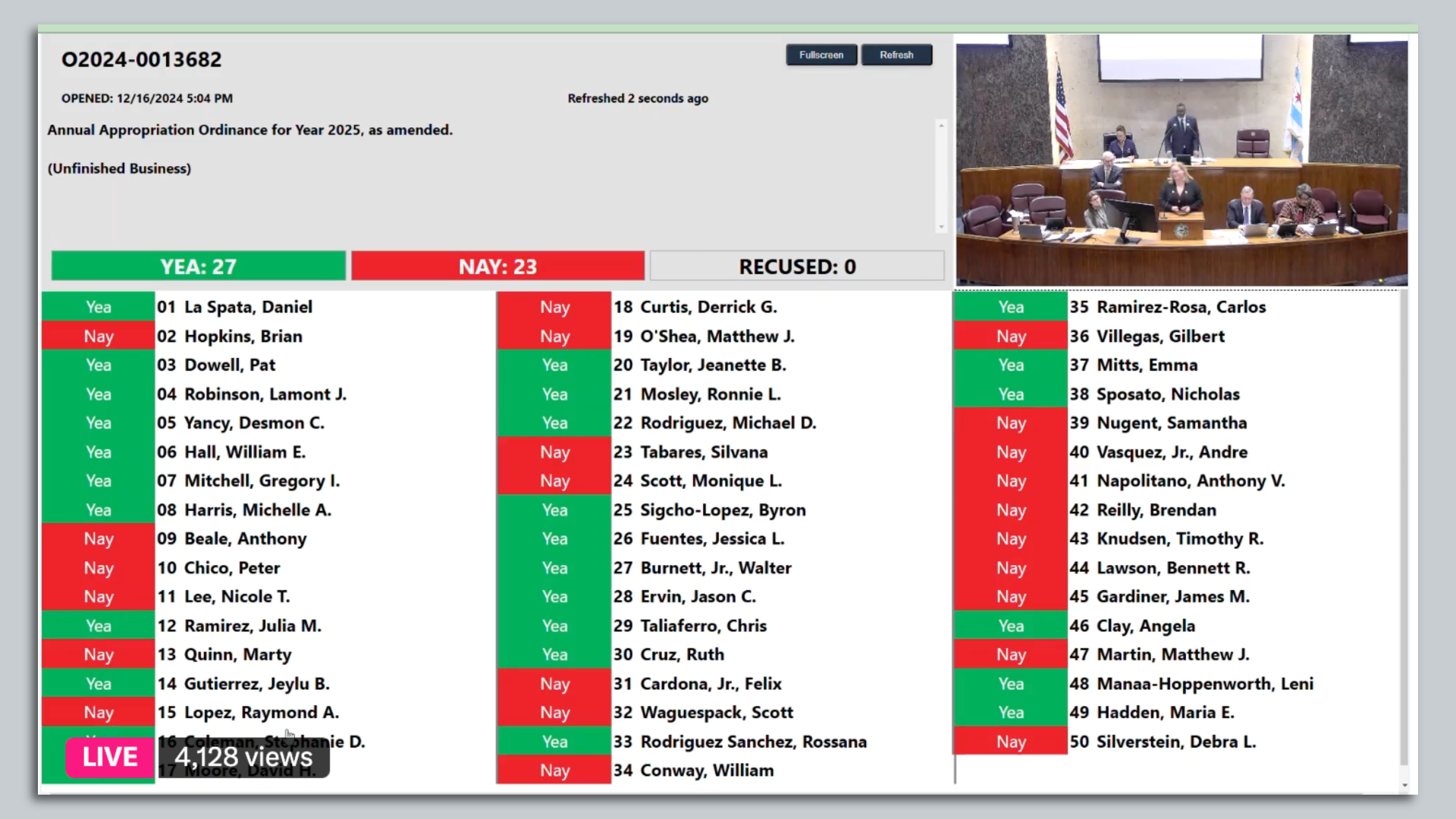
Zoom in: The final vote was 27-23.
- Fifteen alders who outlined their opposition to the budget in a letter to Johnson voted against it.
Flashback: Johnson pitched a $300 million property tax hike in October, but after public outcry and unanimous pushback from alders, the mayor's budget team managed to present a plan this weekend without a property tax hike.
By the numbers: The new plan still calls for $165.5 million in new taxes — down from $243 million in the previous plan.
- But it also offers up $44.9 million in "expenditure cuts," including a $1 million reduction in the mayor's office staff and $2.8 million in middle management cuts.
- The mayor further proposes to find $23.6 million in "operational efficiencies."
- Ald. Daniel La Spata, one of Johnson's most outspoken supporters, is getting $500,000 for his plan for city workers to plow the sidewalks.
New revenue: The plan includes a $10 million "cost recovery initiative" that pursues reimbursement from big event organizers for millions in overtime the city pays to police, fire, sanitation, transportation and emergency management workers.
- It seeks another $40 million in savings by spreading out debt payments for the city's purchase of land formerly occupied by Michael Reese Hospital.
Between the lines: It's unusual for the back and forth between the mayor and council members to be done in public. Historically, mayors have negotiated behind the scenes and haven't called for a vote until they've been confident they have enough to get it passed.
What they're saying: "What you're starting to see around here — Black people, brown people, white people, gay people, men, women coming together because they don't like the way that you are treating people. I can't even get a meeting with you. I represent 55,000 people in the 45th Ward. I can't even get a meeting with you," Ald. Jim Gardiner said.
The other side: "For too long, Chicago's budgets balanced on the backs of working people, forcing them to bear the burden of cuts to schools, clinics, public housing and critical services," Johnson said. "The budget we passed today is an investment towards a better, stronger and safer future for Chicago where our young people, workers and families are prioritized and where equity is no longer an afterthought but the foundation of our decisions."
What's next: Whether the mayor heeds the warnings of several alders to work more closely and be more available to his council.