Alders vote to give police chief ShotSpotter power

Add Axios as your preferred source to
see more of our stories on Google.
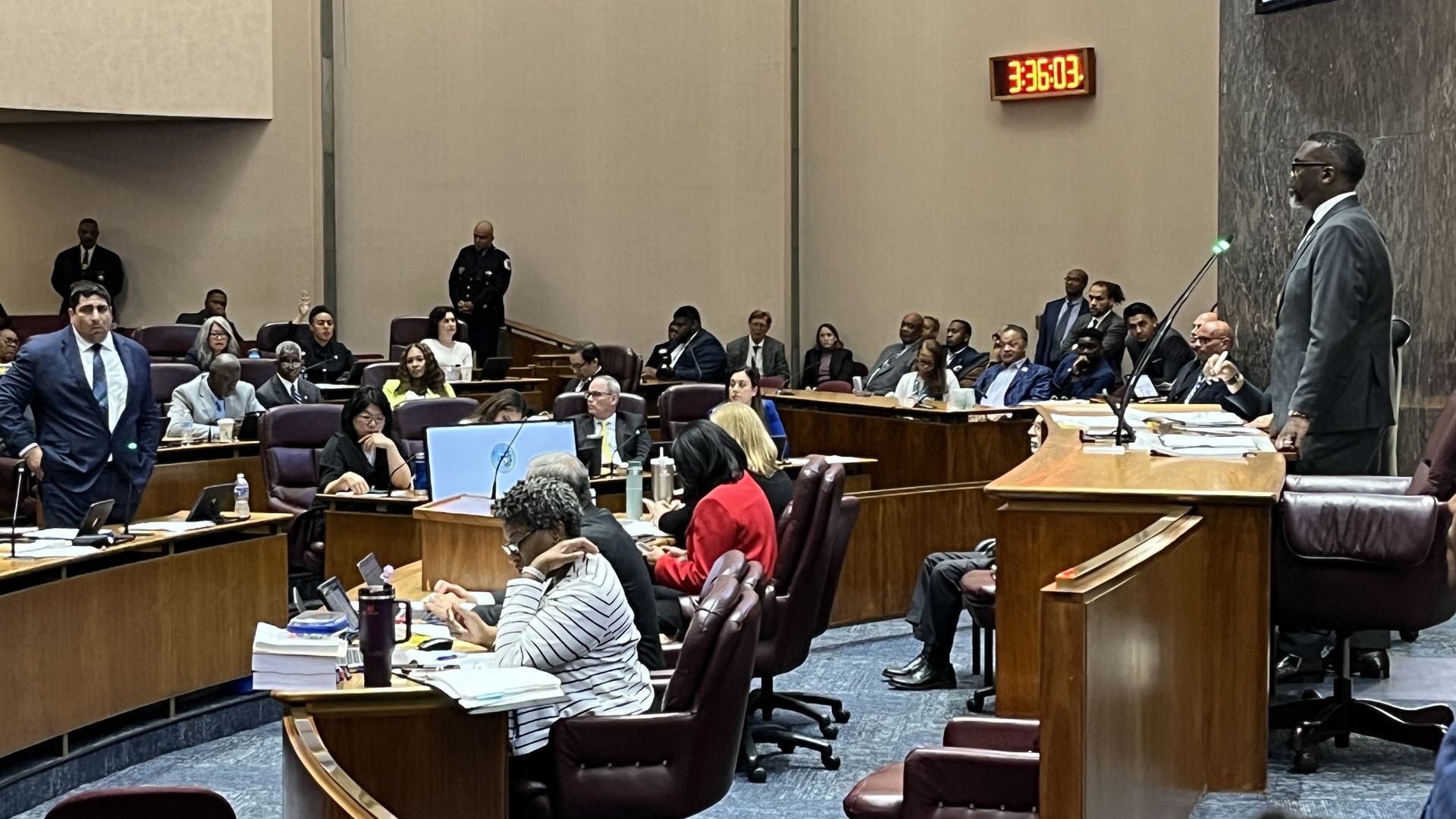
Former police officer Ald. Peter Chico (standing left) tells Mayor Brandon Johnson why he supports keeping ShotSpotter during a lengthy City Council meeting Wednesday. Photo: Monica Eng/Axios
Chicago's City Council voted 33-14 Wednesday to give police superintendent Larry Snelling power to renew the city's controversial ShotSpotter gun detection contract despite Mayor Brandon Johnson's scheduled termination of it.
- But about an hour after the vote, Johnson announced he was vetoing the "illegal" ordinance.
Why it matters: The series of events and other recent rebukes represent an unprecedented level of alder defiance in recent City Hall history and signal a shift in power that could hamper Johnson's ability to deliver on some of his ambitious plans going forward.
What they're saying: "It's illegal," Johnson insisted Wednesday in a press conference after the vote.
- "Now that you have someone who is firm in their values of investing in people, all of a sudden we don't believe that that person should have the powers that every other mayor has?"
- "We're going to find a pathway forward. We're going to find technology that actually works."
Reality check: Even if the mayor hadn't vetoed the ordinance, Snelling would still have been undermining his boss by renewing the contract.
- While Snelling has spoken about the usefulness of ShotSpotter in the past, he declined Wednesday to comment on what he thinks of the contract.
Flashback: Johnson campaigned on removing ShotSpotter, and while he agreed to keep using it through the Democratic National Convention, the city is scheduled to phase it out starting Sunday.
State of play: In an effort to keep the technology, a City Council committee met this month to discuss new ShotSpotter data, and on Wednesday, the company that makes it offered to drop its $1.2 million-per-month fees by 48%.
Context: Alders from wards on the South and West sides, which have been plagued by gun violence, as well as those repping the Northwest and Southwest sides, where many cops reside, say it's a useful tool that helps police.
- "You said you have a campaign promise [to keep]," Ald. Monique Scott told the mayor during deliberations, "but you can't put a life over a campaign promise. Put those people that you promised on hold to protect everybody in the city."
The other side: Opponents of the gunshot detection technology say it's an ineffective waste of money and contributes to over-policing in Black and brown neighborhoods rather than preventing gun violence.
- On Tuesday, Johnson likened it to "a walkie-talkie on a pole" and suggested corporate interests were influencing the current resistance.
- Alders who agreed with the mayor's termination of the program said they are not anti-technology but rather anti-ShotSpotter due to reports from the state's attorney and inspector general that highlight its flaws.
The consensus: Despite the friction, alders on both sides stressed that they were open to adopting other crime-fighting technology with better proven outcomes.
Between the lines: Despite the veto of the ordinance, the vote marks a new low for the embattled mayor, who has struggled to keep control of the City Council in the same fashion his predecessors did.
- Johnson has had to cast the tie-breaking vote on two council measures in the last year.
- Just last week, Johnson pivoted from advancing Ald. Byron Sigcho-Lopez as the next zoning chair to endorse Ald. Walter Burnett, who said he volunteered to do it when it appeared the mayor didn't have enough votes.
What we're watching: Alders would need 34 votes to override the veto.
- The mayor and the city's corporation counsel, Mary Richardson-Lowry, however, insist any override vote would be moot because the ordinance violates the Separation of Powers Act and is thus illegal.
- Ald. Brian Hopkins said Wednesday that the matter could end up in court.