Chicago leaders want to prioritize neighborhood schools

Add Axios as your preferred source to
see more of our stories on Google.
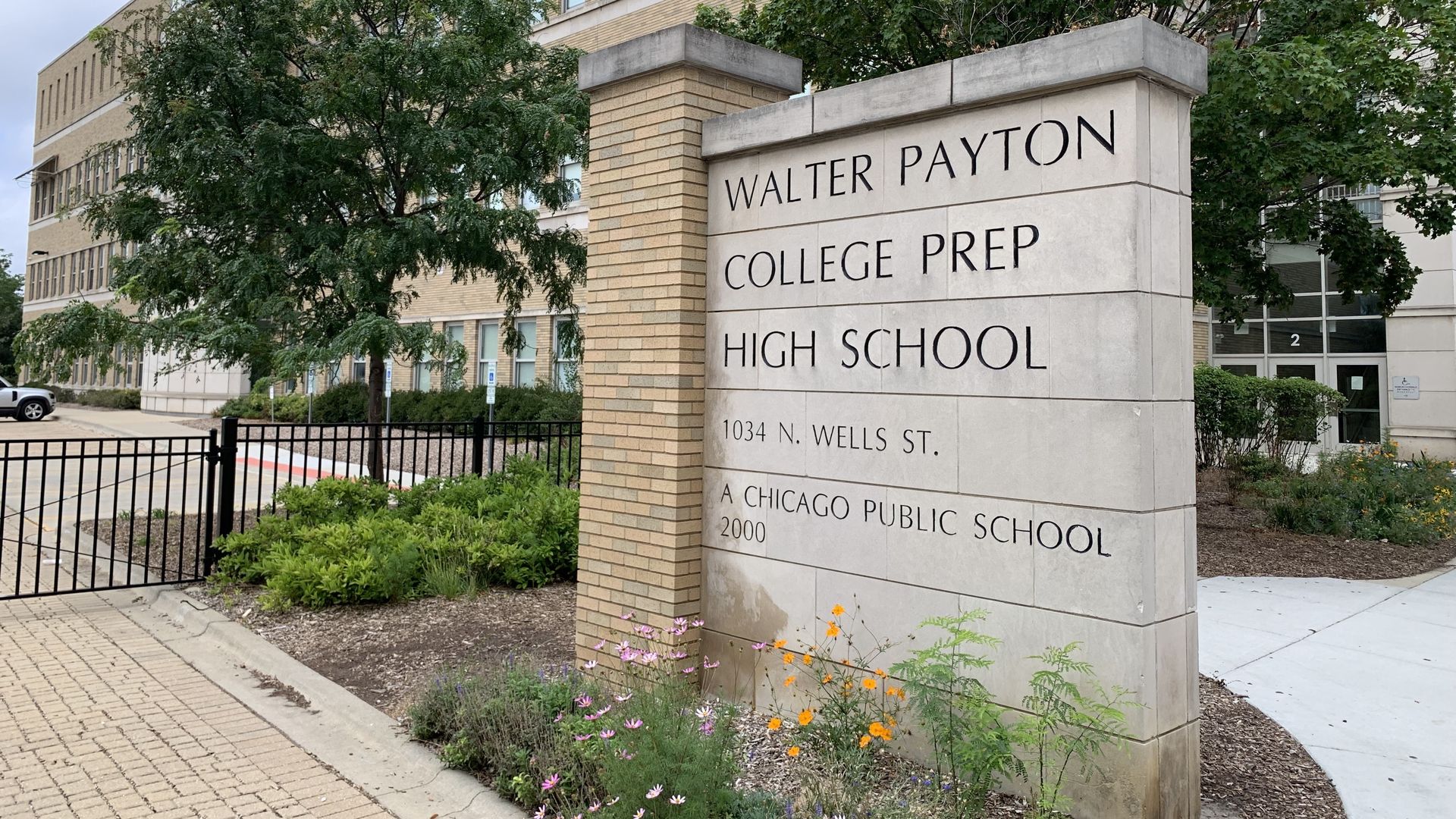
Walter Payton College Prep High School. Photo: Justin Kaufmann/Axios
Chicago Public Schools' Inspector General released his annual report of misdeeds in the district this week, including an allegation that one family lied about their address to gain an advantage in Chicago's selective enrollment system.
Why it matters: The allegation offers an example of a pervasive and uber-competitive culture that Chicago's new school board aims to address over the next five years.
Catch up fast: The Chicago Board of Education last month approved a resolution that shifts priorities from selective and charter schools to neighborhood schools.
- The move comes after Mayor Brandon Johnson campaigned on changing the school choice system.
What they're saying: CPS will "transition away from privatization and admissions/enrollment policies and approaches that further stratification and inequity in CPS and drive student enrollment away from neighborhood schools," the resolution states.
- The board acknowledged that the current model "reinforces, rather than disrupts, cycles of inequity."
- The Chicago Teachers Union called the resolution a "step in the right direction."
The other side: Former CPS CEO Janice Jackson penned an op-ed in the Sun-Times, criticizing the board and supporting the current system.
- "Strong neighborhood schools and choice schools can and do coexist. Nothing is stopping policymakers from investing more in them. Continuing to pit one against the other is misleading and divisive."
Context: In the 2000s, then-Mayor Richard M. Daley opened several schools that did not require students to live in the traditional neighborhood boundaries, ushering in a wave of new selective enrollment, magnet and charter schools.
- The goal was to create educational opportunities for every student, regardless of neighborhood, but over time it fueled a competition to get slots in schools with better resources and siphoned students away from neighborhood schools with dwindling enrollment.
- This falling enrollment contributed to the historic 2013 closings of 50 neighborhood schools by then-Mayor Rahm Emanuel.
- In the 10 years since those closings, enrollment has continued to decline, with the exception of this year.
By the numbers: Around 56% of elementary school students and 23% of high school students attended their neighborhood school last year, according to Chalkbeat Illinois.
- That's a far cry from 2003, when those numbers were 74% and 46% respectively.
Zoom in: Enrollment at the district's top 5 selective high schools is 10% Black and 30% white, according to the Chicago Teachers Union. Overall CPS enrollment is 35% Black and 11% white.
What's ahead: The board plans to approve a five-year strategic plan for CPS this summer, just a few months before Chicagoans elect 10 new school board members in November.
- The school board is seeking public input to help shape the plan, especially from CPS parents and students, via this survey that closes at the end of the week.
Between the lines: Voters may have the last say.