Black women bear brunt of crime in Chicago

Add Axios as your preferred source to
see more of our stories on Google.
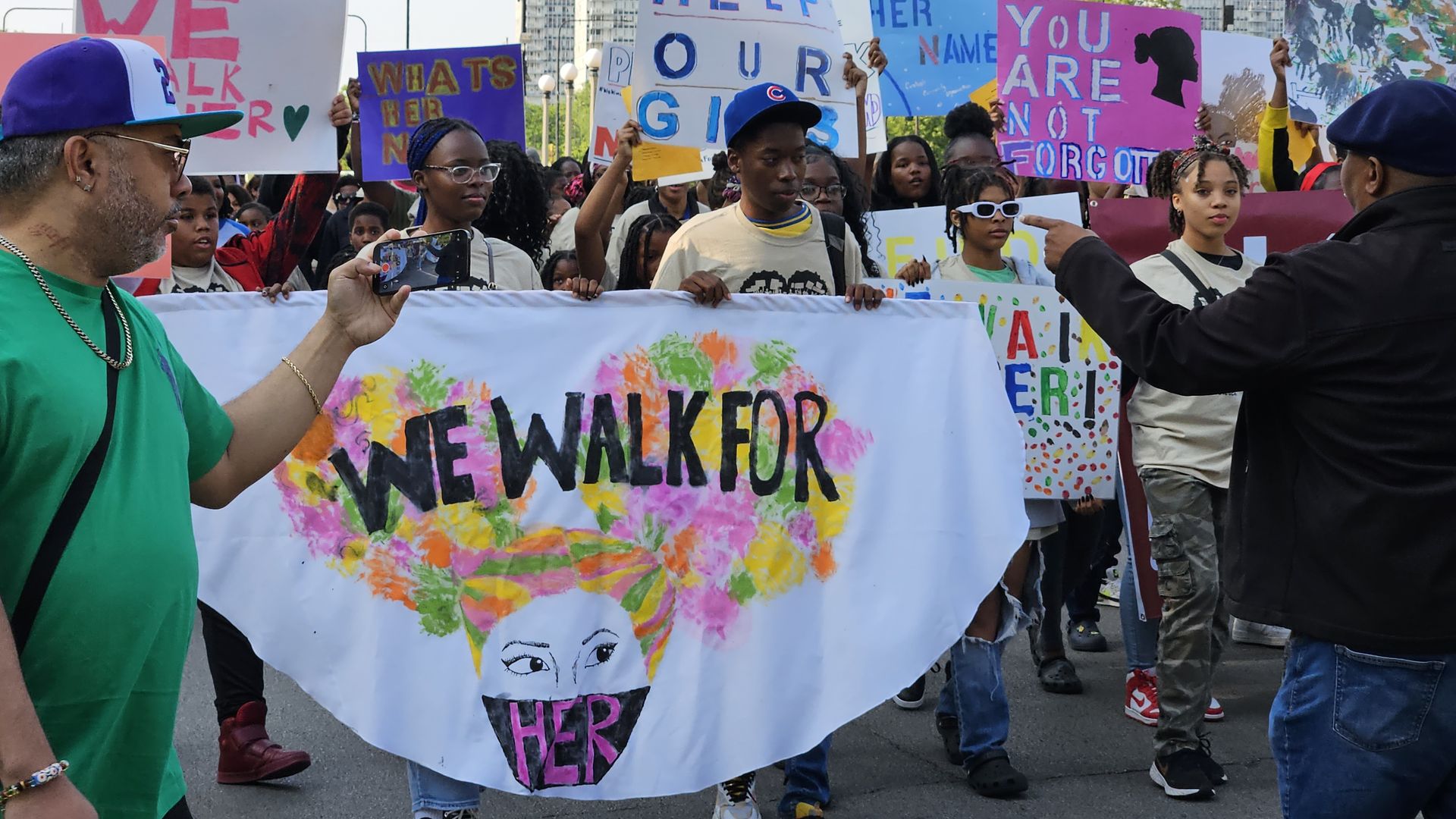
The sixth annual "We Walk for Her" march. Photo: Courtesy of Saif Alavi
Several people marched through Bronzeville last week to bring attention to missing and murdered Black women and girls on the South and West Sides.
Driving the news: The Kenwood Oakland Community Organization (KOCO) used its sixth annual "We Walk For Her" march to call for investigations into the disappearances of at least 51 Black women missing since 2001.
The big picture: About 25% of crime victims in Chicago last year were Black women, though they make up just 16% of the city's population, according to a new CBS2 analysis of police data.
- In 2022, Black women were the victims in 35% of city assaults, 38% of batteries and 50% of human-trafficking cases.
- Over the past two decades, Chicago police say 35% of missing persons have been Black women.
What they're saying: "We walk so that the spotlight, the attention, the care and concern are finally placed on the Black women who who have been ignored and neglected," 17-year-old Moriah Chandler tells Axios.
- "Every step we take while walking is a step closer to finding our lost women, and we walk so that we can lose no more and to get justice."
Zoom out: This is not just a Chicago problem. In 2021, 28% of the nearly 257,400 individuals reported missing in the U.S. were Black women age 20 or younger, per the National Crime Information Center database.
Flashback: In 2019, Chicago police and the FBI investigated a possible serial killer targeting Black women. Even though some of the deaths by strangulation were similar, they determined the DNA evidence didn't support the claims.
- But that hasn't stopped advocates from asking for more thorough investigations, nor lawmakers from pushing for a federal task force.
- Just last year, KOCO was instrumental in pushing the state to establish the Task Force on Missing and Murdered Chicago Women, following Minnesota's lead in 2021.
What's ahead: Illinois' task force is working on a report that will outline methods for better tracking and collecting data on violence against Black women. That's due at the end of 2024.