Chicago loses ground in U.S. public park rankings


Add Axios as your preferred source to
see more of our stories on Google.
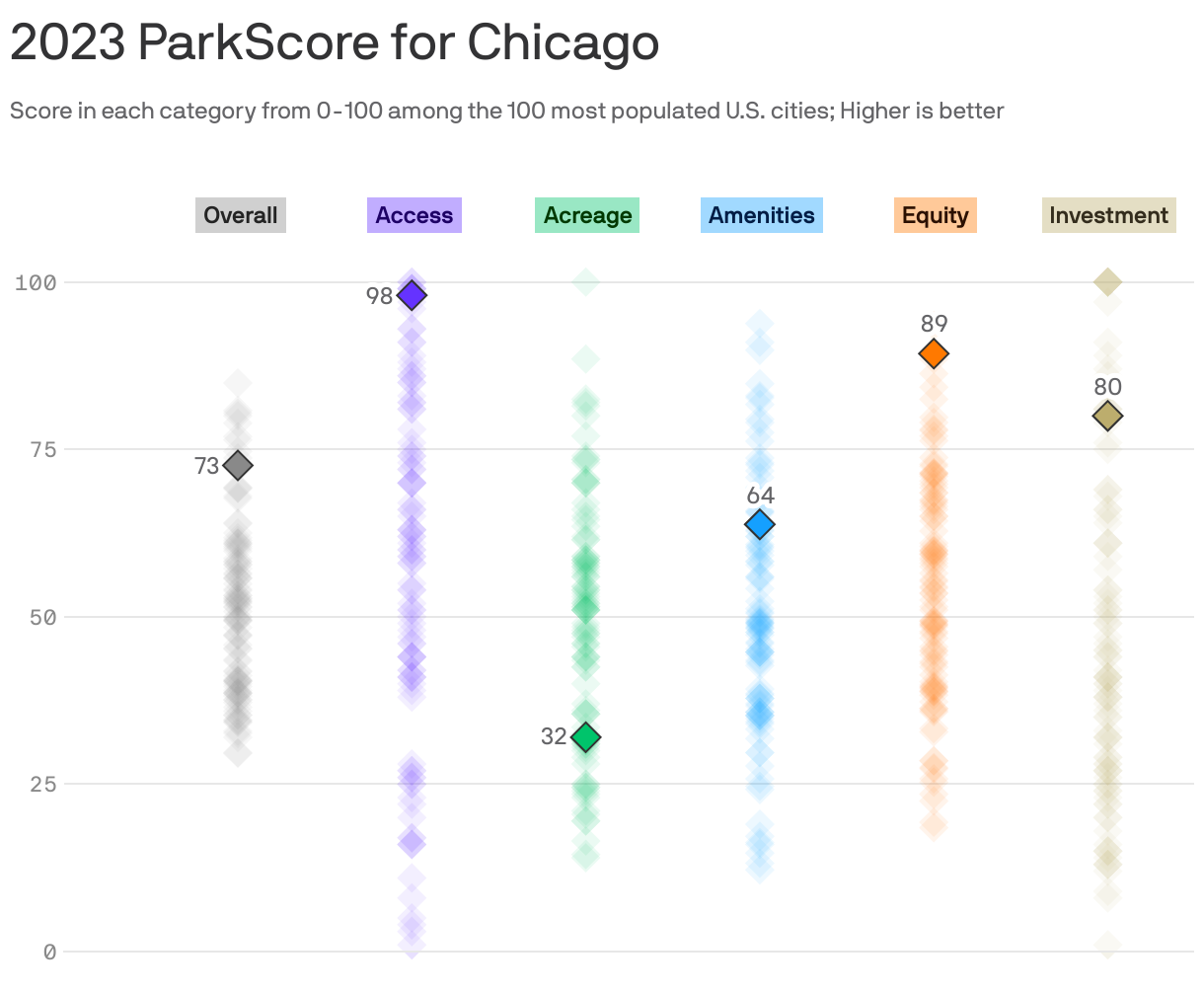
Chicago ranks 12th among the 100 largest U.S. cities for its public parks, per the latest report from the Trust for Public Land (TPL), a pro-parks nonprofit, Alex Fitzpatrick and Kavya Beheraj report.
- That's a precipitous drop from last year, when we ranked 6th. This is the first time we've been out of the top 10 since 2017.
Why it matters: Parks confer a wealth of benefits — including, as TPL points out in its latest annual report, significant health boosts.
- Parks offer spaces for physical activity and social gatherings, improve visitors' moods, and provide city dwellers a reprieve from noise and air pollution and the effects of climate change.
- Residents of the top 25 cities awarded a "ParkScore" are less likely to report poor mental health or low physical activity, per TPL's latest report.
Methodology: A city's "ParkScore" is determined by a variety of metrics, including the percentage of residents who live near a park, the share of city land reserved for parks, parks investment and more.
By the numbers: Chicago scored 98 for access, 80 for investment, 64 for amenities and 89 for equity.
Yes, but: The TPL says Chicago's score was also dinged by a drop in park investment, calculated by public and private spending. Chicago saw total per capita park spending fall from $182 a person in 2022 to $178 a person in 2023.
- We notched a paltry 32 for acreage. Our parks average 2.2 acres, compared with the national average of 5.4 acres.
Details: The study says 98% of Chicagoans live within a 10-minute walk to at least one of the city's 1,249 parks.
- Chicago's Latino neighborhoods have the least access to parks, 39% less than the city median.
The big picture: At a national level, parks spending still hasn't recovered to pre-Great Recession levels, says TPL senior director for strategy and innovation Linda Hwang.
- But that's largely driven by the country's biggest cities — by contrast, many midsize cities are increasing their parks spending.
What they're saying: "Memphis stands out," Hwang tells Axios. "They're a great example in that they have [made] significant public and private investment in recent years."
- One concern, Hwang added, is that many parks departments are still recovering from COVID-19's impact, as well as dealing with maintenance backlogs.
- Access also remains a troublesome issue: Nationally, residents of predominantly non-white neighborhoods have access to 43% less park space per person than residents of predominantly white neighborhoods.
The intrigue: Cities increasingly view their parks and parks departments through a public health lens, says Howard Frumkin, TPL senior vice president and director of the Land and People Lab.
- "Simply defining parks as part of the public health infrastructure of a community, and then steering some health dollars towards the parks because they're healthy, is a really interesting innovation," Frumkin tells Axios.
- "And it's not rare — it's getting more and more common."
Reality check: Not every city park is a multi-acre Olmstedian masterpiece — yet even diminutive "pocket parks" and community garden lots confer physical, mental and social benefits, especially if you can walk to them.
- "If there's a pocket park with no sports facilities at all, but I walked 12 minutes to get there and I walk 12 minutes home, I've got my 24 minutes of moderate activity for that day," Frumkin says.
What's next: TPL's report offers a bevy of recommendations for cities looking to boost their ParkScore, including expanding access (through better public transportation, for instance), starting drop-in sports programs, and exploring innovative partnerships with local health care organizations.
The bottom line: "Parks in the past were like, 'Well, I've just got to prune the trees, mow the grass, take the trash out, keep the bathrooms clean, and we're good,'" says Hwang.
- "And they have to do all that — but now there's a level of sophistication that we just haven't seen and a better understanding of what people need in their neighborhoods."