Population share of young children drops in metro Atlanta


Add Axios as your preferred source to
see more of our stories on Google.
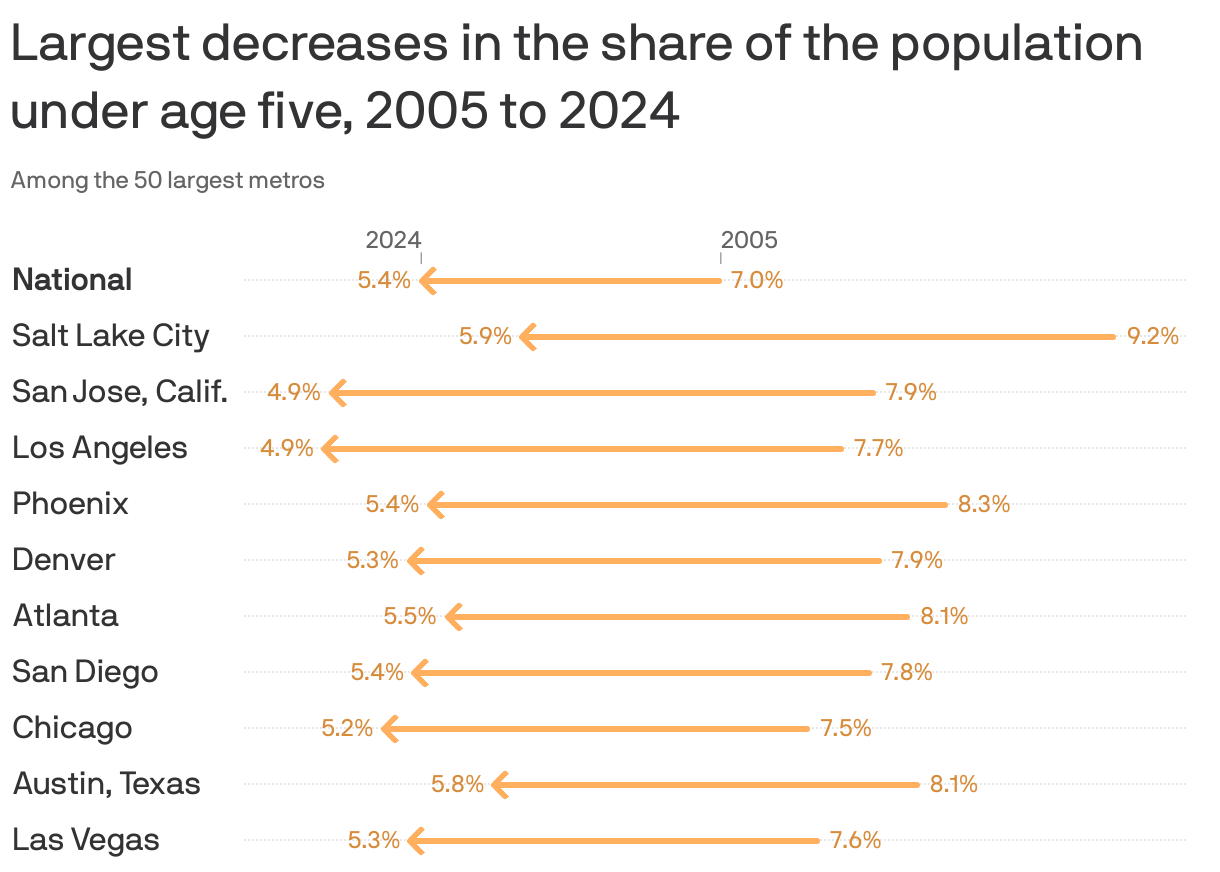
Young children's share of the population in Atlanta fell 2.5 percentage points over the past two decades, U.S. Census Bureau data shows.
Why it matters: Kids' population trends can reflect cities' ability to attract, retain and support families, but larger nationwide factors like birth and death rates and immigration are also at play.
- Those trends may also translate to a drop in future student enrollment in public schools, which in Georgia rely on state funding that's calculated, in part, based on how many students are showing up to class.
- When fewer students enroll, state funding decreases. This causes districts to cover the budgetary shortfall by raising property taxes, cutting staff and other expenses, and closing schools.
By the numbers: Among the 50 biggest metros, Salt Lake City (-3.2 percentage points), San Jose (-3pp) and Los Angeles (-2.8pp) had the biggest dips in young children's share of their overall population between 2005 and 2024.
- Phoenix (-2.8pp) and Denver (-2.6pp) also had sizable drops.
- That's compared with -1.6pp among the U.S. broadly.
- The Census Bureau defines young children as those under 5.
Zoom in: Declining enrollment has already forced Atlanta Public Schools and Fulton County Schools to adopt school closure plans, despite opposition from parents and community stakeholders.
- 150 schools across APS and Clayton, Cobb, DeKalb, Fulton and Gwinett counties experienced at least a 20% drop in enrollment over the last decade, according to the AJC.
- Georgia Department of Education data shows enrollment dropped by around 30,000 students from October 2024 to October of this year.
Context: Enrollment declines in public schools accelerated during the COVID pandemic, while homeschooling gained ground.
State of play: Data released in 2023 by the Centers for Disease Control and Prevention shows Georgia's birthrate fell nearly 29% between 2007 and 2022.
Zoom out: The U.S. birth rate hit a record low in 2024, while life expectancy is approaching 80 following a pandemic-era dip.
- Those data points suggest that children will make up less of the overall population over time — fewer kids, more older folks.
- Yet the country grew around 1% between 2023 and 2024 — breakneck speed, as such things go — driven primarily by immigrants (including children, complicating the births-versus-deaths picture).
Between the lines: Falling birth rates are fueling concerns about economic growth and societal change in some corners, particularly among "pro-natalist" conservatives.
Flashback: In 2015, urbanist Richard Florida found that "kids are far more prevalent in metros where immigrants and Latinos make up larger shares of the population."
What we're watching: The Trump administration's efforts to clamp down on and dissuade illegal immigration may affect kids' population shares in ways not yet well understood.