Atlanta's "lost winter days" due to climate change

Add Axios as your preferred source to
see more of our stories on Google.
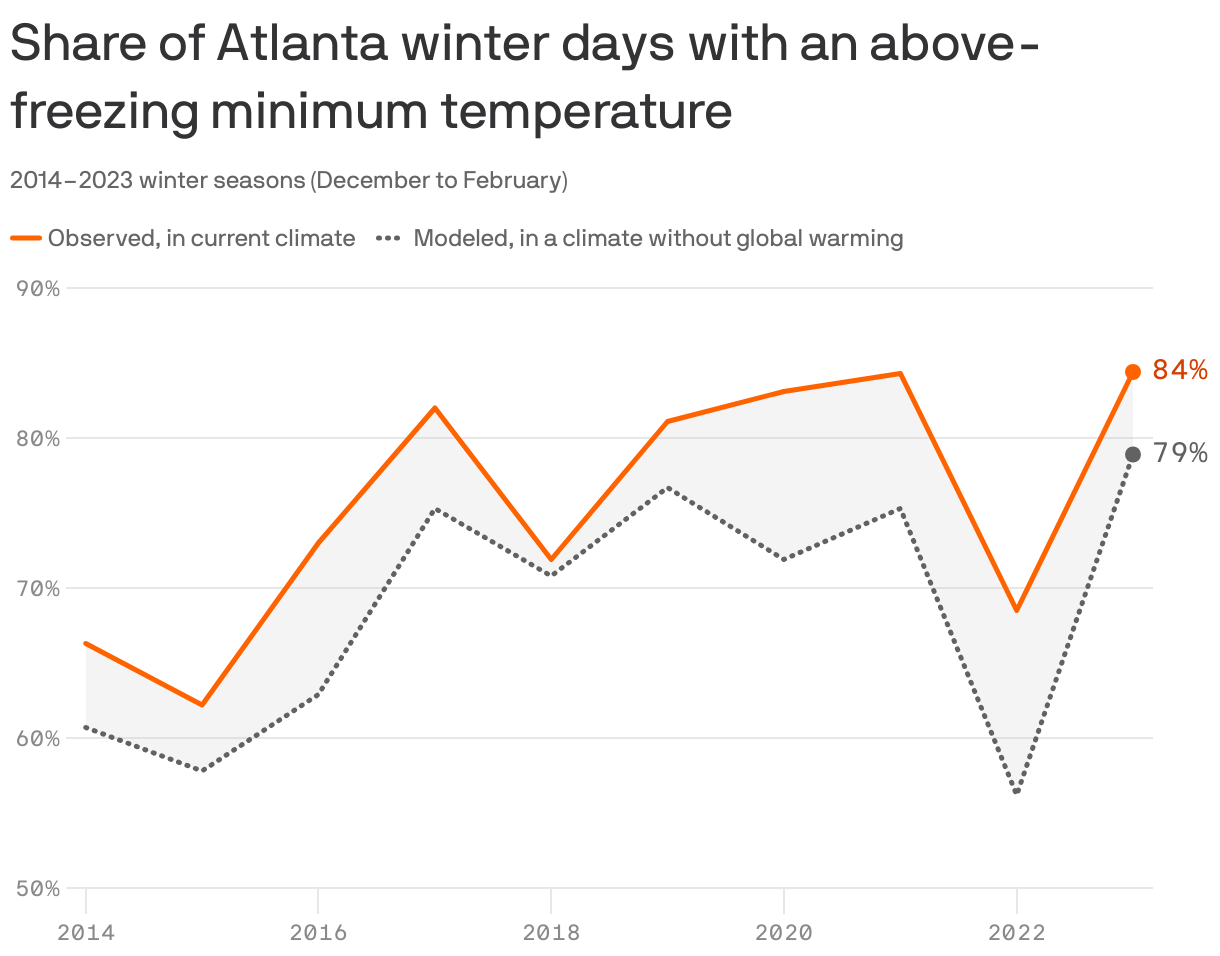
Winters in Atlanta would be a tad bit cooler in a world without global warming, a new report shows.
Why it matters: More warm winter days mean fewer opportunities for winter recreation and can have knock-on effects on water supplies during the following warm season, Axios' Andrew Freedman writes.
Zoom out: Winters are rapidly warming across the Northern Hemisphere because of human emissions of greenhouse gases from burning fossil fuels, according to the climate science and communications group Climate Central in its analysis.
- This is now being seen in many more days with temperatures above freezing.
Zoom in: Per the analysis (PDF), Atlanta recorded 76 days with an above-freezing minimum temperature in 2023.
- If global warming did not exist, the models say, Atlanta would experience five fewer days with above-freezing minimum temperatures.
The big picture: Climate change has added at least an additional week of days with temperatures above freezing each winter during the past decade in more than one-third of 123 countries analyzed, researchers found.
- The analysis compares recent trends with what would be expected to occur in a world without increasing amounts of heat-trapping greenhouse gases.
The intrigue: In the U.S., 28 states and 63% of cities analyzed experienced at least a week of what the group terms "lost winter days" each year during the past decade due to climate change.
- Boston has 'lost' 14 days each winter during that time, the report found.
- New York City 'lost' 13, while Chicago and Milwaukee lost 12 such days thanks to climate change, and Washington, D.C., lost 11, the report found.
The bottom line: Winters are warming, and winter days that dip below freezing are becoming more rare.