Warm winter days surge across Europe, North America and Asia

Add Axios as your preferred source to
see more of our stories on Google.
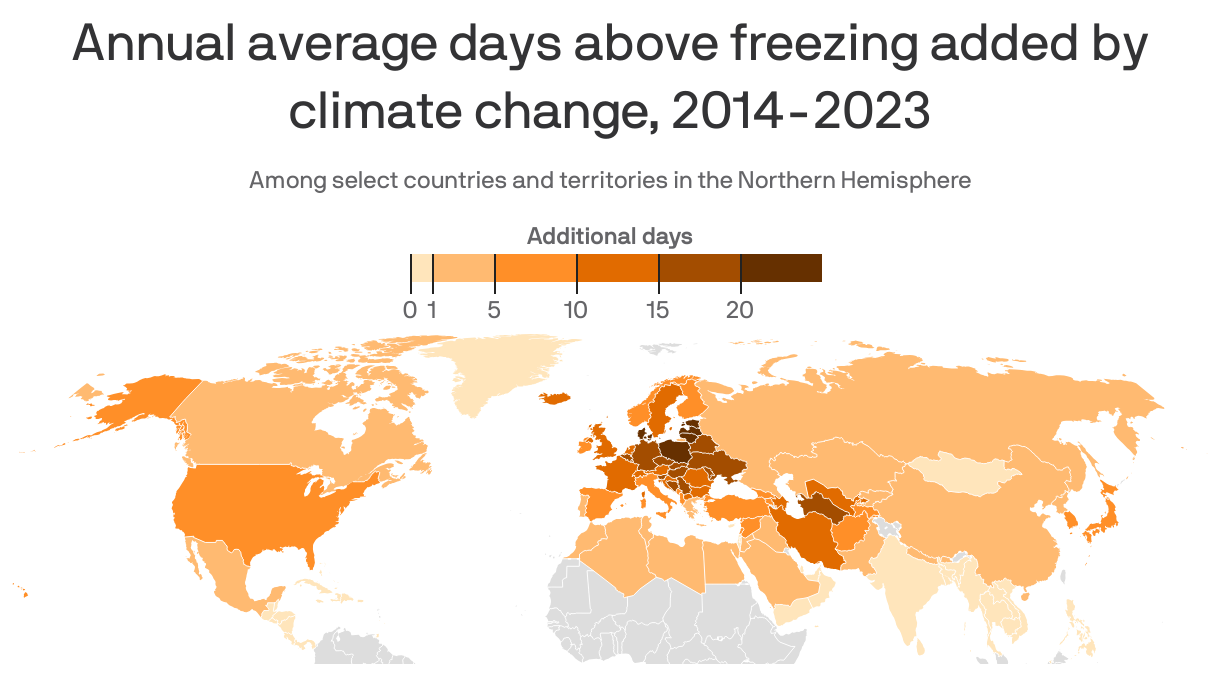
Winters are rapidly warming across the Northern Hemisphere because of human emissions of greenhouse gases from burning fossil fuels, a new report shows.
- This is now being seen in many more days with temperatures above freezing.
Why it matters: More warm winter days means fewer opportunities for winter recreation and can have knock-on effects on water supplies during the following warm season.
The big picture: Climate change has added at least an additional week of winter days with temperatures above freezing each year during the past decade in more than one-third of 123 countries analyzed, researchers found.
- The analysis compares recent trends with what would be expected to occur in a world without increasing amounts of heat-trapping greenhouse gases.
Zoom in: While previous analyses have looked at winter warming rates in the U.S., the new work — from the climate science and communications group Climate Central — covers the entire Northern Hemisphere.
- It specifically zeroes in on the increase in the number of days during which temperatures remain above freezing during meteorological winter, which spans from December through February.
What's especially unique about this report is the attribution aspect.
- Rather than only describing trends, the authors used published research and an in-house tool known as the Climate Shift Index to pin the increase in warm winter days directly to climate change.
- About 44% of cities analyzed saw at least an additional week's worth of days above freezing each year due to human-caused climate change, the report found.
- The cities with the greatest increase in warm winter days are located in Europe, which is the world's fastest-warming continent, and Asia.
- Fuji, Japan, Khujand, Tajikistan and Turin, Italy each have gained 30 or more days during winter with above freezing temperatures annually during the past decade, owing to human-caused climate change, the analysis found.
The intrigue: In the U.S., 28 states and 63% of cities analyzed experienced at least a week of what the group terms "lost winter days" each year during the past decade due to climate change.
- Boston has gained 14 winter days with above freezing temperatures each year during the past decade from climate change, the report found.
- New York City has gained 13 lost winter days each year during the past decade, while Chicago and Milwaukee have picked up 12 such days thanks to climate change, and Washington, D.C., has gained 11, the report found.
The Climate Shift Index (CSI) is based on peer-reviewed methods, though the new analysis itself has not been peer reviewed.
- The CSI tool allows climate scientists and the public to see how long-term, human-caused climate change is manifesting itself in present-day weather conditions, on land and at sea.
- The trends the new analysis depicts match other data on winter temperature trends, which show that in many places, the cold season is warming faster than other times of the year.
By the numbers: Europe stands out as the global winter hot spot, with Denmark, Estonia, Latvia and Lithuania each seeing an average of at least three additional weeks of lost winter days due to human-caused climate change.
- Nineteen countries — including Germany, Poland, the Czech Republic and Belgium — have seen at least two additional weeks' worth of above freezing days during the past decade, compared to what would have happened in the absence of global warming.
- Climate change added between one to two weeks' worth of above freezing winter days each year during the past decade in France, Italy, Japan, the Netherlands, Spain and the U.K., the research found.
Yes, but: Typically, attribution studies show how climate change altered the likelihood of a particular extreme weather event.
- But researchers claim that Climate Central's CSI tool can be used to estimate what temperatures would be in the absence of climate change with considerable precision.
The bottom line: Winters are warming, and winter days that dip below freezing are becoming more rare.
